Airfield racing is a discipline of the post-war period. After 1945, there were airfields in many countries that were no longer needed. However, there was plenty of motorized racing and therefore a need for suitable tracks immediately after the end of the war.
In England, it was the bypass roads around the airfields, the "perimeter roads", on which car and motorcycle races could be held. These perimeter roads gave rise to both Silverstone - The Heart of British Motor Racing - and the Goodwood Circuit.
In the USA, the former Sebring airfield in Florida is still used today for championship races - the Sebring 12 Hours. After the war, Germany and Austria had a whole series of airfields to offer, which could be converted into race tracks with little effort using tire stacks and pylons due to the smooth concrete runways. The best known in Germany are
- Achum
- Diepholz
- Kassel Calden
- Mainz-Finthen
- Wunstorf
In Austria:
- Vienna Aspern
- Tulln
- Zeltweg, even F1 1961
Kassel is not only the city of the Documenta, it is also the city of the "Sleeping Automobile Beauties", the exhibition of the Schlumpf Collection's depot vehicles in a historic factory hall in 2013. And this exhibition was thanks to the initiative of old car enthusiasts Heinz W. Jordan and Dietrich Krahn, who not only came up with the idea, but also single-handedly realized it in collaboration with the curator of the Musée National Mulhouse, Richard Keller. The exhibition attracted attention throughout Europe and was a complete success despite the enormous costs of transportation, insurance and rental. Since then, the names Jordan and Krahn have been well-known in the scene.
Kassel Calden airfield race - a brief history
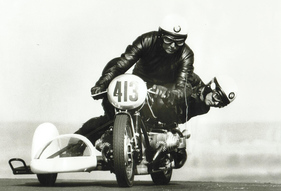
From 1971, car and motorcycle races for the German Circuit Championship with Formula 3 and Formula Vee cars, sports cars and prototypes and the German Road Championship for motorcycles were held in Kassel Calden.
This continued until 1987, and in addition to touring cars and formula cars, Porsche 917s and McLaren M 20s with power outputs in excess of 800 hp also took to the 2.65 km track. There were separate races for motorcycles from 1977.
The popular airfield race came to an end in 1987 because an instrument landing system was installed to expand flight operations in Calden. The last motorsport event took place as a night prologue in 1997 at the ADAC Nordhessen Rallye.
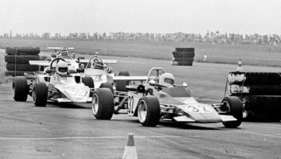
Famous drivers competed in Calden, including Jochen Mass, Klaus Ludwig, Hans-Joachim Stuck, Hans Heyer, Hellmut Kelleners and Willi Kauhsen. Among the international drivers were Nelson Piquet, Vittorio Brambilla, Henri Pescarolo, Bob Wollek, Toine Hezemans, Tim Schenken, Herbert 'Stumpen' Müller and Karl Wendlinger. Toni Mang, Dieter Braun and Martin Wimmer stood out among the motorcyclists.
Reactivation as a race track
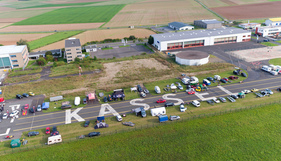
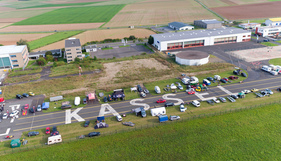
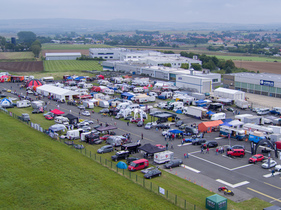
So it is no wonder that Jordan and Krahn remembered this not entirely insignificant racing history of Kassel Calden Airport, which was promoted by the construction of a new airport opposite the old one. The first revival was scheduled for 2016, but had to be moved to the new airport because the halls of the old one were used as refugee accommodation. Apartments have now been found for the refugees and so the two were able to start preparations for Kassel Calden 25 - 27.08.2017 at the historic site. Zwischengas reported, word of mouth did the rest and a field of 100 racing and sports cars and 80 motorcycles was quickly assembled, which, divided into generous classes, were able to take the 2,100 m of the marked track under their wheels over two days - four right turns, one left turn and a 180O turn.
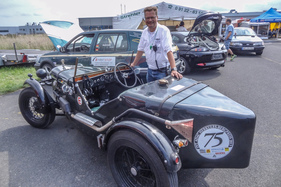
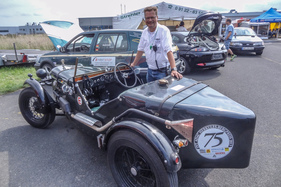
Although Heinz Jordan's message is "Life is too short to miss a good dinner and drive a prewar race car." and he himself also drives an Austin Seven in proper style, most of the participants, with a few exceptions, were represented by vehicles from the 60s to 80s.
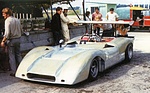
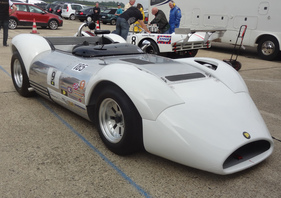
The 8.3-liter Chevy engine of Georg Hallau's Lola T 310, which was warming up near the entrance, set the mood in style, attracting all eyes and ears with its extra-wide, yet very flat body.
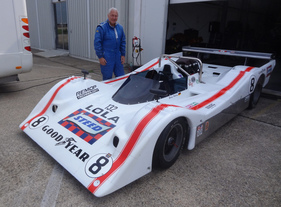
Eric Broadley built a whole range of successful racing cars for a wide variety of classes in the 1960s and 1970s. They are regularly seen at historic races from the Nürburgring to Le Mans Classic. For the Can Am series, which started in 1972, Lola launched the T 310 with an 8-liter Chevy engine and 810 hp at a weight of 780 kg in response to Porsche's 917/30. Used by the Haas team and driven by David Hobbs and Bobby Rahal, this one-off is a prominent representative of the horsepower monster Can Am series.
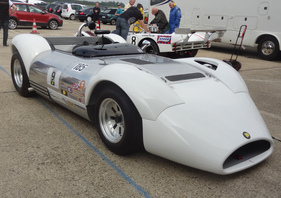
Right next to it is a no less interesting two-seater racing sports car built with new technology in the style of the 1970s, called the Proto Champ Series. It is appealing in that it does not appear to be a recreation of a historic racing car, but is nonetheless elegant in appearance and an asset to the event.
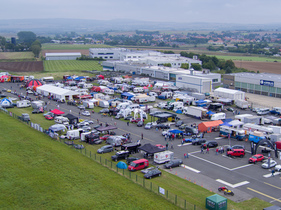
Let us now take a look at the overall layout:
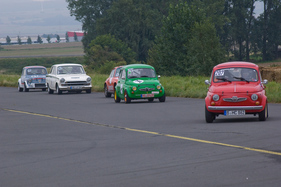
The class of the tiny ones
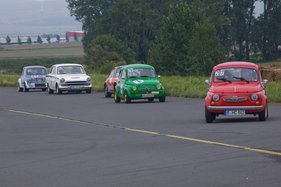
The Fiat 500 and its derivatives Abarth and Steyr Puch are an eye-catcher at any event with old cars. Externally similar, engine at the rear, but otherwise clear differences in the drive. While the Fiats have 2-cylinder in-line engines, the Puch driver is justifiably proud of his air-cooled 2-cylinder boxer engine. With a little effort, this can be tuned to 650 cc and up to 50 hp. These likeable little riders were particularly successful in hill climbs.
The Formula Student
Formula Student is an international university competition held since 2006 with single-seater racing cars that are designed and built by students and financed by raising sponsorship money. Initially started with combustion engines, there has also been an electric class since 2010.
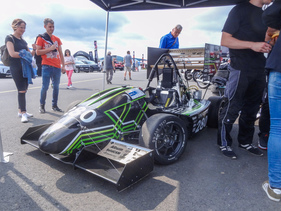
The University of Kassel brought the 2016 model to Calden, powered by a transversely mounted 4-cylinder, with the gearbox blocked. The regulations stipulate a 610cc engine and an air restrictor fitted behind the throttle valve, with a diameter of 20 or 19mm depending on the fuel quality. The rear wing must be positioned inside the rear wheels and can be a maximum of 120 cm high. In the model used here, it is designed as a double wing.
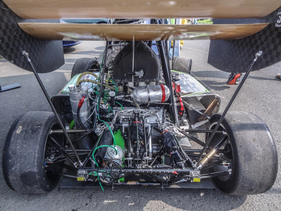
The front wing can extend across the entire width and is held in shape by wire ropes on the outer edges of this model.
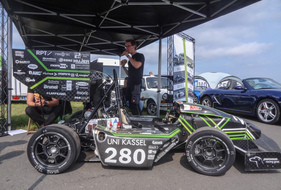
The cockpit and driver's seat show that maximum emphasis is placed on technology and performance in such a mammoth task, but that the finish has to take a back seat, as can easily be seen on the dashboard, steering wheel and seat shell. However, the steering wheel is already equipped with Formula 1-style gear knobs. Function is everything!
From ladder frame to monocoque - a brief chassis lesson
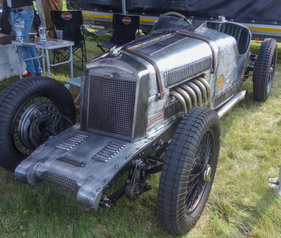
Due to the wide range of model years from the 1920s to the 1990s, I would like to take the opportunity to show the development of the chassis, or rather the chassis of some typical representatives. Starting with the pre-war racing cars cited by Heinz Jordan, the Wolseleys are good examples of the early standard chassis consisting of a ladder frame, rigid axles, friction dampers and leaf springs.
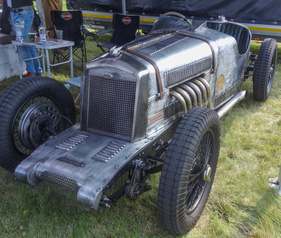
In the 1930s, Porsche introduced the crank axle at the front and the two-link swing axle at the rear, as we know it from the Auto Union GP car, the VW and the Porsche 356. Represented here by the various Formula V vehicles:
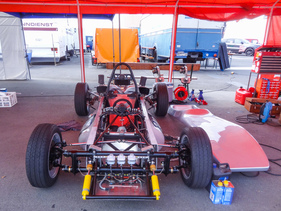
We have the ingenious Dante Giacosa to thank for the next stage of development. When he visited the empty building provided by Piero Dusio in 1946 for the future production of the Cisitalia D 46, he found a bicycle production facility in a corner and, looking at the tubes stored there, came up with the idea of the tubular lattice frame. Lighter and more torsionally rigid. And here is the frame of the Emeryson Formula Junior from 1960 - the resemblance is unmistakable:
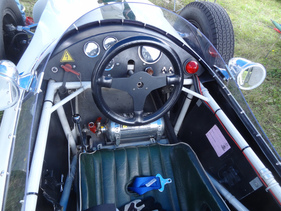
The Emeryson has a second design feature first used by Rudolf Uhlenhaut in 1964 on the Mercedes W 196, namely the inboard shoe brakes to minimize the unsprung masses on the rear axle:
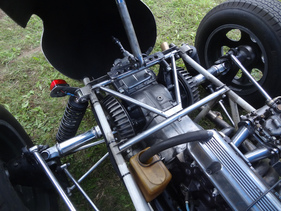
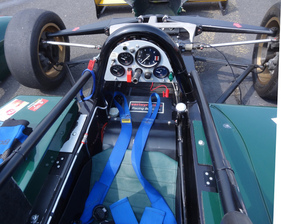
While the tubular trellis frame was the standard for two-seater racing cars until the Porsche 917 of 1972, it was the ingenious Colin Chapman who introduced the tubular frame as early as 1962 with the monocoque riveted together from aluminum parts, thus achieving greater rigidity, less torsion and lower weight:
After this perhaps somewhat dry lesson in chassis for some readers, here are some equally interesting vehicles that caught my eye during my tour of the paddock and are definitely worth a mention. These are: Alfa GTA, Austin Healey Froschauge, Dallara Spiess Opel and Formula Renault, Ford Galaxie, Lotus Cortina, and for good measure the Trabbi "Jeep":
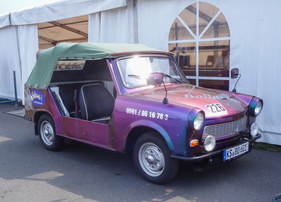
Overall, Kassel Calden was a diverse event with interesting vehicles, which the participants enjoyed so much that, as Heinz Jordan has already announced, it will take place again in 2018.
Additional impressions can be found in this video: