In its press release, the Hamburg trade fair speaks of an "all-round success" and of 18,000 classic and vintage car fans who visited the Hamburg Motor Classics between October 13 and 15, 2017.

That sounds euphoric and can also be seen as a good result. After all, there were many indications of a difficult starting position in the run-up to the event. There were staff changes in the core team, dissatisfied exhibitors and short-term cost-cutting measures, to which some attractions and comfort features (e.g. the carpets in the aisles) probably fell victim. Stand owners also complained that not everything went as expected when it came to stand allocation and set-up, and some also complained about the rather high prices for additional services.
Satisfied visitors
However, these teething troubles apparently went largely unnoticed by the public, as - according to a representative survey conducted by the trade fair - 86 percent of them would recommend a visit to their friends, and more than 70 percent of visitors rated the trade fair as good to very good. The bookings for the next event, which is scheduled for October 19 to 21, 2017, will show whether this assessment is also accurate from an exhibitor perspective. Especially as the first day, Friday, which is often the best day from a trade perspective, was relatively poorly attended.

With two fully occupied halls and an additional vehicle market hall, the trade fair was quite manageable. But you shouldn't compare a regional trade fair, which is primarily aimed at people from Hamburg, Schleswig-Holstein and Lower Saxony, with the Techno Classica or the Rétromobile.
Attractive vehicles from the region
Hamburg is not exactly one of the centers of the German car industry, but at least there were some manufacturers who produced vehicles in the Hanseatic city many decades ago, such as Tempo by Vidal & Sohn, which built vans with three and four wheels.

Several of these Tempo vehicles could be admired in a special exhibition as well as at the Prototyp Museum stand.

Somewhat hidden from view was another product made in Hamburg, the Herbst Piccolo small car, which was powered by an ILO 250 cc engine in the rear.

ILO engines, which were built just 25 km north of Hamburg in Pinneberg, were even available for bicycles, one of which was also on display.

Another original exhibit was the Wendax, a kind of hybrid vehicle that resembled a car at the front and a motorcycle at the back.

Dealer stands with premium offers
Despite the regional character of the trade fair, some major classic car dealers had confirmed their participation. Thiesen, for example, showed a selection from its extensive range, including a Lamborghini Miura, but also a Dino 246 GT and a Lancia Delta Integrale.

Springbok had three white mid-engined sports cars on the stand as an attraction, two from Ferrari and one from Lotus.

At Kautschuk Klassik there were elegant Mercedes-Benz and other makes to admire.

Axel Schuette, who had probably decided relatively late to take part, showed four older classics, including a Packard and a Darracq

Other dealers presented various Rolls-Royce, Porsche and, again and again, Mercedes-Benz models.

In addition, there was a private market where many Americans were waiting for buyers, but where you could also buy an Opel Kadett A Caravan, an Autobianchi A112 Abarth or an Alfa Romeo Montreal.

In total, there were probably around 200 to 300 vehicles on offer, so of course you couldn't expect a selection to cover every interest. The advertised prices mostly expressed a great deal of self-confidence on the part of the sellers.
Club presentations with highlights
However, there were special cars not only at the dealers but also at the clubs. There were no fewer than four De Lorean DMC-12s on one stand, where the friends of this brand also impressively presented a movie car from "Back to the Future".

The entire Audi Ur-Quattro history was presented by the Bavarian Ur-Quattro Club with six (!) vehicles.

The Spitfire-Club Germany had four racing Spitfires on the stand.

Various regional clubs exhibited road and racing classics, such as the Audi Quattro Pikes Peak, which Walter Röhrl drove up the mountain in the USA in record time in 1987, or the Opel Ascona B, in which Jochi Kleint became European Rally Champion.
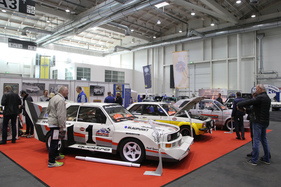
Incidentally, the two gentlemen were also on site and eagerly handed out autographs and talked about the good old days.
Seminars with added value
As an additional attraction, the Hamburg trade fair organizers came up with a seminar stage where people from the classic car scene talked about exciting topics.

For example, you could listen to Helmut Horn talk about identity forgery with old cars or learn tricks and tips for handling historic cars from well-known "classic car driving instructor" Martin Henze. In between, there was music, which had a positive effect on the atmosphere in the rather dark halls.

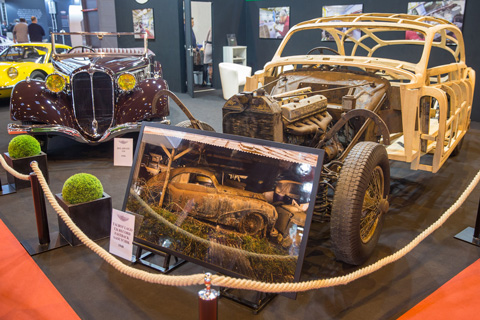
Anyone who wanted to learn something about classic cars could also enquire about the numerous service providers. Assekuranzkontor OCC, for example, presented a new type of repair cost insurance for old cars, while restorers presented semi-finished products that provided an insight into their working methods.
No manufacturers
The major German car manufacturers stayed away from the regional trade fair in Hamburg. This is actually a shame, as Wolfsburg, for example, is less than 200 kilometers away from the inland port city.

At least the Autostadt provided a Beetle, which was then parked at the Porsche Club between a Porsche diesel tractor and a 356.
For the men
As if the many cars, spare parts offers and service provider presentations weren't enough of a men's theme, there was also the "Man's World", where "men" could trim their beards, stock up on made-to-measure shoes or buy a motorcycle.

The visitors as exhibitors
The classic car parking lot was very well located for visitors. It was located directly between the two main halls of the trade fair. With mostly fine weather and temperatures of up to 22 degrees, strolling through the parked cars was one of the most pleasant activities at the Hamburg trade fair.

And some rarities could only be seen outside, such as four Datsun Zs from different model series, a Ford Capri Turbo-May or a Citroën 2 CV pickup.
The special project
It is called the "Cuno Bistram Project" and is dedicated to a man and his little "racing cars". They were all back at the trade fair in Hamburg, the little racers that Cuno Birstram built in the 1940s and which were the big attraction for visitors to Hagenbeck Zoo from 1948 to 1972.

There was also the only slightly larger racing car, which was once road-legal and raced through the British zone at speeds of up to 60 km/h.
In order to bring technology and craftsmanship back into schools and to offer underprivileged young people the kind of technical training that will be in demand in the future, the "yourmove" project was launched around these Cuno Bistram cars. And the work and the project were presented to visitors at the Hamburg trade fair.