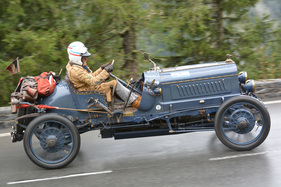
The famous Grossglockner High Alpine Road was opened 80 years ago. After five years of construction, the north-south connection was opened to traffic on August 3, 1935.
1935 The first Grossglockner race
Just one day later, the starting flag fell for the 1st international Grossglockner Race. Divided into various sports and racing car categories, 75 drivers lined up at the start. The starting list included no fewer than 12 Bugatti's, 11 Alfas, 4 MG's and 4 Maserati's and 5 Fiat's but only 1 BMW. Hans von Stuck is listed as starting number 110 with an Auto Union. But like Mercedes, Auto Union also stayed away from the first event. The track, mostly a rolled sand road, was wet at the start on that day in 1935. Only one race was run. The winner was Mario Tadini in an Alfa Romeo P3 from Scuderia Ferrari with a time of 14:42.74 minutes and an average speed of 79.59 km/h. In addition to cars, there were also various motorcycle classes at the start. The winner in the over 500 cc class was the Viennese Martin Schneeweiss on an Austro Omega (600 cc JAP engine) with a time of 15:17.57, which corresponds to an average speed of 76.5 km/h.
1938/1939 German Grand Prix on the Grossglockner
The political situation changed fundamentally with the annexation of Austria to the 3rd Reich. The race was now renamed the "Grosser Bergpreis von Deutschland".
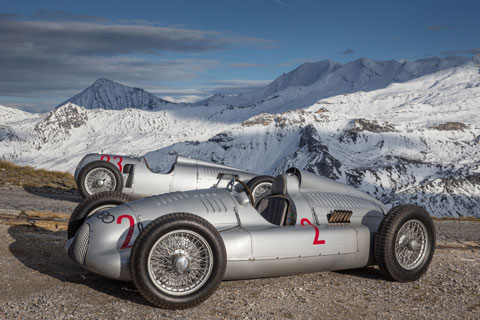
The 1938 race suffered from unfortunate weather conditions. The start was no longer in Fusch but further up the mountain at today's toll station in Ferleiten. The Mercedes and Auto Union works teams competed on the Grossglockner for the first time. The winner in 1938 was Hans Stuck in an Auto Union C-Type in 9:32.09, an average speed of 74.4 km/h.
A year later, in 1939, the weather was not much better. Heavy rain, thunderstorms, fog and sunshine alternated throughout the day. Two heats were run and the times added together. The winner was Hermann Lang with a Mercedes-Benz W 125 in 20:07.90
A few weeks later, the outbreak of World War II put an end not only to the racing series on the Grossglockner, but also at countless other locations.
It was not until 73 years later that the four-wheelers returned to the Grossglockner in a revival event.
Anniversary Grand Prix 2015
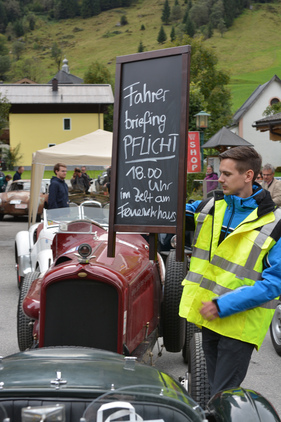
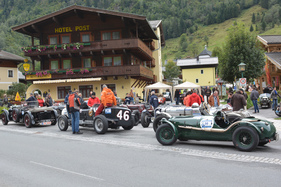
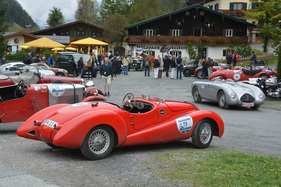
The 80th Anniversary Grand Prix 2015 kicked off on Thursday, September 24, 2015, with riders, mechanics and support staff arriving in Fusch during the course of the day for registration and technical scrutineering. The location plays an important role in the history of the Grossglockner Race, as the first International Grossglockner Race started there on August 4, 1935.
The list of participants comprised over 120 vehicles divided into four classes:
- Class 1, pre-war vehicles (built 1900 - 1939)
- Class 2, special class Veritas and similar (year of construction 1940 - 1955)
- Class 3, racing sports cars built (1950 - 1965)
- Class 4, racing sports cars / Group B (year of construction 1966 - 1974)
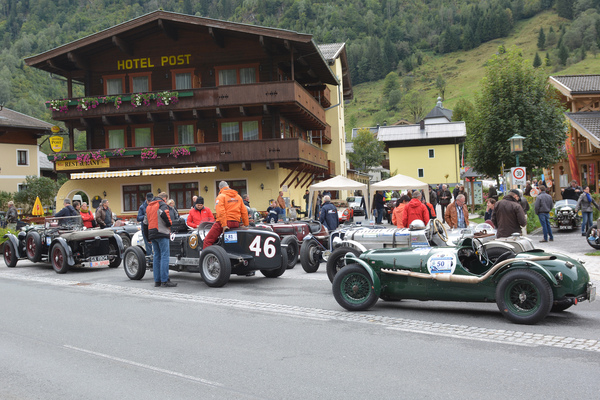
As with the previous Grossglockner Grand Prix, the main focus was clearly on the pre-war vehicles class with over 80 participants. The winning car from 1935, the Alfa Romeo P3, was also supposed to take part in the anniversary Grand Prix. But three days before the start of the event, the owner withdrew the entry.
Unfortunately, no Silver Arrows or Auto Union cars were entered at the Grossglockner this year. History repeats itself. The works teams from Mercedes and Auto Union were also absent from the first event.
Thanks to good relationships and a great deal of effort, the organizing committee headed by Marcus Herfort (Classic Days Schloss Dyck, among others) was able to put together an exceptional field. Cars such as the Alfa Romeo 8C Monza, Maserati 8 CM, Bugatti T45 Grand Prix - with a 16-cylinder engine! - or Invicta S-Type Low Chassis on the start list.
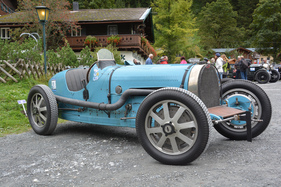
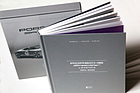
The participating vehicles were published in an elaborate and beautifully designed brochure. In addition to the history of the Grossglockner Race, it also contains a reprint of the first program booklet from 1935. In addition to the complete start list, it also contains the rules of conduct for visitors at the time. The following is an excerpt:
"Some advice to the public ".
2. "Make sure you have fuel and cooling water before the ascent so that you don't hold up an entire convoy by standing still. - The ascent is not very steep (maximum 11 percent), but long, so many engines will tend to overheat. Do not drive at full throttle, but rather at a lower gear with less gas".
4. "Park avoiding any waste of space and, if at all possible, in the downward direction. Shut off the fuel valve under all circumstances, apply the brakes more firmly than usual and engage reverse gear. Then hand over your vehicle to the parking lot attendant.
Snow on the Grossglockner
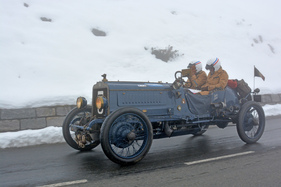
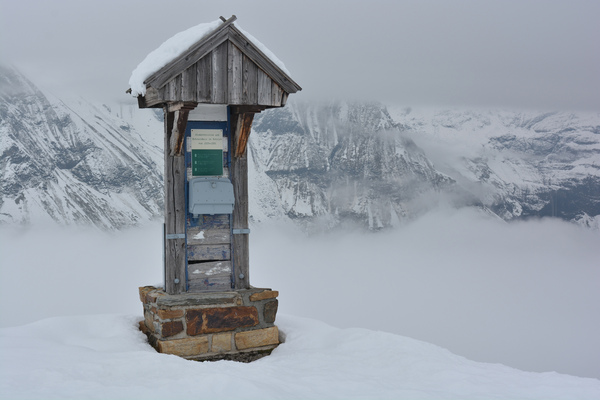
The date on the last weekend in September is not without its problems. At this time of year, winter snowfalls are not uncommon at an altitude of over 2000 meters. In fact, heavy snowfall on Wednesday made for wintry conditions in the upper section of the route. The road operators and organizers worked hard to clear the road of snow - without using salt, of course. This would have caused too much damage to the valuable cars.
On Friday morning, the cars were led in convoy from Fusch to the starting area in Ferleiten. The drivers now had the opportunity to make final adjustments to their vehicles. The large difference in altitude of over 1200 meters from the start to the finish required changes to the carburettor settings of many vehicles.
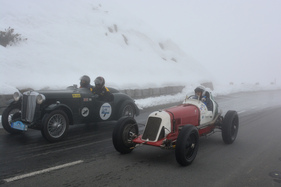
Not a race, but a regularity drive
Nowadays, it is almost impossible to organize and finance a race on such a long and demanding route. So the first-class organized anniversary event was also advertised as a regularity ride.
The start of the anniversary Grand Prix was also at the Maustelle in Ferleiten at 1142 meters above sea level. On the route up to the finish at Fuscher Törl, there are 1280 meters of ascent to overcome. The road has 92 bends and 14 hairpin bends spread over a length of almost 15 km. The finish is at 2428 meters. In comparison, the Klausen Pass is "only" 1948 m high.
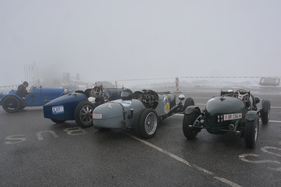
Late on Friday afternoon, the road was closed and the start of the 1st timed ride took place. More or less the entire route was wet from the meltwater. In addition, fog hindered the pilots in the upper part of the course. While the start in Ferleiten was around 10 degrees Celsius, the temperature in the finish area dropped close to freezing point.
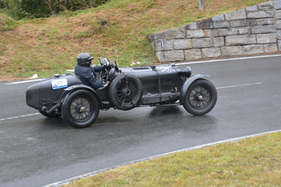
At 9 o'clock on Saturday morning it was time for the first confirmation run. The road conditions were unchanged, i.e. wet asphalt and fog in the upper third. The final confirmation run was released at 4 pm. In the meantime, the road had dried out at the bottom, the fog had remained and the track was extremely slippery from turn 9 onwards, presumably due to ice formation. However, the drivers restrained their racing fever, so that apart from minor slips, the entire event remained accident-free.
Exceptional vehicles
The main attractions at the anniversary Grand Prix were cars that have rarely been seen at classic car events. One of these vehicles came from Switzerland. Classic car enthusiast Rolf Engler had spent two years painstakingly building a Riley Big Four into a Supercharged. The 4-cylinder 2.5 liter long-stroke engine impresses with its enormous torque. The car was only completed a few days before the Grossglockner Grand Prix 2015 and was still in the running-in phase.
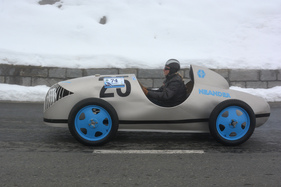
Thomas Trapp brought another extraordinary racing car to the start with the Neumann Neander driving machine. The vehicle had already competed at the Grossglockner in 1939. With Paul Weyres at the wheel, it took 6th place in its class. The lightweight vehicle is powered by a 1000 cc Harley Davidson engine.
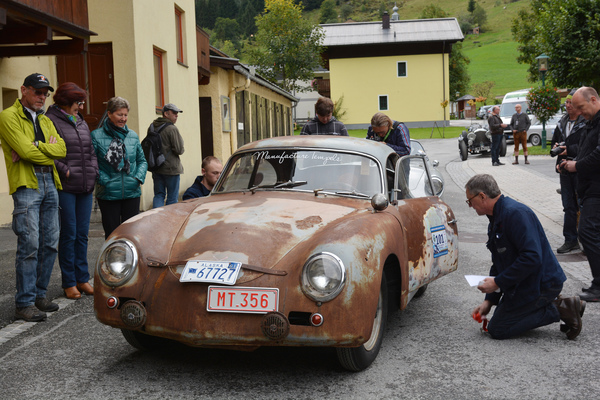
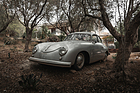
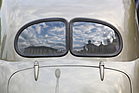
The Porsche 356 Pre-A "Alaska" caused controversy. The Porsche was purchased and driven by an American fighter pilot stationed in Germany in 1956. A few years later, the pilot (and with him the Porsche) was transferred to Alaska. Now the 356 was driven on Alaska's gravel roads. The last area of use was ice lake racing before the 356 fell into a long sleep in a barn. Belgian Porsche enthusiast Mike Tempels had tracked down the vehicle on the Internet and imported it in parts from Alaska. The engine was solid, the entire interior was missing, the rear and front were dented and the chassis was completely rusted. Mike Tempeles overhauled the engine and got the bodywork back into shape.
Incidentally, Gmünden, which is considered the birthplace of the Porsche 356, is not far from the Grossglockner. So it was clear to Tempels: the car had to drive on the Grossglockner. With a lot of patina, the Porsche attracted everyone's attention.
Hopefully another Grossglockner Grand Prix in 2016
Changing weather conditions have played a key role in the history of the Grossglockner races. Even at the anniversary event, the weather was not ideal, but the event can certainly be celebrated as a complete success. As the organizer Marcus Herfort announced, a Grossglockner Grand Prix is also planned for next year. Riders and spectators are already looking forward to 2016!