When is a car considered "German"? When the parent company is based in the Federal Republic of Germany? Or only when the factory in which it was once built is located in Germany? Or both? And what if the first condition is met but the second is not? And what applies in the opposite case?
At the German Car Meeting on October 5, such hair-splitting did not take long and both the BMW Z3 and the Seat Cordoba were granted entry to the former Maggi factory. Perhaps they were glad that anyone had come at all. The forecast thunderstorms meant that the admission inspectors initially had very little to do.

However, as it slowly became apparent towards lunchtime that the weatherman had been wrong once again, the grounds filled up quickly - albeit not as much as at last year's debut. Moreover, those who had the choice seemed to prefer the galvanized car (you never know). Accordingly, makes from the eighties and nineties formed the clear majority of the classics.

Nevertheless, friends of economic miracle mobility were not left empty-handed: a Heinkel cab, a "pretzel beetle", a "bathtub" and two DKW Juniors had gathered on the raised plateau of "Valley Square". Only a Borgward was not present - if it was, its presence did not overlap with that of the Zwischengas editor. A lone BMW 327 represented the pre-war faction.

Speaking of presence: the German car par excellence - the VW Beetle - was surprisingly almost completely absent. Its counterpart from the GDR - the Trabant - could be found just as often: namely twice. The same applies to the T1 and T2 van series, of which only one each found their way to Kemptthal. Perhaps this was less due to the weather than to a clash of dates: a large Volkswagen special show was being held on the same day at the Albisgütli Classics .

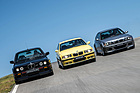
On the other hand, enthusiasts of young high-performance models were in danger of sensory overload: BMW M3s of almost all generations, several Audi S3s and RS4s, numerous AMG models and an Opel Astra OPC vied for the attention of visitors in sometimes garish colors. However, some owners overdid it by constantly revving their engines and banging their exhausts while stationary. However, this hustle and bustle was quickly stopped.

The question of when a car is half-German, exile German or otherwise German did not interest anyone for the rest of the day. Perhaps that was just as well. If, for example, the nationality of the company founder was taken as a yardstick, around half the field of participants would have had to be thrown out of the German Car Meeting 2025. After all, Ferdinand Porsche was Austrian.