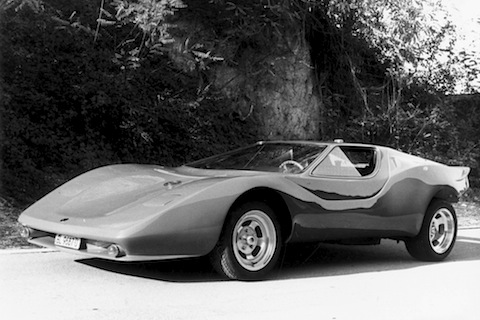
The "Fantastic Plastic" meeting of plastic cars took place for the fifth time and, as usual, the cars met at the Swiss Museum of Transport in Lucerne on June 3, 2017, where not only the renovated road traffic hall with the Monteverdi exhibition, but also the beautiful weather could be enjoyed.

The journey then continued in perfect weather conditions to Bleienbach Airport and towards evening the caravan set off for Rain, where the day ended with lasagne and a convivial get-together after a total of around 150 km of driving.
Almost 100 vehicles
Despite the unsettled weather, a total of almost 100 vehicles came together, representing the spectrum of the plastic era from the 1950s to modern times.

A Microplas Toledo was the earliest car with over 60 years of age, two Lotus Exige marked the modern era, with British, German, French and American plastic sports cars and of course the buggies in between.

Colorful individuality in the buggies
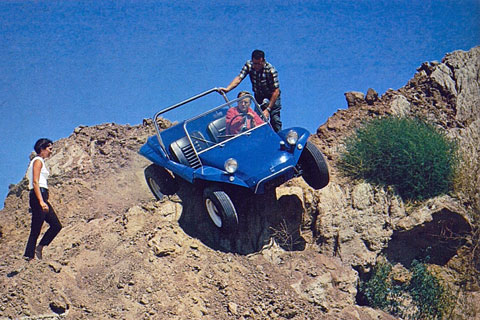
The fifth Fantastic Plastic focused on the colorful leisure cars based on the VW Beetle. Although a Meyers Manx was missing, of which there are hardly any examples in this country, the typical Swiss buggy manufacturers Sporzi, Swiss Buggy and Albar were impressively represented in terms of numbers, supplemented by Apal (Belgium) and a Gutrag Buggy.

A total of over 20 buggies found their way to Lucerne and showed just how individually this type of vehicle has been designed. No two buggies are the same, not only the color was often chosen very uniquely, but also the shape was optimized and the interior in any case. On the drive side, too, you will find everything from a well-behaved Beetle engine to a Porsche drive set.

Round or wedge-shaped
Plastic is known to be an easy-to-process material with which even the smallest vehicle series can be built cost-effectively. In fact, less than 100 examples of some of the cars taking part in the meeting were produced. Of course, this also allowed a great deal of freedom in terms of design, as the aim was not necessarily to appeal to the masses.

The wedge-shaped TVR 350i convertible, for example, speaks a completely different design language than the Renault Sport Spider or a Lotus Elan. The very rare Avanti with four doors appeals to completely different tastes.

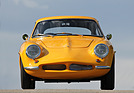
And the yellow Rochdale Olympic was probably the most extreme series-produced plastic car of the sixties, as this design completely dispensed with a metal chassis.

Finally, the Dellsberger Porsche was the first genuine Swiss car on display, a one-off with a tubular frame, Enzmann body (with doors!) and Porsche engine. However, the once installed RSK-Königswellen engine no longer sits in the rear of the interesting design.
BMW also built plastic cars, and not just once!
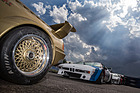
Two classic plastic sports cars were created by the German manufacturer BMW. There was the BMW M1, which was once developed with Italian business partners and then produced in-house to provide the basis for a Group 4 racing car.

And then, around ten years later, there was the BMW Z1, which was developed by Motorsport GmbH and, with its retractable doors, still holds a special place in automotive history today. Both the M1 and the Z1 were on site at the Fantastic Plastic meeting!
Lotus, Marcos and where is TVR?
When you think of plastic cars, the brands Lotus, Alpine and TVR usually come to mind first. In Lucerne/Rain, however, there were at least as many Marcos sports cars as Lotus, while fewer TVR and Alpine drivers made it to Lucerne in 2017 than in other years.

TVR is on the verge of a hotly anticipated comeback and you can also buy a sports car from Alpine again.
Entertaining day
In addition to the visit to the Museum of Transport, guided tours were also on the agenda in Bleienbach, where visitors learned that the Hogwarts Express from the Harry Potter school of wizardry was built near Dättwiler - in plastic, but not for the film but for an amusement park.

The oldest still operational airplane in Switzerland, known as the "Motte", was also on display and while the Fantastic participants feasted on grilled sausages, older and newer monoplanes and biplanes were constantly landing and taking off on the runway next door.

The current status of the non-public Swiss Museum of Transport collection could then be inspected in the outdoor storage facility in Rain and Swiss Museum of Transport Director Martin Bütikofer explained that the exhibits, e.g. a Tesla, had to be stored now so that they could be exhibited in 20 or 30 years' time as trendsetters or development flops of the past.
Crowned prize winners
In the small and largely participant-driven "Concours", René Abt's Marcos was voted the most exciting sports car, followed by a Swiss Buggy, a Citroën Méhari, a Sporzi, the Gutrag Buggy and another Swiss Buggy. The buggies also left their mark on the event in terms of participant selection.
Almost stayed dry
As always, the organization around Daniel Geissmann from the Swiss Museum of Transport and his team was excellent and no one went hungry or thirsty. The focus of the day was on good discussions and the opportunity to learn all kinds of new things about plastic cars.

While many participants managed to return home reasonably dry, others were caught out by torrential downpours that turned the roads into puddles. Even the inside of closed cars got wet, such was the weather.