Barely half an hour separated a relaxed excursion from an annoying wait. Those arriving in Triengen at a quarter to eleven drove to the entrance, paid their five francs and were directed to the nearest free parking space. Those who arrived at a quarter past eleven found themselves in a one-kilometre-long traffic jam of classic cars that stretched from the airfield along the access roads all the way up to the main road and paralyzed the entire western end of the village.

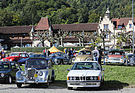
The rush to this year's FNA annual meeting on 29 September was so great that the organizers had to close the access road after around 450 cars in order to get an overview again in peace. It was only after additional parking spaces were spontaneously opened up and the new arrivals were guided through the crowds of spectators that the caravan of cars slowly began to move again. Although some of those tired of the traffic jam had turned back in frustration, the number of vehicles on display was probably well over 500.

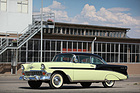
A large proportion of these were American models from the fifties and sixties, which took up almost the entire southern meadow. Fortunately, the field was not only made up of Ford Mustangs and Chevrolet Corvettes, but also included numerous large saloons and, above all, an unusually large number of station wagons - as well as a few examples of the Swiss favorite Plymouth Valiant from local assembly in Schinznach-Bad.

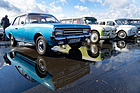
The European vehicles were also dominated by down-to-earth models. There were only a few representatives of the higher price regions, such as a Ferrari 365 GT 2+2 or a Mercedes-Benz 300 SL Roadster. Some rarities even masqueraded as mass products: the Opel Rekord Caravan 2200 was only assembled and offered in Switzerland in 1967. In Germany, the six-cylinder was only available as a saloon and coupé, although the Commodore predecessor in the latter design was also to be found on the airfield.

In general, many models appeared in pairs: Audi F103, Sunbeam Alpine, Citroën 11 CV - but also rare ones such as the two 1937 Chrysler Royals, which are not usually even encountered individually. The two '59 Cadillacs parked right next to each other beautifully illustrated the differences between the Sixty-Two and Fleetwood Sixty Special models. In keeping with the style, two white Auto-Union 1000 Sp cars, complete with their tail fins, also mingled with the Americans.

In their new role as human traffic lights, the marshals had their hands full guiding the cars past each other and the visitors. The influx of classic cars did not stop in the early afternoon. As a final measure to gain parking space, they were lined up diagonally along the entrance and exit, which meant that only one lane could be used for long stretches. Anyone wanting to leave the site by car had to be almost as patient as when they arrived.