The discussions about the current Formula 1 have become very one-sided. Unfortunately, people only talk and write about its lost appeal. A sport that required additional grandstands in Michael Schumacher's day and elicited at least one story from the media in every issue celebrating Formula 1 or its heroes.
Those days are over. While hundreds of thousands of spectators came to the first new edition of the GP in Austria a year ago, this year it was only half that number. A yawningly boring race ran over almost endless laps and in no way offered the substance for the price paid. At the highest level, people are discussing scenarios on how to get things back under control and make them much more attractive. Louder engines, new and probably even more complicated regulations and the reintroduction of refueling are being discussed.

The appeal of the old heroes
There was, however, an offside paddock which was actually even quieter than the current F1, but despite this attracted all spectators like a magnet. It consisted of just eight cars, plus their heroes, of course. Yes, they were somehow still real heroes, in contrast to the PR products of today.
Why were they given hero status? Quite simply, thanks to the action on and, above all, off the track.
Today's drivers are lost on race weekends. You only see them in their cars, hidden behind the visor. Later, the first three on the podium in overalls washed in Perwoll (noticed after the two-hour heat battle in Singapore in 2014) and finally at the press conference, where they only say what the team chews up for them every day. Regardless of whether Hamilton has a woolly on Rosberg, or the whole team, he puts on a good face and explains to the journalists that he was struggling with "graining" and was therefore unable to attack his team-mate.
Formula 1 becomes attractive again precisely at the moment when the drivers are once again allowed to say what they really want to say. The marketing people will certainly not like this at all, but it will bring F1 back to its roots and provide a lot more talking points. This could perhaps win back many of the fans who are currently dropping out.

The monoposti of the turbo era ...
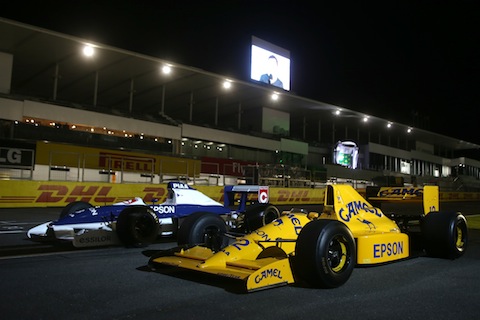
As already mentioned, the more attractive paddock was home to eight cars, first-generation turbos from the 1980s. Euphonious names such as Brabham-BMW, McLaren-Porsche and Renault were ready to be driven. The driver heroes were also there: Piquet, Lauda, Prost, Berger, Patrese, Danner, Martini and Alesi. The latter was the youngest and without turbo experience in the Sauber C14.

As soon as the old heroes were united in one place, the action started. There were jokes everywhere and everyone tried to play a trick on each other.
... and the heroes of yesteryear behind the wheel
Prost helped Lauda into his overall and once again tried to make the Austrian believe that he was clearly the faster man back then. Patrese remembers his crash due to a technical defect in the Texaco chicane at the time. He slid backwards over the wet grass towards a photographer. She was able to avoid the Italian, but forgot her photo bag in the hectic rush, which was then promptly run over by the Brabham's right rear wheel.

Opponents became friends over the years. Lauda coolly gave Prost the finger, whereupon the latter threatened to cut his finger off his hand for show. Berger kept getting Piquet's gloves thrown in his face during the ORF interview. Patrese tried to steal Piquet's car.

Lauda couldn't follow Prost, came back and complained that the boost pressure was set far too low at 1.8 bar. "We used to run 3 bar, I want that again now," he shouted. Danner barely managed one lap before the vulnerable Zakspeed was out of action.

Gerhard Berger retired shortly afterwards with a major engine failure and the accompanying turbo-typical cloud of smoke.
Lauda really set the Porsche engine on fire and Martini torched the Motori-Moderni completely.

The Renault only ran to a limited extent and Alesi in the Sauber probably wanted to continue driving until he had integrated himself into the field of the current cars at 2pm. Where he certainly wouldn't have cut a bad figure ...

So there was a lot going on again in Spielberg. Piquet laughed with Roche about the eleven engine failures in just one day and talked about his best pit stop. The Brabham-BMW came into the pits for refueling and a tire change while leading. The car was checked in by the mechanics and allowed to continue. At that moment, Nelson got out of the car and said casually: "You really didn't need to rush like that, because the gearbox is a mess."
Short, but worth seeing spectacle
The parade only lasted a few laps, most of them didn't even make it, but one thing was immediately clear: the show of the support act was funnier and more entertaining than that of the main group. Only the spectacular accident involving Raikkonen and Alonso added a little salt to the oh-so-bland soup.