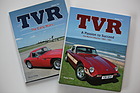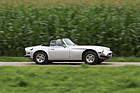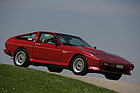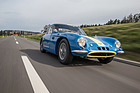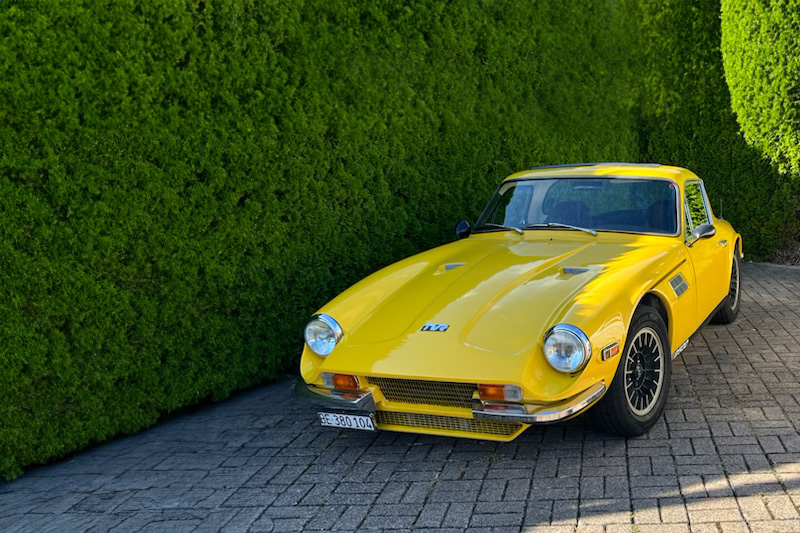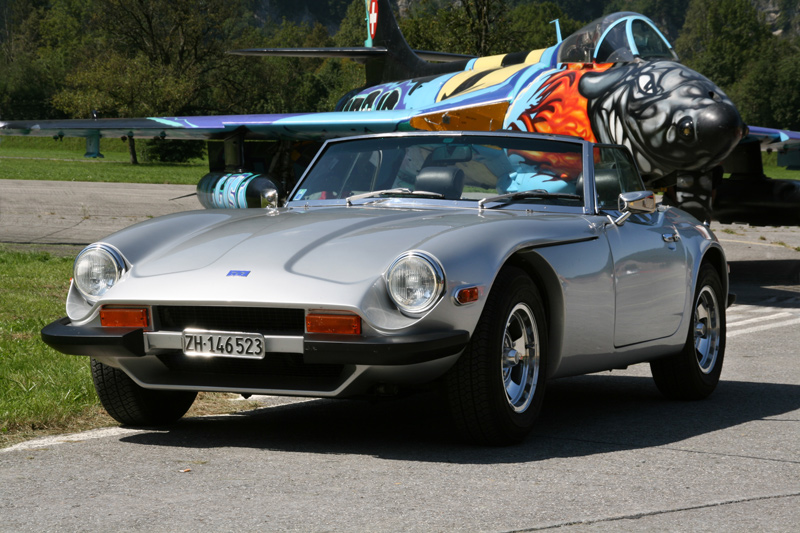
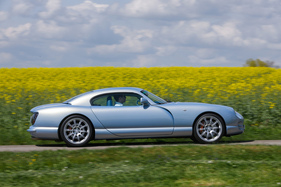

Peter Wheeler had already taken over TVR from Lilley in the 1980s. He inherited the wedge-shaped models, developed them further and gave them more power. With the S model series, he returned to the Roadster 3000 S of the seventies and moved closer to his own design taste, that of the fifties. TVR then landed the big hit with the Griffith, which was first seen in 1989 and made its official debut at the NEC Birmingham in 1990. Sweeping curves and powerful Rover V8 engines made the Griffith stand out. In 1992, the somewhat more moderate Chimaera version appeared, which in turn introduced new design aspects.
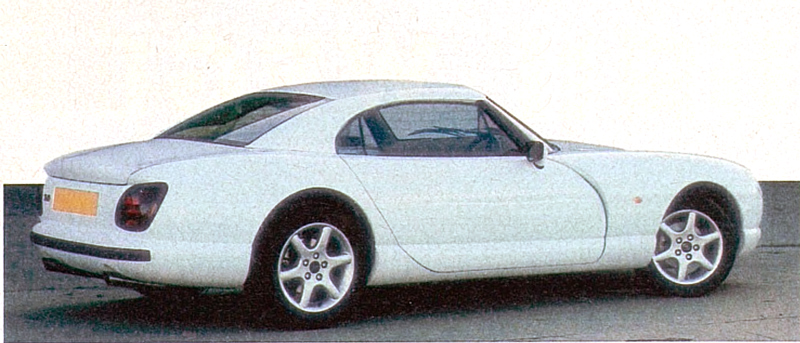
But it was only with the Cerbera, first shown as a prototype in 1993, that Peter Wheeler completely broke with the recent past, as this was the first 2+2-seater since 1985 and the first coupé for TVR since 1989. Above all, however, the Cerbera was the first road-going production model with its own engine.
Joint venture
However, this engine did not even exist when the first ideas for the Cerbera, which was originally to be called Cerberus, were conceived. But Peter Wheeler was worried that the Rover V8 would not be available forever. In addition, the idea of offering his own engine had its own appeal for the sports car enthusiast Wheeler, although GM Holden engines had also been investigated as an alternative to the ageing ex-Buick Rover V8.
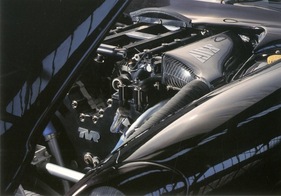
Together with Al Melling and John Ravencroft, Peter Wheeler defined the key parameters for the new engine; the first names of the three men led to its designation AJP. Originally, the main consideration was a V8 and a V12, which led to the cylinder bank angle of 75 degrees, whereas normally the two cylinder banks are at an angle of 90 degrees to each other in a V8 engine and 60 degrees in a V12 engine.
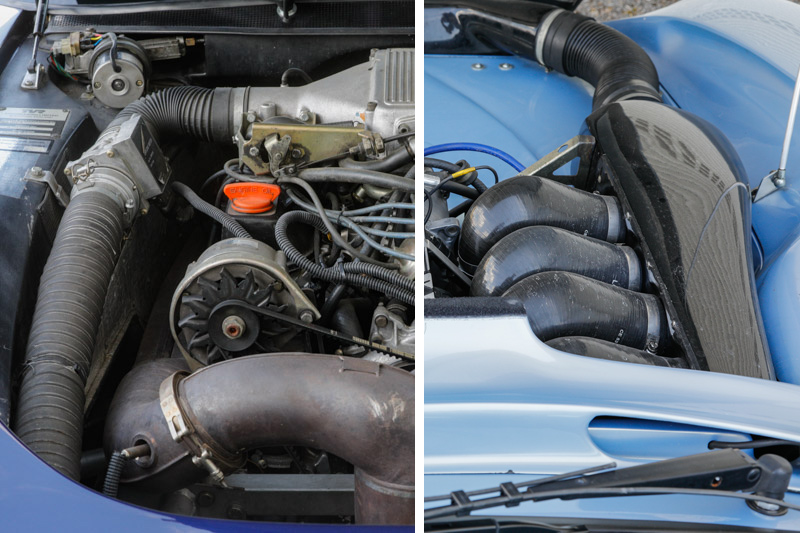
For cost and weight reasons, the decision was made to use a design with two valves per cylinder and only one camshaft per cylinder bank. This made it possible to build a very compact engine that weighed just 121 kg thanks to the extensive use of light metal.
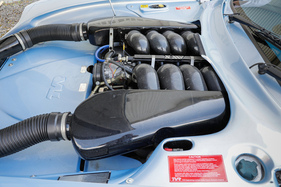
The AJP V8 was designed with a strong focus on racing engines. Great importance was attached to efficient oil and water circuits, and versions with dry and wet sump lubrication were developed. In contrast to the Rover V8, the decision was made to use a so-called "flat plane crankshaft". In the AJP engine, the cylinders always fired alternately in one cylinder bank and then in the other. This design was and is particularly popular in sporty engines, which is why Ferrari also uses this design time and again. The advantages are lower weight, higher engine speeds and better power development. Typical of flat-plane crank engines are the running noise, which is more reminiscent of four-cylinder engines, vibrations and a certain lack of torque in the lower rev range.
The new V8 was initially tested in TVR's own Tuscan racing series. The dry sump version was not spared and a lot of knowledge was certainly gathered until normal customers were able to buy a 4.2-liter AJP V8 in the TVR Cerbera in 1995.
A new approach
Peter Wheeler had been thinking about a four-seater or a 2+2-seater for some time, not least because he also liked to take his dog "Ned" with him. In addition, TVR owners kept asking for more space, as their families were growing and a pure two-seater was no longer as appropriate as it once was.
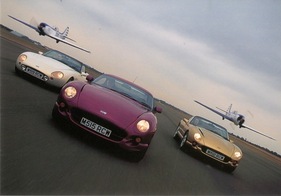
Initially, they thought about a Chimaera 2+2. The first design was created simply by placing two photos of the convertible on top of each other and pulling them apart in the middle. The result was convincing and so the first prototype was created in 1993 in just a few months, with a wheelbase of 2.48 meters. In October 1994, an improved version with a wheelbase of 2.56 meters was shown at the British International Motor Show in Birmingham and resulted in around 300 orders.

In the meantime, the 2+2 Coupé, now called the Cerbera - the name goes back to a three-headed dog that guards the underworld in Greek mythology - had been given a harmonious design with very long side doors and had been modified to accommodate the AJP V8. This resulted in a modified tubular frame chassis which, together with the supporting plastic bodywork, was sufficiently torsion-resistant for the powerful engines. An integrated roll bar ensured passive safety, while traction control or ABS were dispensed with and the driver was simply offered a long accelerator pedal travel as a "safety feature".
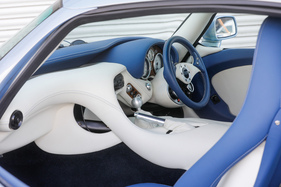
For the interior, designers Damian McTaggart and Nick Coghlan really let off steam and created a landscape of curves with some unorthodox design ideas such as the instruments distributed around the steering axle or the ventilation rosette behind the steering wheel. Conventional door openers were completely dispensed with; push buttons under the rear-view mirrors and above the door pockets ensured that the doors could be unlocked and opened electrically.
With a length of 4.28 meters, the coupé was still very compact, but the low overall height of 1.22 meters made the car appear larger.
The engine was installed as far back as possible, so the weight distribution of the car, which weighed around 1.1 tons, was largely neutral.
Almost exclusively for the British
Finally, in 1995, the Cerbera, which was always built as a two-wheel drive car, was finally available to buy for £ 37,000. According to the factory, its 4185 cm3 V8 produced 360 hp at 6500 rpm. Combined with the low kerb weight, this resulted in performance that could compete with a Porsche 911 Turbo costing at least twice as much. In the test, the coupé managed the sprint from 0 to 60 miles per hour in 4.2 seconds, reaching 100 miles after just 9 seconds. A similarly expensive BMW M3 was clearly left behind.
Jeremy Clarkson organized a "drag race" against the Porsche 911 Turbo, the Lotus Esprit V8, the Aston Martin Vantage, the Caterham Seven JPE and the Dodge Viper, which the TVR clearly won. However, even back then it was rumored that a not quite standard V8 had been installed in the front of the TVR.
In any case, the new coupé was very well received by motoring journalists, who were surprised by its GT characteristics and impressed by its performance, especially in comparison to the purchase price.

Wheeler and the TVR team did not stop at the initial laurels, however. Over the next few years, they added a 4.5-liter 420 hp version to the series, and those who wanted an even sportier version could order a "Red Rose" tuning with 20 additional hp. And with this, the Cerbera accelerated even better than a Ferrari F40 ...

At the end of the 1990s, the V8 engines were joined by the inline six-cylinder version of the AJP engine called "Speed Six*". Now equipped with four valves per cylinder and two overhead camshafts, the engine delivered at least 355 hp at 6500 rpm in the smallest displacement configuration. And its sound was reminiscent of the Aston Martin sports cars of the fifties and sixties that Wheeler so admired.
The TVR Cerbera also underwent a number of visual modifications, the most visible of which were the two Tuscan-style headlights, one above the other, which the Cerbera received in 2002.
A total of 1486 Cerberas were built between 1995 and 2004, half of which (722) were equipped with the 4.2-liter V8, a further 536 with the 4.5-liter V8 and 228 with the straight-six. Only a few of these cars made it to mainland Europe, where they were sold for CHF 143,000
or EUR 73,728 as right-hand drive models. And since the Cerbera coupés have been 25 years old, Americans have also started to take an interest in them thanks to relaxed import regulations.
Really a classic car?
Even today, more than 30 years after its launch, the TVR Cerbera still looks modern and impresses with its flat, flowing design. Pressing the button under the exterior mirror lowers the side window slightly and opens the long door. Good if you are not standing in a narrow parking space, because then it may not be possible to get in without acrobatic maneuvers. However, if there is enough space to the side, you can get in without any major contortions.

The rear seats seem to be more a matter for children, but the Cerbera was called "3+1" for a reason, because with the front passenger seat pushed forward, even an adult fits into the rear of the flat coupé.

Once seated behind the small steering wheel, you can look over the multi-layered, curved and interlocking interior, which is upholstered in fine leather and houses elegant aluminum buttons in various places. There are even four pushbuttons on the steering wheel for the horn, windshield wiper/washer and headlight flasher, although they are labeled. The two displays for the time and fuel level under the steering wheel and the ventilation rosette in between are unusual.

And to the right of this is the black "Lust" button. The Cerbera is not started with the ignition key, but by pressing a button. If the immobilizer does not intervene, the eight-cylinder engine wakes up with a clearly audible bark. The AJP V8 certainly doesn't sound like an American-style eight-cylinder, more like a very sporty four-cylinder. It revs up at lightning speed and its noise is clearly audible both inside and out. And the sound and the "throbbing" are pleasing.

The pedals are just right, the steering wheel requires a somewhat unusual grip due to its shape. The five gears can be shifted precisely. Constant adjustment of the transmission ratio is also necessary for rapid progress, as the V8 offers little traction at the bottom end and only really gets going from 3000 revs upwards. Then, however, it moves forward very dynamically and this is when the sensitive, very direct and almost somewhat poisonous steering comes into play.

All-round visibility is excellent for a coupé and, thanks to its modest dimensions, the car can also be driven unerringly on narrow roads. Even the comfort is not disappointing, not least because of the long wheelbase; you can even imagine long stretches of highway. For a car of this type, only a few background noises penetrate into the interior; the engine dominates the driving impression.

The Cerbera is unlikely to be the measure of all things for city traffic due to its relatively poor wheel lock, but who would want to be stuck in a traffic jam with this car? Serpentines, mountain passes and fast country roads are its thing, and the sporty engine sound makes you forget the radio immediately. Weasel-like, with small steering movements, you rush from bend to bend and hope that your destination is still a long way off ...

The AJP V8 engine was only fitted as standard in the Cerbera, so only around 1200 units were produced. It is therefore not surprising that the "business case" for this engine was only successful to a limited extent. Anyone who gets behind the wheel of one of these rare cars will certainly experience something very special.
We would like to thank classic-autos.ch for the opportunity to take a test and photo drive.