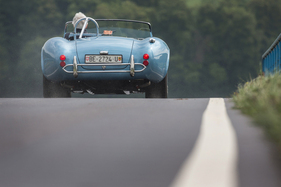


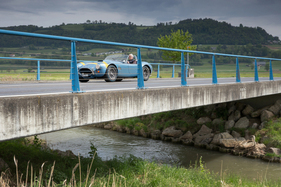
How do you approach a horsepower legend that was associated with many fatal accidents at the time? With caution ...
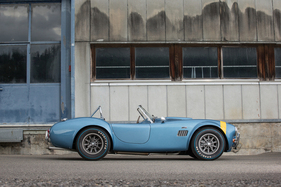
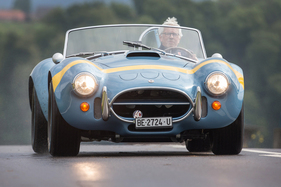
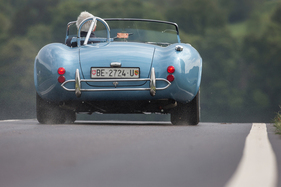
... and with reverence. After all, the car photographed is a '66 Cobra with chassis number CSX3300. Original seven-liter Cobras are almost worth their weight in gold on the market, as only a few hundred were built in four years, and only some of them are likely to have survived.

So let's turn the ignition key and press the start button. The V8 engine in the front of the car roars into life. Almost undamped, rattling sounds escape from the thin exhaust pipes and you can practically feel every combustion process on your own body. The entire body shakes as the large pistons rise and fall.

Let's enjoy this moment a little longer and look over the impressive collection of instruments in front of us to check that everything is running smoothly. Apart from some carpeting, these "clocks" are the only luxury that Carroll Hal Shelby treated his customers to, the rest was actually just for delivering the fastest road car in America.
Bullish torque
The 6997 V8 engine shakes around 650 Nm onto the crankshaft.
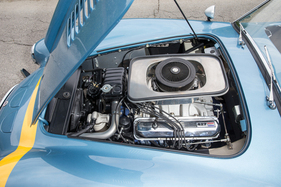
The choice of gear no longer really matters when it's all about propulsion. First gear extends to around 100 km/h in the road reduction ratio, so it's no wonder that the Cobra can achieve unprecedentedly low times for sprinting from 0 to 60 miles or to 100 km/h. In third gear, it can be driven at practically any speed permitted by road legislation beyond the highway. And thanks to the fat tires, traction on dry roads is formidable.

But even bends are no problem for the Cobra. The open-top sports car can be steered unerringly with the rack-and-pinion steering, and the perfect all-round visibility (with the car open) makes the sports car even easier to handle than it already is thanks to its compact dimensions (396 cm long and less than 180 cm wide).
You don't even have to get close to the limit to be really fast on the road. After all, given the prices being asked for original Cobras today, awe is also appropriate. You also have a survival instinct. And finally, driving slowly is also rewarded, namely by the admiring glances of observers from the roadside.

And leisurely driving is also possible with the "beast", where the Cobra is even much easier than some of its super sports car competitors of the time. But the next local exit is sure to come ...
From 90 to almost 500 hp
The basis for the Cobra was the AC Ace, whose shape was in turn modeled on the Ferrari 166 by John Tojeiro. The British sports car manufacturer used the Tojeiro Special as the basis for the ACE, powered by comparatively mild six-cylinder engines with 90 to 125 hp.
Carroll Shelby combined the sleek British roadster with a V8 engine from Ford and the first Cobra was born. It initially had a displacement of 3612 cm3, but soon grew to 4261 and finally 4737 cm3, leading to the designation Cobra 289.

Because Zora Dantov was preparing a seven-liter Corvette, Shelby ordered an equally large engine from Ford. Modified in Nascar style, this V8 produced 425 hp in road trim and 485 hp in the racing version. Race and test driver Ken Miles managed to accelerate the Cobra 427 to 100 miles per hour in 13.8 seconds and brake it back to the ground. With the right gear ratio, this Cobra ran at around 300 km/h; with a shorter gear ratio, it left black stripes on the road in almost every gear.

7495 American dollars, or 2000 more than a Cobra 289, were to be spent on the sports car, but even more money couldn't buy a faster car. Nor a more dangerous one, as some Cobra buyers are said to have had fatal accidents in the first few days because they couldn't control their foot on the gas.
Of course, Shelby had significantly improved the Cobra's suspension compared to the original AC Ace. At the rear, independent suspensions with coil springs and telescopic dampers instead of the variant with transverse leaf springs provided more reliable grip in the 427, and all chassis components had been reinforced over time and adapted to the brute power of the eight-cylinder engines.
Thick wheels were housed under widened wheel cut-outs and disc brakes all round provided the necessary deceleration.

Around 350 original Cobra 427s are said to have been built between 1964 and 1967, most of them as road versions. The smaller Cobra 289 made it to around twice as many factory examples.
Perfected
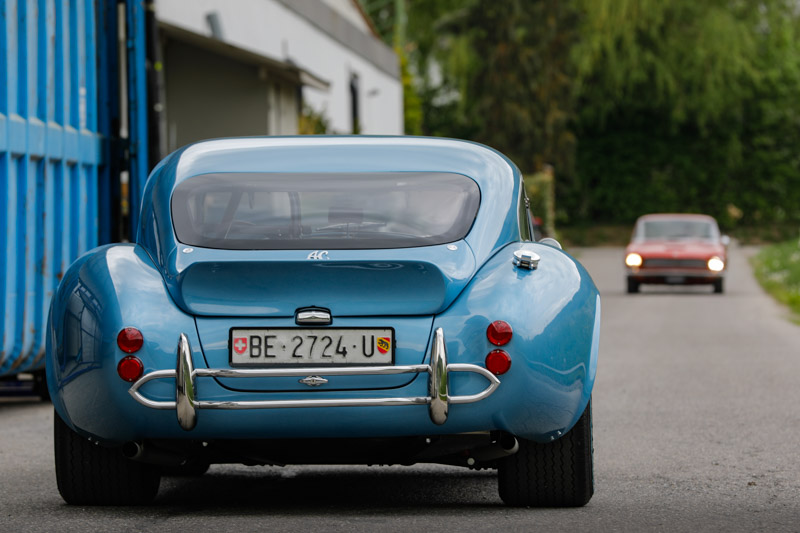
Each Shelby Cobra was built by hand, so differences from car to car were quite normal. And these cars are now around 60 years old and most of them have been restored accordingly, including the Cobra we drove with chassis number CSX3300.

Many things were improved and refined as part of the work, but the centerpiece is probably the elaborately designed hardtop, which turns the roadster into a coupé with a tailgate.

However, the car is still the most fun to drive without the roof, when your hair is blowing in the wind and the sound of the V8 reaches your ears unmuffled.
The Shelby Cobra 427 from 1966 photographed for this article will be auctioned by the Oldtimer Gallery on May 30, 2026 as part of the Swiss Classic World . Thank you for the opportunity to take a photo.
Note: Further research by Oldtimer Galerie has shown that there is a second vehicle with the same chassis number in North America. It has not yet been possible to determine which of the two vehicles is the original Cobra.


_RM.jpg)