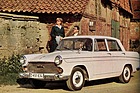
Morris Oxford V in the (historic) test - family car without flaws?


You have only
1 out of 28
images seen in high resolution


Summary
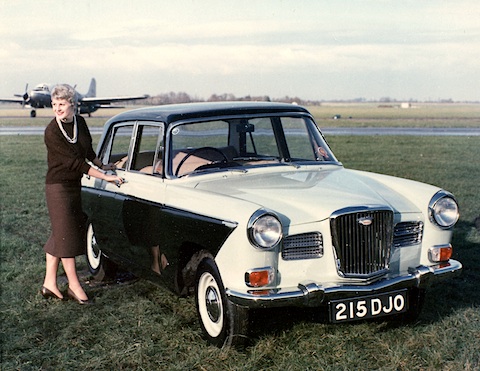
As a member of BMC's ADO9 family, the Morris Oxford V completely lacked both visual and technical originality. The spacious "saloon" matched its sibling models from Austin, MG, Wolseley and Riley in many respects, such as the Pininfarina-designed bodywork. The likewise split 1.5-liter four-cylinder had a comfortable, but also quite massive saloon to move. Did the British Motor Corporation's calculation work out? This article reproduces an original driving report and shows the British mid-range saloon in historical images and sales material.
This article contains the following chapters
- Resilient engine, good gearbox
- The driving behavior
- One year warranty
- From the female perspective
Estimated reading time: 13min
Preview (beginning of the article)
Take a modern 1.5-liter four-cylinder engine and a good four-speed gearbox, hang the front wheels on a trailing arm with coil springs and the rear wheels on a rigid axle with longitudinal leaf springs and wrap the whole thing in a modern body. The Morris Oxford V was created according to this recipe: a conventional English mid-size car whose basic design was perfectly suited to the current tastes of a broad public of buyers. It is comfortable and spacious, easy to drive, reliable and robust, has four doors, a good luggage compartment and attractive lines. So what more could you want? The Oxford V comes from the British Motor Corporation's 1.5-liter modular series. It is therefore similar to the Austin A55 Cambridge, the Magnette from MG, the Riley 4/68 and the Wolseley 15/60 in all major assemblies and differs from them only in certain details. For example, the Oxford is equipped with a full-length front bench seat with fold-out center armrest, while the other corresponding BMC models have individual seats.
Continue reading this article for free?
Images of this article