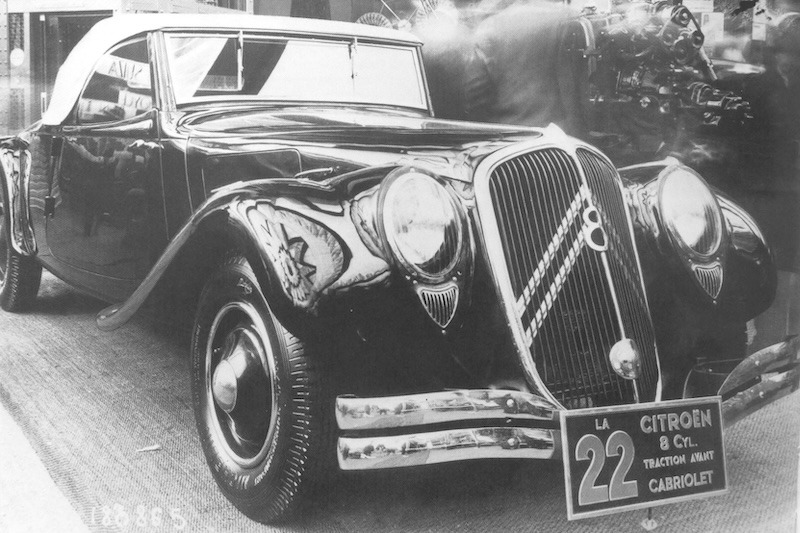
Citroën 22 V8 - Salon Lion and Phantom of the Road


You have only
1 out of 21
images seen in high resolution


Summary
Even before the revolutionary Traction Avant went into series production, Citroën had already thought about a later top-of-the-range engine - not in the form of the six-cylinder engine that appeared in 1938, however, but in the form of a V8 engine developed in-house. Test cars were driven and brochures were printed, but then the project was abruptly halted. To this day, the 22 CV remains one of the greatest mysteries in the brand's history.
This article contains the following chapters
- The engine
- Short development time
- Adventurous test drives
- Premature advertising and premature end
- Creating legends
- Citroën's engine curse
Estimated reading time: 5min
Preview (beginning of the article)
The Citroën 7 CV and 11 CV models - the world-famous "Traction Avant" - were conceptually revolutionary: all-steel monocoque body, low center of gravity, front-wheel drive, independent front suspension, torsion bar suspension and hydraulic brakes. The car was significantly lower than the competition, but they did not have the courage to choose a consistent aerodynamic pontoon shape. That's why the free-standing front fenders were retained. But perhaps this was a wise decision in view of the market, which punished excessive design leaps with disdain. The four-cylinder engine was a new design and "floated" in the monocoque chassis to increase comfort. The engine was rigidly bolted to the side members in the ladder frame designs that had been common until then. A certain amount of torsion of the car around the longitudinal axis was then still possible, and the body had a certain degree of freedom in relation to the chassis. With the stiffer monocoque, however, a firmly bolted engine would have led to severe vibrations.
Continue reading this article for free?
Images of this article





_RM.jpg)