Aston Martin Lagonda Series 1 - Child of the crises


You have only
1 out of 57
images seen in high resolution


Summary
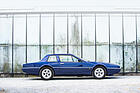
Ten years after the unsuccessful Lagonda Rapide, Aston Martin once again ventured to produce a four-door saloon. Based on the architecture of the DBS, it was intended to capture the market share of the recently discontinued Maserati Quattroporte and secure Aston Martin's financial position as a volume model. In the end, the number of cars built only marginally exceeded the number of insolvency proceedings. This article tells the story of the first four-door Aston Martin built in (small) series and shows it in many photos.
This article contains the following chapters
- Two before four
- Eight or six
- The first bankruptcy
- Two instead of four
- The second bankruptcy
- Three at once
- Two for seven
Estimated reading time: 10min
Preview (beginning of the article)
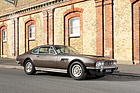
William Towns preferred to shorten rather than lengthen. Aston Martin's in-house designer preferred to derive a coupé from a four-door saloon rather than artificially lengthen a two-door sports car and somehow cheat an entrance for the rear seat passengers into the bargain. Even if it was usually done differently in the circles of small-series sports car manufacturers, Towns followed not only the aesthetically but also the etymologically correct sequence. After all, "Coupé" means "cut off" in French. Whereas the name "Prolongé" is rarely used for saloons. When a successor to the Aston Martin DB6 was sought at the end of 1966, Towns began designing a hatchback saloon, following his own logic. Company owner David Brown no longer wanted to leave the luxury sports saloon segment to Jaguar and Maserati without a fight. The design language of the new Aston Martin was more angular than that of its predecessor, the basic features of which dated back to the 1958 DB4. A radiator grille across the entire width of the car with recessed twin headlights made the new model look wider and lower. Although both body variants were developed more or less in parallel, only the coupé initially went into series production. With a shorter wheelbase, lower roofline and half the number of doors, the new Aston Martin made its debut at the Paris Motor Show in October 1967 as the "DBS".
Continue reading this article for free?
Images of this article


_RM.jpg)