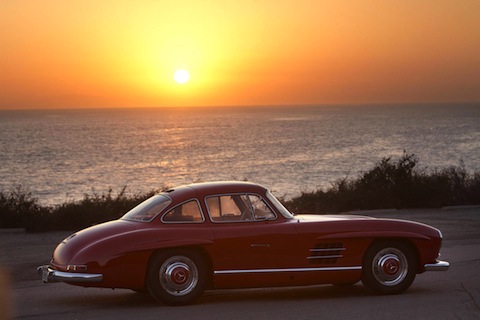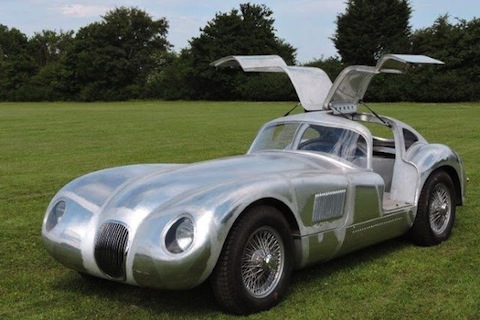


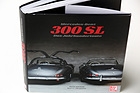
This book, limited to 1500 copies, describes everything to do with the Mercedes-Benz 300 SL racing car, with which Mercedes-Benz not only stormed the podiums of the Mille Miglia and Carrera Panamericana, but also took the double victory at the Le Mans premiere. The captivating background information peppered with numerous quotes and anecdotes make this photo-rich book an exciting read.
Why the book is convincing
After the first few pages, you immediately realize that a true connoisseur and author was at work here. This comes as no surprise when you learn that Robert Ackerson had already made a name for himself with previous books: the works on the W196 R Grand Prix racing car or the 300 SLR impressed with their in-depth knowledge and technical background information. This is also the case in this book and it is extremely exciting to follow his stories and analyses.
A special feature of the book is certainly the numerous references to other books or magazines from which the author has compiled information.

From pre-war times to the Carrera Panamericana in 1952
The first chapters are devoted to the beginnings of Mercedes-Benz in motorsport. The reader is first catapulted into the 1930s, where the development of the W-154 Grand Prix racing car is described in detail. Brief portraits of the racing drivers of the time, such as Hermann Lang, Rudi Caracciola, Karl Kling, Rudolf Uhlenhaut and, of course, Juan Manuel Fangio, enrich these chapters. Mercedes-Benz withdrew from motorsport in 1939 and did not return until 1952.
The third chapter describes in detail Mercedes' return to motorsport and how the first three 300 SLs were shipped from Stuttgart to Italy. The quoted echo in the press at the time, which the three 300 SLs left behind, is interesting. Equally fascinating, however, are the reviews of Rudi Caracciola, the 1931 Mille Miglia winner who took victory in a Mercedes-Benz SSKL at the time, who was at the start again a good 20 years later at the age of 51.
The course of the 1952 Mille Miglia race is very entertainingly summarized in the book and the duels with the opponents read like a thriller. But probably the toughest race of the time was the Carrera Panamericana. An entire chapter was dedicated to this unique race and features incredible photos.

Rudi Caracciola's last race - The book tells many anecdotes
After the Mille Miglia, in which Mercedes-Benz "only" achieved second place with the 300 SL, the Bern Grand Prix for sports cars took place on May 18, 1952. For the first time, a Mercedes 300 SL took first place, and it was a triple victory! The fourth 300 SL was driven by Rudi Caracciola, who immediately took the lead at the start from row 2.
The book quotes many people who record some of the details of Caracciola's laps. For example, Caracciola himself tells us that his 300 SL was already very unsteady from lap 2 onwards when he pressed the brake pedal. However, he hoped that he would still be able to finish the race and let all his team-mates pass, because a pit stop meant too much delay in a short race.
On lap 13, however, disaster struck in the Forsthaus corner, where the cars were hurtling around the bend at 160 km/h: the brakes no longer released, a rear wheel locked and Caracciola crashed head-on into a tree, crushing his right leg in the process.
Despite the failure of the technology, Caracciola showed the 300 SL a great deal of respect and later emphasized once again that the tubular frame of his 300SL was undamaged. The accident also marked the end of Rudi Caracciola's racing career.

Premiere and double victory at Le Mans
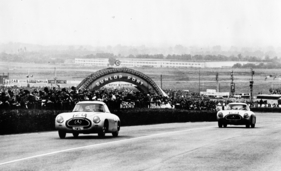
A milestone in Mercedes-Benz' motorsport history is certainly its premiere at the 24 Hours of Le Mans. Never before had a Silver Arrow competed in the Sarthe and the first time in 1952 they secured a one-two victory. The race is described in great detail, hour by hour. Of course, the book also deals with the famous air brakes, which were not used in the race after all.

Glitz and glamor at the Nürburgring
In 1952, the "25 Years Nürburgring" anniversary took place, a festival with several different races. One of these was a 10-lap sprint race on the Nordschleife (approx. 280 km). Mercedes-Benz brought four 300 SLs to the start, and from a marketing strategy point of view it was a must to have the racing cars drive in Germany so that fans in the home country could experience these previously successful racing cars live! The 300 SLs were converted into the so-called Spyder models, and it was worth it, the successes in 1952 were crowned with a quadruple victory.

Wonderful photo archive
Although the book contains many photos that perfectly accompany and complement the text, the reader may wish for more photos that have never been seen before. Of course, the subject matter of the book is limited to a very narrow period (1952) and one can therefore understand that there are probably few photo sources that cover that period so well. However, we find it a bit of a shame that only photos from the Daimler archive were used and that no other sources could be taken into account.

Who will find the book interesting?
While the book will clearly appeal to enthusiasts of the 300 SL, it should also appeal to fans of endurance racing. Interesting details about the entries in the Mille Miglia, the Carrera Panamericana and Le Mans shed light not only on the internal workings of the Mercedes-Benz team but also on the competition at the start and their vehicles. From time to time, specific aspects of the race track are also highlighted.

Due to the limited edition of the book and the resulting high price, not everyone is likely to buy it immediately. However, anyone who is a 300 SL fan or does not yet have any books about the sports car races of 1952 should definitely consider this book.
Book information
- Available to buy from Amazon or directly from Veloce Publishing
- Author: Robert Ackerson
- Length: 144 pages
- Publisher: Veloce Publishing (December 1, 2013)
- Language: English
- ISBN-10: 1845846176
- ISBN-13: 978-1845846176
- Size: 25.6 x 25.6 x 1.8cm

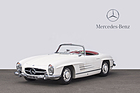

_RM.jpg)