In 2008, two Swiss economics professors, David Stadelmann and Reiner Eichenberger, set out to answer the question "Who is the best Formula 1 driver"? They carried out an econometric talent assessment [Perspectives on Economic Policy 9(2008)4, pp. 486-512]. Scientifically, it has been Juan Manuel Fangio, Jim Clark and Michael Schumacher in that order since the drivers' world championship has existed, i.e. since 1950. This finding (as is often the case with economic studies) is not particularly groundbreaking, but confirms what most people would assume from mere knowledge of the facts. In this case, the order is perhaps still controversial.
The best Formula 1 drivers
The ranking further back is more difficult to comprehend. It says of Nigel Mansell, who is ranked 80th, and Jody Scheckter, who is ranked 98th, that the two "were able to be so successful not least thanks to particularly good cars". A harsh verdict! Especially for Nigel Mansell, who was described by Colin Chapman as having great talent.
Nigel Mansell's career can certainly be compared with the most important competitors of his generation. Most of them drove karts at a very early age, i.e. as children, and switched to a junior formula around the age of 20. The older drivers such as Niki Lauda and Keke Rosberg (as well as Gerhard Berger) did not come to racing via karts, but started in Formula Vee, Ford, Renault etc. or touring cars after obtaining their driving license.
Once they had passed the Formula 3 test (which was of course the case for the future Grand Prix winners and world champions), they usually fast-tracked into Formula 1. It then took less than three years for the winners to achieve their first victory in a world championship race.
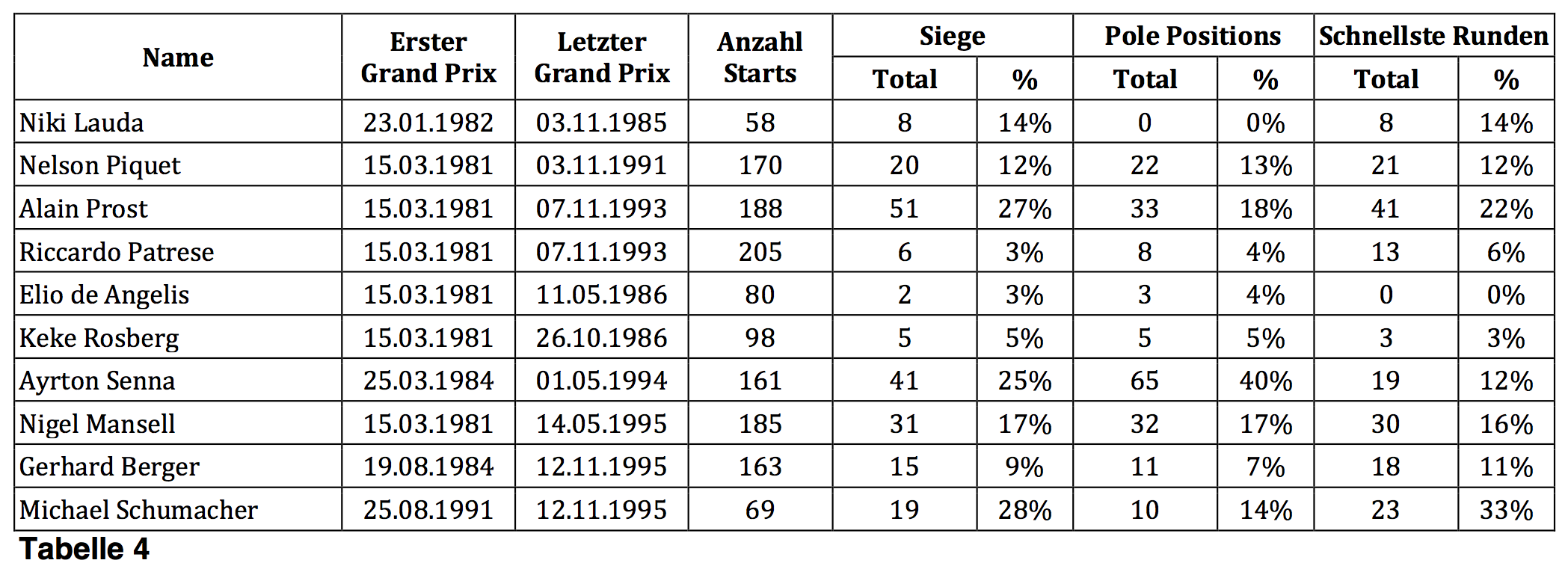
In practice, of course, this pattern only applies to a limited extent. The following table compares the actual career data of Nigel Mansell and his most important rivals as far as possible. Niki Lauda and Michael Schumacher form the link to the previous and subsequent generations respectively:
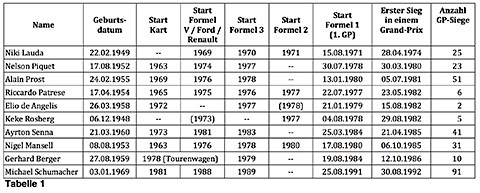
Nigel Mansell and Keke Rosberg are the two drivers with the highest age in the group at their first start in a Grand Prix. It is also noticeable that Mansell, at the age of five, also had to wait a long time between entering Formula 1 and his first victory in a world championship race. This has raised some doubts about his talent.
Nigel Mansell was born on August 8, 1953 in Upton-upon-Severn near Worcester in the wider Birmingham area. After leaving school, he did an apprenticeship at Lucas Aerospace. He graduated as an engineer from Matthew Boulton College in Birmingham and then worked at Lucas as an aircraft engineer until 1977. In 1979 he had a job at Lotus as a quality engineer for bought-in parts.
Career start with kart racing
Like many of his colleagues, he began competing in kart races at an early age. He made a name for himself there, enabling him to switch to Formula Ford in 1976. He won the "Brush Fuse Gear" FF1600 Championship in 1977. He drove 42 races that year and won 33 of them. From the end of 1977, he drove intermittently in Formula 3 and finished eighth in the 1979 British championship (B.A.R.C./B.R.D.C. Vandervell British F3 Championship) in the March 783/793 of the Unipart Racing Team after winning the third race at Silverstone. In 1980, he took part in a total of four out of twelve rounds of the Formula 2 European Championship and finished second in the last race, the Prize of Baden-Württemberg and Hesse at the Hockenheimring. By this time, however, he had already won three Formula 1 Grand Prix races for the Essex Lotus team. He had received a contract from Lotus as a test driver for 1980 and was used as the third man behind Mario Andretti and Elio de Angelis in these races.

In 1981, he took over from Mario Andretti at Lotus and drove into the points for the first time at the Belgian Grand Prix in Zolder, finishing third on the podium. Colin Chapman was so impressed with Mansell that he gave him a three-year contract at the end of the year. However, the Lotus was only competitive to a limited extent during this period. During Mansell's time between 1980 and 1984, only Elio de Angelis managed a victory in the 1981 Austrian Grand Prix. Colin Chapman died at the end of 1982 and Nigel Mansell lost his mentor. Peter Warr, who subsequently managed Lotus' racing operations, thought nothing of him, neither as a person nor as a driver, and he explained this in detail once again in 2012 (Peter Warr, Team Lotus: My View from the Pitwall, Haynes 2012, ISBN-13: 978-0-85733-123-6). Two years followed in which Mansell was demoted to number two in a team that was still trying to catch up. During his time at Lotus, he achieved a total of five third places as well as one pole position and one fastest lap each. In pouring rain, he lost the 1984 Monaco Grand Prix while leading due to a driving error. For 1985, Peter Warr hired the new star of the circus, Ayrton Senna, and Mansell had to leave the team.
New partner - Nelson Piquet
He found a place at Williams in 1985 as number two behind Keke Rosberg and won the European Grand Prix at Brands Hatch on October 6, 1985. Shortly before that, he had celebrated his 32nd birthday (for comparison: Alain Prost won his first GP at 26, Ayrton Senna at 25 and Michael Schumacher at 23). This was followed two weeks later by victory in the South African Grand Prix. At the end of the season, he had the same number of victories as his team partner and 1981 world champion. In 1986 and 1987, he was partnered by Nelson Piquet, a two-time world champion. Nevertheless, he won the most races of all drivers both times. However, he did not become world champion: in 1986 due to a flat tire and in 1987 because he crashed his car into the barriers during practice in the second-last race in Suzuka, causing him to drop out of the last two races. World champions in 1986 were Alain Prost in a McLaren MP4/2C-TAG-Porsche and in 1987 Mansell's team partner Nelson Piquet in a Williams FW11B-Honda

In 1988 Honda no longer supplied engines to Williams. Judd's replacement proved unreliable and the season was characterized by many retirements. Two second places were Mansell's only finishes that year, which was completely dominated by the McLaren MP4/4-Honda driven by Ayrton Senna and Alain Prost.
Switch to Ferrari
For 1989, Nigel Mansell therefore succumbed to Ferrari's wooing and signed with the Scuderia alongside Gerhard Berger. And Nigel won his first race for his new employer: the Brazilian Grand Prix on March 16, 1989. Pure delirium and he was crowned "Il leone". The Ferrari 640 was fast, but not very reliable. Mansell achieved two first, second and third places and four fastest laps that year.
In 1990, Alain Prost joined Ferrari and Mansell once again found himself in the role of number 2. Prost won the second race in Brazil and followed it up with four more victories. Mansell shone with three pole positions and three fastest laps, but his only victory in Portugal paled into insignificance next to Prost's successes. After the British Grand Prix in July, he announced his retirement from racing at the end of the season. He had written off his dream of becoming world champion and decided that it was no longer worth the risk.
Resignation from retirement
Following the ban on turbos, Williams joined forces with Renault as an engine supplier and developed a car with active suspension. Adrian Newey contributed the aerodynamics. The FW14 was born. The seat next to Riccardo Patrese was offered to Nigel Mansell in 1991, as neither Senna nor Prost were available. The latter decided to retire. In the years 1991-1992, he won 14 of a total of 32 world championship races (Senna: 10, Berger and Patrese: 3, Piquet and Schumacher: 1) and the drivers' world championship in 1992. He was now 39 years old.
For Nigel Mansell, Formula 1 was basically over, especially as Williams opted for Prost in 1993. In 1993 and 1994, he drove alongside Mario Andretti and as a replacement for Michel Andretti at Kmart Texaco Newman/Haas Racing in the PPG IndyCar World Series. Again he won the first race and a total of 5 races as well as the title. Mario Andretti achieved one victory and sixth place in the championship. Neither of them won any more races in 1994. The Penske PC 23-Ilmor with Emerson Fittipaldi, Paul Tracy and Al Unser Jr. at the wheel proved to be too strong. Nigel Mansell still managed a few pole positions and fastest laps. He finished 8th in the championship.
But on May 1, 1994, Ayrton Senna had a fatal accident in the Williams at Imola. Whatever happened next and whatever role Bernie Ecclestone played, the fact is that David Coulthard had to make way for Nigel Mansell as Senna's nominal replacement in four races. The latter even won a world championship race for the last time on November 13, the Australian Grand Prix. He was now 41 years old.
Much to the displeasure of Nigel Mansell, Williams did not exercise the option for 1995 and gave preference to 24-year-old David Coulthard.
Little success with McLaren
He therefore signed with Ron Dennis and McLaren for 1995. However, the McLaren MP4/10-Mercedes was too small for him, so he had to be replaced by Mark Blundell. He drove the San Marino and Spanish Grand Prix in the hastily prepared MP4/10B. In both practice sessions, he had to settle for a place in midfield and (much worse) behind his team-mate Mika Häkkinen. In San Marino, he finished two laps down in 10th place. In Spain, he retired in disillusionment on the 18th lap after riding off into the gravel. Mark Blundell took the wheel again in the following races. Nigel Mansell retired as a Formula 1 driver for the last time.
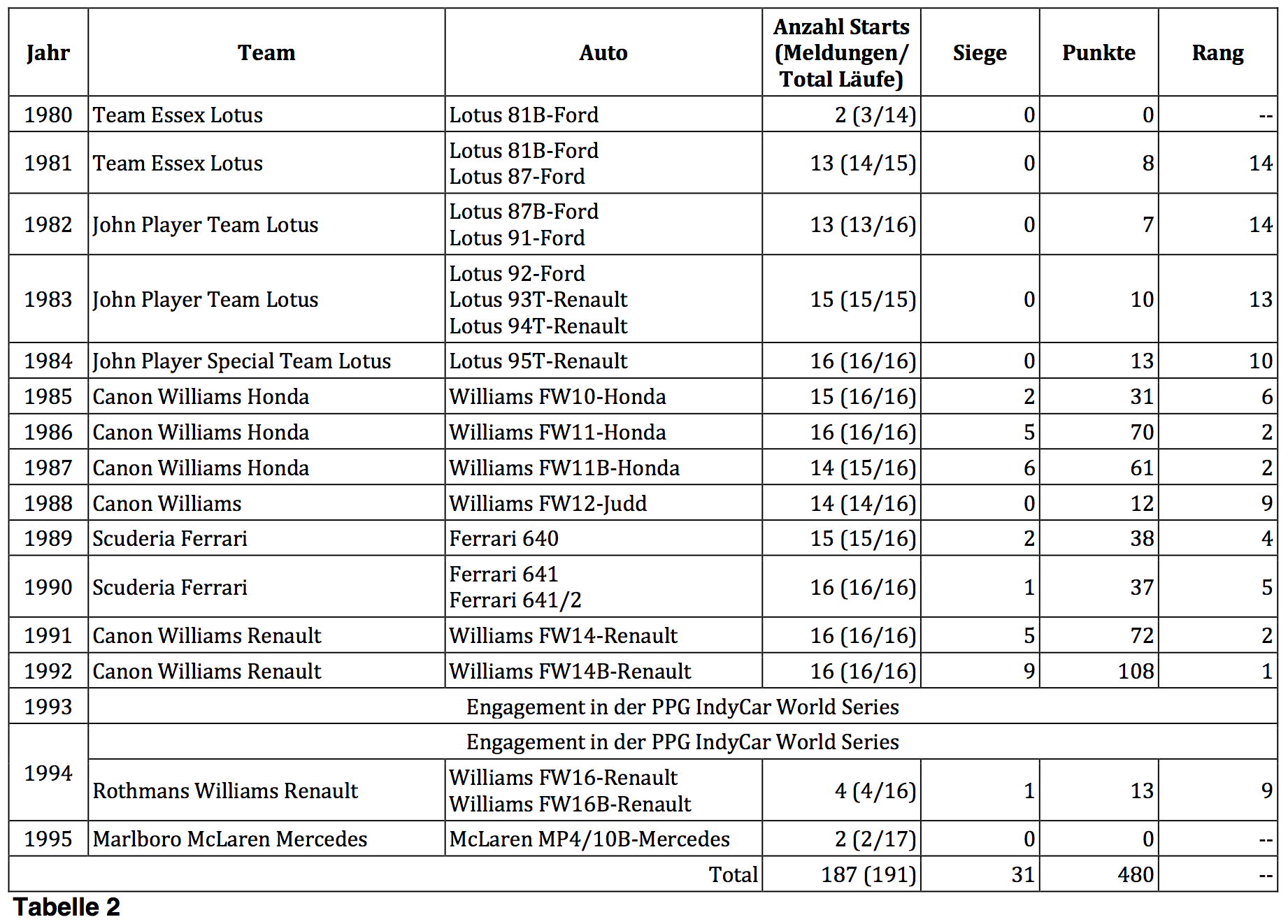
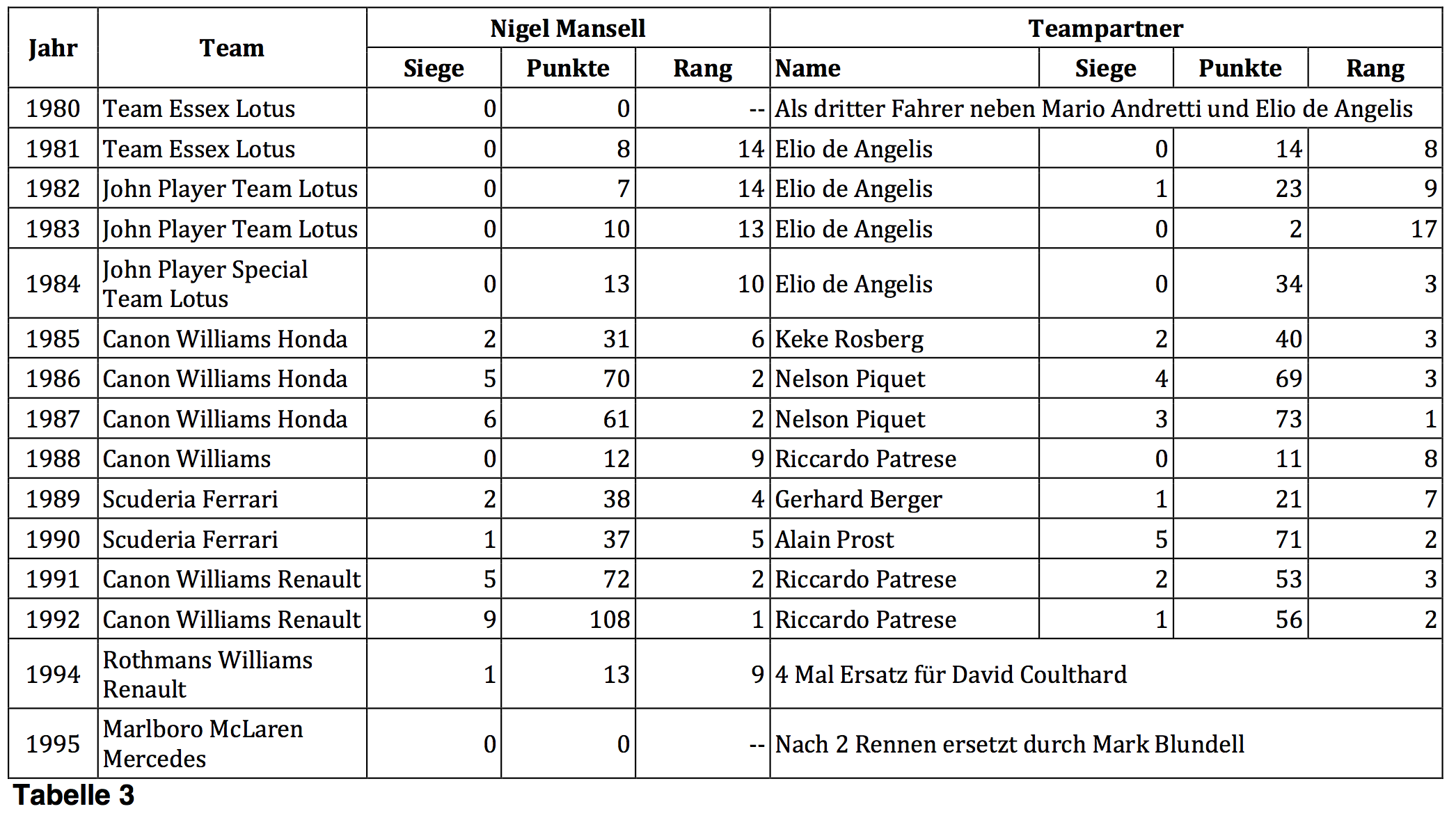
His statistics in the drivers' world championship are as follows:
This career is the subject of his first autobiography from 1995.
Not just a new edition
The question arises as to what is driving Nigel Mansell to write a second biography twenty years after his first? It should be noted right away that this is not simply a new edition with an additional chapter covering the last few years. It is an independent book, written by himself without a ghostwriter. His declared aim is to find out whether his assessment of things has changed, softened or even remained the same over the last twenty years ("... to see how my view of the events has altered, mellowed and maybe in some cases stayed the same in the two decades ..."). He made the decision to do this during the 2014 British Grand Prix, when he acted as race steward (FIA driver steward) and once again came into close contact with the scene.

One thing is immediately noticeable: while the first edition focused entirely on the racing driver, this time it is the man, family man, racing driver, pilot, golfer and temporary policeman Nigel Mansell. It is about the feelings of success and the suffering of a racing driver in equal measure. Accordingly, the book does without statistics.
His second biography consists of three parts:
- The Racing Years
- Formula 1 - Then and Now (Formula 1 then and now)
- Isn't Life Wonderful? (Isn't Life Wonderful?)
Nigel Mansell was considered an obsessive. His will to win was proverbial and he describes the overtaking maneuvers against Berger, Piquet, Prost and Senna with great satisfaction. It is important to him to be seen as equal to Piquet, Prost and Senna.
Unconditional support from his wife
To make his dream of racing come true, he gave his all and was obviously supported unconditionally by his wife. The Mansell couple sold their house in 1978 to buy into the March Formula 3 team, but after six weeks it was over: "So now we had no money, no home; we were living in rented accommodation with seemingly no future". Mansell had already given up his job as an engineer at Lucas Aerospace to devote himself fully to racing. His wife earned the household money.
In 1979, he was given a seat in the Unipart Formula 3 team and in the support race for the British Grand Prix at Silverstone, he caught the eye of Colin Chapman: "Well, I was impressed by the way you went through the chicane, your braking and the speed you carried through there. Very good" (Yes, I was impressed by the way you went through the chicane, your braking and the speed you carried through there. Very good). He had arrived.
"Bouncing back"
Defeats and mishaps always seemed to motivate Mansell. "Bouncing back" (coming back or not letting things get you down) is his motto in life and the recommendation to all readers. This also includes the fact that Nigel Mansell had several serious crashes during his racing career, some of which were life-threatening: Morecambe Bay 1973, Brands Hatch 1977, Oulton Park 1979, Suzuka 1987, Phoenix 1993. One word that appears on what feels like every page of the book is concussion. He seemed to have accepted it all as a necessary part of his dream job and even denies that racing has anything to do with courage. He describes himself as a fatalist: "... most drivers are fatalists. During my whole career, I felt that if it is my time, then so be it. If it wasn't my time, then I would bounce back" (... most drivers are fatalists. Throughout my career I felt that if it was my time, then so be it. If it wasn't my time, then I would bounce back). "Courage for me is an outstanding act of valor, when someone goes way over the normal call of duty and in fact puts their own life at risk to save others".
This clearly clashed with his responsibilities as a family man. His wife had to lie down for weeks before the birth of their third child in 1987, while her husband exposed himself to the risk of racing. His comment on this is clear and unambiguous: "However, we did get through it, by staying strong and soldiering on. In the day and age we were brought up in, you were expected to face whatever you were presented with; you 'got on with it'" (Nevertheless, we got through it, by staying strong and soldiering on. In the time we grew up in, we were expected to face whatever you were presented with; you got on with it).
Of course, his comments on modern Formula 1 are interesting:
- He praises the high safety standards. At the same time, he notes that some of the young drivers behave very irresponsibly and drive as if they were in a coup car (Dodgem, bumper cars).
- He calls for the cars to be more demanding to drive again, with wider tires and thus more grip, but also more horsepower.
- He complains that the number of seats in Formula 1 has decreased, meaning that fewer drivers can get a chance. He goes so far as to demand a permanent seat in Formula 1 for the winner of GP2 the following year.
- It is quite clear that he sees that today, with his modest background, he would have had less chance of having the career he was able to have in the 1980s.
From professional golfer to temporary policeman
After his career as a racing driver, he became a passionate golfer and toyed with the idea of turning professional. He had to bury this plan and later sell his golf resort in Devonshire after his wife fell seriously ill for a long time. He acted as an auxiliary policeman. In 2010, he competed in the LMP2 class at Le Mans together with his two sons Greg and Leo in a Ginetta-Zytek GZ09S. After just four laps, a tire burst and he narrowly escaped the accident and had to undergo a long convalescence. During this time, he learned to be a magician. Today, he owns a Mitsubishi dealership in Jersey, where he has also set up a museum. He is also President of UK Youth. This organization helps young people from difficult backgrounds to grow up with extracurricular (informal) training opportunities.
How good was he really?
But how good was Nigel Mansell as a driver? Did he have talent? In a direct comparison with his team partners at the time, he comes off worse than Elio de Angelis at Lotus and Alain Prost at Ferrari. However, he is on a par with the two world champions Keke Rosberg and Nelson Piquet at Williams and better than Gerhard Berger at Ferrari and Riccardo Patrese at Williams:
If you take the results of the above drivers in the period 1981-1995, then Nigel Mansell, together with Nelson Piquet, Alain Prost, Ayrton Senna and Micheal Schumacher, belongs to the group of drivers who show a double-digit percentage everywhere in the number of victories, pole positions and fastest laps in relation to the number of starts:
However, in the ranking by Professors Stadelmann and Eichenberger, Nigel Mansell is in second-last place compared to the drivers selected here:
Michael Schumacher 3rd place
Alain Prost 7th place
Elio de Angelis 18th place
Ayrton Senna 26th place
Keke Rosberg 42nd place
Nelson Piquet 48th place
Riccardo Patrese 60th place
Niki Lauda 61st place
Nigel Mansell 80th place
Gerhard Berger 81st place
As this is a statistical study, the standard errors must also be included in the analysis. Differences in rank of 1 or even 5 are therefore not considered significant. Nevertheless, the differences between Patrese and Piquet on the one hand and Mansell on the other are particularly surprising. The statement that the latter became world champion because of the car is thus strongly relativized, as according to the professors' calculations, he clearly had more talented colleagues as team partners in 1986-1988 and 1991-1992, whom he dominated overall in terms of the number of victories, but also pole positions and fastest laps in the periods in question.
The quality of a racing driver
But what is talent? Innate driving ability? Nigel Mansell points to three things that define the quality of a racing driver:
- Being able to drive a Formula 1 racing car at the limit has to be learned. The process goes through stages: today, for example, from karting to Formula 3 and GP2 to Formula 1. But don't be fooled: even Max Verstappen, who joined Formula 1 in 2015 at the age of 17, already had a career of almost ten years in junior formulas, including karting, behind him when he joined. That's more years than Jim Clark, for example, who started out in 1956 in his father's Sunbeam and a friend's DKW and went on to drive Porsche 1600 S, Jaguar D-Type, Lister-Jaguar, Formula 3 and Formula 2 at Lotus in 1960 and then Formula 1 in the same year.
And even in Formula 1, a driver goes through another learning process. - The decision as to who drives is made by the team owners. They create the opportunities, which are always associated with expectations regarding the performance of the respective drivers. It is up to the drivers to seize such an opportunity. Nigel Mansell scored just 38 points in four years at Lotus and had to give way to Ayrton Senna at the end of 1984. In addition, his old employer gave him a very poor report card. Frank Williams nevertheless placed his trust in him and Mansell justified this convincingly. If he had not passed in 1985, his career would probably have ended quickly.
Innes Ireland (58th place) felt on a par with Stirling Moss (15th place) in 1961. When he was dropped from Lotus at the end of the season to make room for Jim Clark, he fell into a deep hole. His victory in the 1961 US Grand Prix remained his only one. From 1962 onwards, he was employed by second-class teams.
In order to be consistently successful, a driver must repeatedly earn a place in the potentially winning cars. Williams made Nigel Mansell a generous offer for 1991, despite his less than friendly departure at the end of 1988. Obviously Frank Williams knew that he had to have a driver who could stand up to Senna, despite the FW14. For Innes Ireland, the good places after 1961 had become unattainable. - The ability to win is a special one. In his first biography, Nigel Mansell gives a detailed description of his time at McLaren in 1995 and also what he needed to be able to win consistently: "I need a car in which I can go into a corner deeply on the brakes and then when I turn the steering wheel, it will react immediately and go where I point it - to the apex of the corner. Sadly the McLaren couldn't do this at all. So I couldn't trust the car or build a relationship with it and I certainly couldn't drive on the limit. If I tried to go ten-tenths, the chances of having an accident were very high. ... (I need a car in which I can brake deep into a bend and which, when I turn the steering wheel, reacts immediately and goes where I want to go - to the apex of the bend. Sadly, the McLaren wasn't capable of doing that at all. That's why I couldn't trust the car or build a relationship with it; I certainly couldn't drive it at the limit. If I had driven one hundred percent, the risk of an accident would have been very high. ...).
My team-mate Mika Hakkinen got to know the car better than me, because obviously he did a lot more miles in it, and he just drove through a lot of its problems. He is young and inexperienced and so it was more acceptable to him than it was to me. He doesn't know what it takes to win and win consistently and like any young driver, he's prepared to put up with a lot - as I did in my Lotus days. When you've won 31 Grand Prix, and two World titles, your tolerance threshold is that bit lower. You know straight away when you're in a bad car and you have a pretty good idea how much work needs to be done to make it competitive" (My teammate Mika Häkkinen got to know the car better than I did, as he had obviously driven a lot more kilometers with it and simply disregarded its many weak points. He was young and inexperienced and therefore he could accept them more easily than I could. He doesn't yet know what it takes to win and to win consistently; like any young driver, he is prepared to accept a lot of things - like I did back then at Lotus. When you've won 31 Grand Prix and two world titles, the tolerance level is a little lower. You know immediately when you're in a bad car and you have a pretty good idea of how much work is needed to make it competitive).
So in order to win, you have to create (work on) the conditions. The ordinary driver's approach of sitting in the car and stepping on the gas is not enough.
The careers of racing drivers take very different paths. They are marked by ups and downs. Some seize the opportunities that present themselves. Others don't. Still others don't get a chance. Some make the jump in time and leave in style, others don't and disappear through the back door. For still others, an accident brings their career to an abrupt end. It was not for nothing that Niki Lauda blocked discussions about deserving and undeserving world champions: "A world champion is a world champion, you can only congratulate him". He is clearly saying (in this case about Jenson Button in 2009) that comparisons are pointless.
Mansell contradicts the idea that the results in the races can be recorded as the sum of talent, the quasi unconditional, natural driving ability (measured as a comparison of drivers who drive the same car in the same season), the quality of the cars as technical constants, some correction factors for weather, failures, etc. and a statistical error. It is the combination of knowledge, assertiveness, hard work and luck that leads to success.
In terms of measurement, the following points should also be considered:
- Innes Ireland's Lotus 33-BRM from Reg Parnell Racing in 1965 is not a Lotus 33-Climax from Team Lotus. Lotus had far more resources than Parnell, and Clark always had the best engine of any Coventry Climax customer in 1965. Ireland's BRM P56 was from the previous year. However, in the statistical model, a 1965 Lotus 33 is always a 1965 Lotus 33, so the basis of comparison car is by no means clear, at least not in the earlier days.
- A win is (almost) always more hotly contested than an eighth or twelfth place. The simple difference between the positions of team-mates does not take this factor sufficiently into account, especially when the comparison is made in the midfield or even in the rear regions. There, less risk is taken with regard to the material. This was at least true in the years when budgets were still a fraction of what they are today.
- It is a truism that Formula 1 has changed a lot since it was founded in 1950. This is also reflected in the careers of the three greats Juan Manuel Fangio, Jim Clark and Michael Schumacher, who effectively represent three different periods. Pure sporting success measured in terms of the number of victories per race driven is of course central. But all of them were also doyens in their time who had earned a special respect. Of course, this also applies to Tazio Nuvolari in the 1930s, who must be included as the fourth in the bunch. You can call this factor talent. But at the same time, you have to realize that the composition of the bundle of skills that is described as talent was very different, just as the demands on the drivers were different. [Fangio, Clark and Schumacher represent the 50s, 60s and the period 1990-2010. It is noticeable that in the 70s and 80s a driver from the category of untouchables is missing].
How useful is such an analysis?
Is a comparative statistical analysis to establish a ranking among the riders at all useful? The top ten riders can perhaps still be discussed because the vast majority of them have become world champions and, above all, have a long career. There is therefore a certain degree of comparability. But not with rank 80. The argument with the car is highly dubious. Fangio (in particular), Clark, Schumacher, but also Prost, Senna, Hamilton, ... all had excellent, if not usually the best cars. Their art was to consistently win or finish well by implementing the quality of their cars. There are other drivers who have not been successful at this. Chris Amon is the standard example (33rd).
In addition, Nigel Mansell and Innes Ireland never met directly on the racetrack, so only indirect comparisons are possible. Nevertheless, the model continues to calculate talent values as a counterpart to the quality of the cars driven and these can of course also be used to create a ranking. But to compare racing drivers whose careers are 25 years apart and have taken very different paths with a single number is absurd and does not do justice to the achievements of the individuals. Innes Ireland had some notable racing successes in Lotus in 1960 and 1961. The hopes he derived from this did not materialize. However, after his career as a racing driver, he became a competent motoring journalist. Well done Innes!
World champion after all
Nigel Mansell achieved his goal of becoming world champion after all. He also always demonstrated enormous speed and a racer's soul. However, his combative nature also led him to make rash decisions. His career was very special and unique in one respect. He was the last driver that Colin Chapman and Enzo Ferrari signed up themselves before their deaths. He will probably never get rid of his reputation as a humorless weirdo. And he has not tried to dismantle his old trademark, the face contorted in pain, in his new book (quite the opposite!). But he was one of the few drivers of his generation to marry his childhood sweetheart and start a family with her. He was appointed Commander of the Order of the British Empire (CBE) in early 2012 for his achievements and, above all, his commitment to UK Youth. He proudly stated: "I am entremely proud of my career in motorsport, proud of winning two world titles back-to-back and of all the amazing races and triumphs that I was able to secure". Well done Nigel!
Ayrton Senna was Nigel Mansell's yardstick as a racing driver. Beating him was the thing for him. But he had to make way for him in 1985 and Alain Prost in 1993 at Lotus and Williams respectively. But he was on a par with Keke Rosberg and Nelson Piquet and ahead of Gerhard Berger and Riccardo Patrese.
Not always driving intelligently
However, Table 2 above also shows the other Mansell. In many seasons, he did not drive all the races. He had serious accidents, was disqualified twice in 1989 and was even banned for a race on the second occasion. In the Portuguese Grand Prix, Mansell had driven over the pits while changing tires and had illegally driven back in reverse gear. Back on the track, he chased Ayrton Senna under the black flag and later crashed into him. A completely unnecessary maneuver. He has always said that he did not see the black flag. It is this turbulence in his career that has repeatedly raised questions about his ability. It is probably also this factor that caused him to finish 80th in the Stadelmann/Eichenberger calculations (and not the cars).
Nigel Mansell admits that he has not always driven intelligently. Is that a reason to deny him talent or driving ability?
Primarily recommended for die-hard fans
Nigel Mansell's second biography is primarily recommended for die-hard fans. It will be of little use to others, also because the background is practically assumed (unless you read the first biography in parallel). He jumps back and forth in time and demands that the reader is immediately in the new picture. He presents himself, indeed he almost celebrates himself as a man in pain. This time all the way back to the recent past. This is sometimes quite intrusive. On the other hand, he continues to leave the events surrounding his various contract stories in the dark. However, the book is very well suited as an illustration to the movie "Rush - Everything for Victory" in terms of the level of dedication that participation in the battle for the world championship title in Formula 1 demanded and still demands.
Bibliographical information
1. biography:
- Title: Nigel Mansell: My Autobiography - The People's Champion
- Author: Nigel Mansell with James Allen
- Publisher: CollinsWillow
- Edition: 1st edition 1995 (with four reprints)
- Size/Format: hardcover with jacket, 160 x 240 mm, 351 pages
- Language: English
- ISBN-13: 978-0-00-218497-7
- Price: in second-hand bookshops from a few to 100 euros depending on condition (plus postage and shipping)
2nd biography:
- Title: Nigel Mansell: Staying on Track - The Autobiography
- Author: Nigel Mansell
- Publisher: Simon + Schuster
- Edition: 1st edition 2015
- Size/format: hardcover with jacket, 160 x 240 mm, 370 pages
- Language: English
- ISBN-13: 978-1-4711-5022-7>
- Price: EUR 29.05, from the publisher $16.99, also available as an e-book or for Kindle
- Order/buy: Online at amazon.de or in relevant bookstores