Three very special racing driver biographies will be published in 2016: on Brian Redman, Augie Papst and Ed Hugus. So what?

Part of racing history
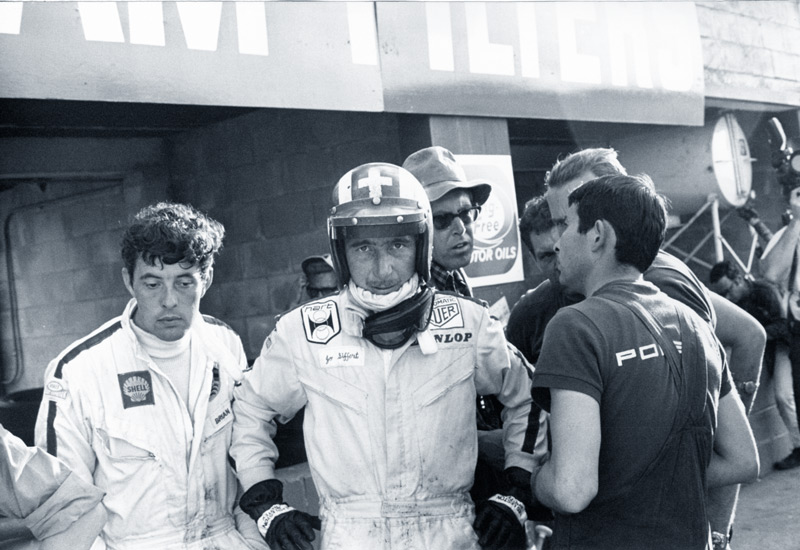
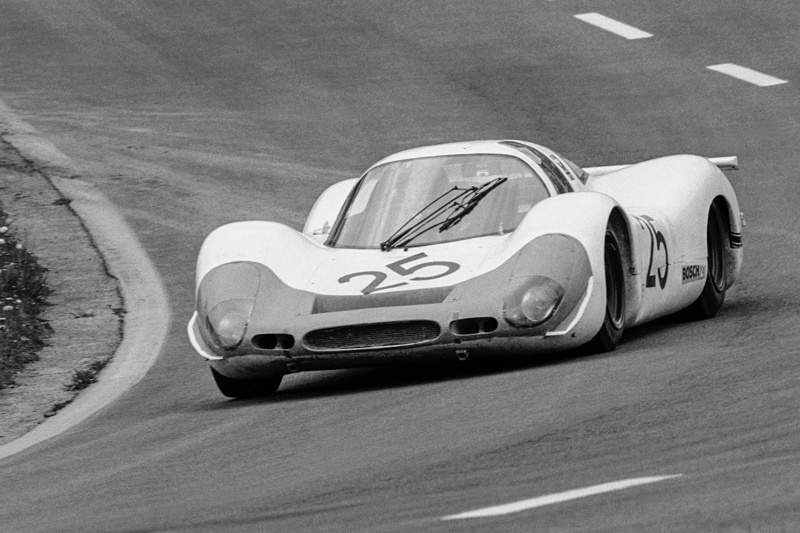
All three were not counted among the absolute top drivers in their day. Nonetheless, they were part of the international racing circus, especially in racing sports cars. And: each of them has a unique selling point that anchors them in racing history. Ed Hugus (30.06.1923-29.06.2006) was the very first Cobra driver. Augie Papst (25.11.1933) took the only victory in a Lola Mk. 6, the blueprint for the monocoque racing sports car. And Brian Redman (09.03.1937), the youngest of them all? He was considered the most underrated driver of his time. And he raced with or against Mario Andretti, Jacky Ickx, Joseph Siffert, Pedro Rodriguez and Clay Regazzoni, to name just the most important. In 1968, 1969, 1970 and 1972, he was a member of the team that won the World Sportscar Championship each time, driving a Ford GT40, Porsche 908, Porsche 917K and Ferrari 312PB.
Start of the racing career
The trilogy begins with Brian Redman's book, which he wrote together with former racing driver Jim Mullen. His racing career took off when he became a driver for John Bridges' Red Rose Racing Team in 1965. His first car was a Jaguar E-Type Lightweight. This was followed by a Lola T70 in 1966 and a Chevron B5 in 1968. In addition, there were individual outings in the Ford GT40 of private driver Peter Sutcliffe in the World Sports Car Championship races.

In 1968 he was a member of John Wyer's team, which fielded Ford GT40s. From 1969 to 1970 he was a works driver for Porsche (including John Wyer's works team in 1970) and from 1972 to 1973 for Ferrari in the World Sportscar Championship races.
Racing activity in American series
From 1973 onwards, his racing activities increasingly focused on American series. He became champion of the American Formula 5000 three times in a row from 1974 to 1976 in Jim Hall's Lolas. After an interruption due to his third serious accident, he rejoined the IMSA in 1978 in the Porsche 935 of Dick Barbour Racing. In 1981 he won the IMSA title in a Lola T600 from Cooke-Woods-Racing. From 1984-1986 he drove the IMSA Jaguar for Group 44 and finished in 1989 with the Aston Martin AMR1 for the works team in Group C.

Brian Redman, on the other hand, was never able to gain a foothold in Formula 1 despite his undisputed skills as a racing driver. He drove a total of 12 races and his best result was a third place in the 1968 Spanish Grand Prix. It seems that he was never in the right place at the right time when it came to places in the top teams. The fact that he turned down Ferrari in 1968 and Frank Williams in 1970 partly explains this development, but certainly not entirely.

Accountability report
When you pick up the book, you immediately notice that it is not an ordinary biography that goes through the stages of a career in chronological order. Most of the chapter titles are named after race tracks or racing series: 1 The original Spa-Francorchamps, 2 Lancashire's fastest mop deliveries, 3 The original Nürburgring, 4 The mind of a driver, 5 The Targa Florio, 6 Stories from the 1960s, 7 Le Mans: Le Heartbreaker, 8 Family matters, 9 Daytona International Speedway, 10 The 2-litre sports cars, 11 Formula 5000, 12 Stories from the 1970s, 13 My brief encounter with death, 14 Closure. Also missing at the end is the usual table with all the races or at least all the victories. It is therefore advisable to read this book not as a biography, but as an account. The status of the paid driver, who earns his living by racing, is to a certain extent the vanishing point of all his stories and reflections.

Two stages
He distinguishes between two stages. The first, from 1965-1975, which also appears in the title, he describes as "daring drivers, deadly tracks". It was a period when death was omnipresent on the track. Drivers he was close to, such as Frank Gardner, Joseph Siffert and Pedro Rodriguez, lost their lives. But on the other hand, Brian Redman drove Frank Williams De Tomaso F1 for a short time as a replacement for the fatally injured Piers Courage.

The second phase is much safer for him. He owed his survival in St. Jovite in 1977 in no small part to the efforts of the Snell Memorial Foundation to improve helmets.
Distance and binge drinking
Life as a racing driver was shaped by this environment. Redman kept his distance from his colleagues in order to protect himself emotionally. For him, the regular post-race binges served to drown his fears. He paints a picture of the mores of the time, which certainly has its problematic aspects. This becomes clearest when he compares his attitude to life with that of his parents and young Brian during the Blitz in the Second World War. Perseverance and survival was the motto (only: he chose this state voluntarily, as did his wife Marion, who has her say at the end).
Redman defines his career choice in a somewhat negative way: racing was what he did best and he didn't have a school-leaving certificate. The driver was the great feeling in the car and on the podium, which always dispelled any fears about the future. His two attempts as a car salesman were unsuccessful, so the two decisions to retire from racing were quickly reversed. The income he was able to earn as a good driver was enough for him to lead a comfortable life.
Multiple re-entry as the only chance
The other side of the coin was that you couldn't earn any money while you were in hospital after an accident. Brian Redman therefore describes the typical career as a sequence of active racing, retirement due to an accident and then returning to racing. So it was also about getting back on track as quickly as possible after an accident. This was true if only because racing teams such as Porsche or Ferrari, in the battle for the world championship title, were equally planning for alternatives after the retirement of a driver. Brian Redman went through this cycle three times between 1965 and 1989.
Brian Redman's aim with his book is to portray the life of a professional racing driver in the period 1965-1975: "My objective in writing this memoir was to make readers feel what it was like to be a professional racer in a particularly dangerous era, using the experiences of my life in racing to provide personal insights into a wonderful, terrible decade. The book, therefore, is less about me than that consequential era when giants like Mario Andretti, Bobby Unser, Jo Siffert, Jim Hall, Pedro Rodriguez, John Wyer, Jackie Stewart, Enzo Ferrari and Jacky Ickx walked the earth". And his wife Marion doubles down by qualifying the text as the best thing you can learn about this period of racing, unless you were there.

Writing racing driver Sam Posey once drew a portrait of Brian Redman. It is printed at the end of the book. He addresses the fact that Brian Redman was considered the most underrated driver and calls him a champion. It is perhaps significant that Redman deals with the professional aspects himself, but leaves the personal aspects to others. However, Redman is not entirely immodest when he states that the American Formula 5000 was superior to Formula 1 in sporting terms in his day. At the very least, he outshone the later world champion Mario Andretti twice.
Food for thought
It is a thought-provoking book and occasionally makes you think. For laymen who mainly followed the World Sports Car Championship in the period 1965-1975, it is certainly an answer to one or two unanswered questions. As someone who was directly involved, Redman can always tell the stories from his own experience. For example, the difficult mise-au-point of the Porsche 917 and the production of the film "Le Mans". What makes the book even more valuable is the information on the terms of his contracts and thus also on the economic background.
It would be interesting to be able to ask colleagues such as Jacky Ickx, Tim Schenken, Jody Scheckter, Hans Stuck Jr. as well as Marc Surer, for example, about their opinions on this book.
The large-format book is illustrated with many pictures. The page layout is generous and makes reading very comfortable. The proofreaders have done a great job (which can no longer be taken for granted these days).
Bibliographical information:
- Title: Daring Drivers, Deadly Tracks - A racer's memoir of a dangerous decade: 1965 - 75 Authors: Brian Redman with Jim Mullen
- Publisher: Evro Publishing
- Edition: 1st edition 2016
- Size/format: hardback, 235 x 280 mm, 300 pages, over 325 illustrations
- Language: English (a French version with 208 pages is also available as ISBN 978-2-36059-099-5)
- ISBN-13: 978-1-910505-10-6
- Price: £ 50 / € 75 (approx.)
- Order/buy: Online at amazone.de or in well-assorted bookstores