The Monaco Grand Prix, Indianapolis 500, the 24 Hours of Le Mans - that's the triple crown in motorsport, and the Monte Carlo Rally is one of these illustrious names away from the circuit. The Monte claims to be the queen of rallies. However, the achievements behind winning a title in these illustrious races pale into insignificance in the face of an event that has been held for more than 50 years. The Safari Rally, with its human achievements and adventures, has never been surpassed by any other motorsport event. Because, quite simply, it was mercilessly tough.
The history of the Safari from McKlein Verlag
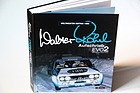
When it comes to the history of rally sport, McKlein Verlag is one of the best addresses. Even with the review of 50 years of Safari from 2003, you get everything that characterizes books from this house.
1. competent writing.
The authors David Davenport and Helmut Deimel, who have been involved in rally sport for decades, not only write well, they also know a lot. And they put this on paper to the delight of the reader.
2. outstanding photography.
Reinhard Klein has been photographing motorsport since the days of Jochen Rindt. He was there when things were going well on and off the track. And also not. His pictures and his archive bring written history to life.

3. clean layout.
In the end, the whole thing should also look good. No graphic gimmicks. Legible typography, clear image presentation.
The result is a 320-page book about more than 50 years of the Safari Rally, which can also be used as a coffee table book. Thanks to exoticism.
Being there is almost everything
The book is roughly divided into 12 chapters. The foreword by Eric Cevil, founder of the Safari Rally and Chairman of the Safari Rally, is one of them. On a short page, he explains what the Safari is all about. Take part and hopefully arrive. Maybe even win if you're lucky. Luck that rally ace Rauno Aaltonnen was not to be granted after 23 participations. With victory sometimes within his grasp, something always went wrong just before the end. And so, at the end of each safari, he had to dream of taking part the following year.

A route like no other
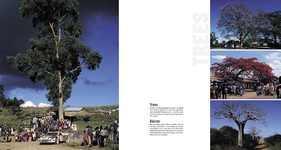
The second chapter is dedicated to the route: Kilimanjaro, Taita Hills or Usumbara Mountains are the fearsome names of the stages, which are brought to life in the third chapter by a 50-page photo series. From the trees along the route to the vehicles, the Maasai, the colors of Africa, the equipment and the teams' workshops, the suffering of the drivers and co-drivers to the finish line and the subsequent parties in the hotel pools, the result is a vivid and vivid insight and overview of the toughest rally in the world.
The safari begins
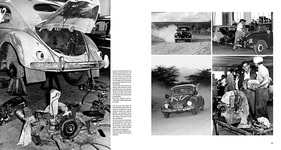
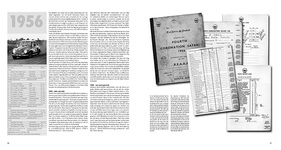
This is followed by chapters that tell the story of the safari in wonderful episodes. From the beginnings to the first rally, which originated as a regulars' table idea on the occasion of the Queen's coronation in 1953 to get into a car, cross half of Africa and be the first to get out. At that time, it was still possible to win individual classes with the down-to-earth technology of a VW Beetle, an Austin A30 or a Vauxhall Velox, or at the very top with a Ford V8 Pilot. DKW also entered its name in the winners' lists with an F91. The first overall victory was achieved by a Mercedes 219a in 1959, when class victories were dispensed with. Even the 1960s, as in Europe, were still dominated by series-produced cars with gentle adaptation to the challenges of nature. Beetles, Ponton-Mercedes, Citroën ID and Anglo-Saxon vehicles continued to toil over the endless total distance at the start. The atmosphere was colonial. Participation with all its tinsel was just as important as winning. At some point, the Japanese discovered the Safari and then the Europeans also wanted to win.
The Safari becomes world champion
In the 70s, the face of the Safari changed dramatically. Rally sport attracted spectators and so, in the wake of rally popularity, it was given world championship status in Group 1-4. From then on, nothing was as it used to be. The European works teams did everything they could to win the Safari. In 1972, Hannu Mikkola in a Ford Escort was the first European to make his mark on the list of victories, which had been dominated by locals for 20 years, leaving his rivals in Datsun Zs or Porsche 911s behind. In the following years, the victories belonged to Safari specialists Joginer Singh and Safari icon Shektar Mehta or Ove Anderson. And although in the late 70s Mercedes with the 450 SLC or Lancia with the Stratos rolled high-tech projectiles into the savannah, they ultimately failed due to the down-to-earth reliability of the Datsuns.

A new level
In the golden era of rallying, the 1980s, Audi tried to push through Africa on all fours with the quattro. But the rally car from Ingolstadt was denied victory. Whether Group 4 quattro or Group B Sport quattro, the Safari simply finished them off, a victory was out of the question. This was only possible with the compromise solution for Group A. In 1987, the Audi 200 sedan took the winner's podium after the group was eliminated. Double victory for the all-wheel drive.
Endless effort
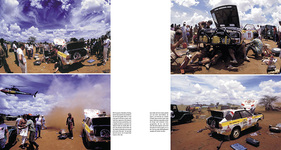
The effort put into the Safari over the last 20 years has been immeasurable. Rumor has it that Audi's World Championship budget was significantly higher than that of a Formula 1 team capable of winning. Whether airplanes, escort helicopters for each vehicle, other teams followed with even larger staffs and soon air traffic control was needed to at least keep the traffic in the air under control. After the Audi victory, the era of Toyota, Subaru and Mitsubishi began. They fought their way through the 90s in Group A. Although the Safari had lost its status as a world championship race in the meantime, this did not diminish its fascination. Not yet. Ford Focus, Mitsubishi Lancer and Subaru Impreza battled it out for victory in this fascinating rally. The parties at the end of a victory were legendary.
At Toyota, they usually ended in the hotel pool. But unmistakably, a chapter was coming to an end. The more successful the engineers were in making a rally car more reliable, the faster it was driven and the more dangerous the whole game became. A trend that began in Europe in the 1960s and soon put an end to events on public roads such as the Tour de France or Marathon de la Route. Somehow this could no longer be sustained in Africa and the route could not be controlled. Safety could not be guaranteed. Even when the course length was reduced to only 1/6 of the length of its heyday, it was not certain what would come out at the end of the event.
The end of the effort
In the end, the safari was bankrupt: monetarily and ideally. This book thus concludes the history of the world's toughest rally with its retrospective. Each event is richer in anecdotes, adventures and pictures than many other WRC calendars. Tragedy, commitment and the poor cost-benefit balance of the Safari, far removed from the actual customer base, put an end to the Safari. It's a good thing they tried to capture it with this book. With success.
Bibliographical details
- Title: Safari Rally
- Language: German/English
- Authors: Reinhard Klein, David Davenport, Helmut Deimel
- Publisher: McKlein, 1st edition 2003
- Format: Hardcover, 306 x 290 x 329 mm
- Size: 121 pages, 170 color and 1 b/w picture
- Price: € 49,00
- ISBN: 978-3927458086
- Buy/Order: Online at amazon.de, at the publisher McKlein or in well-assorted bookstores