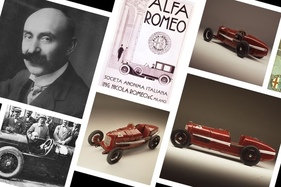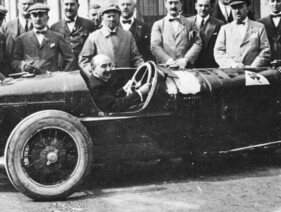

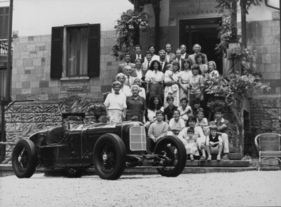


This year marks the 150th anniversary of the birth of Nicola Romeo, the engineer and entrepreneur born in Naples on April 28, 1876, who made his home in Milan. In 1915, he acquired the Anonima Lombarda Fabbrica Automobili, or A.L.F.A. for short - founded on June 24, 1910 - and gave the porcelain-based company its name. June 1910 - and gave the Portello-based company a new mission in the wake of industrial restructuring after the First World War: an extremely concrete vision that would prove successful, focusing on the development and production of high-performance "sports touring cars" and on taking a leading role in international competitions.
Nicola Romeo saw racing as having two main objectives: the promotion of production cars and the development of technological know-how on the racing stage, before transferring the most effective technical solutions to "touring car" models. Romeo had the intelligence and foresight to work with exceptionally talented men - two names in particular stand out: Vittorio Jano and Enzo Ferrari.
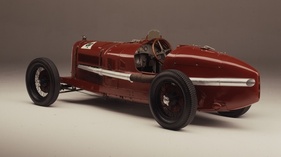
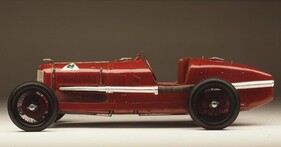
Success at the 1923 Targa Florio, the first truly significant one for Alfa Romeo, was not enough for Nicola Romeo to secure the final establishment of the Biscione in motor racing. It was therefore Enzo Ferrari who brought Vittorio Jano to Milan on Romeo's behalf: the man who was to design the Grand Prix "P2", the car whose victories catapulted Alfa Romeo to the pinnacle of international racing success. Partly as a result of the sporting triumphs of the P2, Jano later took on the role of technical director and a few years later designed first the "6C" and then the world-famous "8C".

The man who gave his soul to the Biscione
It all began on April 28, 1876, when Nicola Romeo was born into a large family of modest circumstances in Sant'Antimo near Naples. Despite economic hardship, the enterprising young man continued his studies and obtained degrees in civil and electrical engineering in Naples and Liège, Belgium. He lived for a time in France and Germany and then began working for British and American companies in the railroad sector. In 1906, he went into business for himself and founded the company "Ing. Nicola Romeo & C." in Milan, which imported dismantled machines from the United States for civil engineering work.
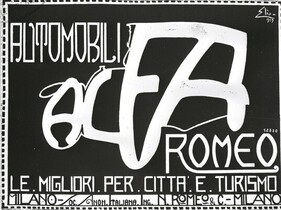
During the First World War, Romeo expanded his company by taking on new partners and took over A.L.F.A., which had just gone into liquidation, in order to start production for the war effort. The venture made Romeo rich, and in 1918 he opened the company to new capital, changed the name to "Società Anonima Italiana Nicola Romeo & C." and restructured production, moving into the agricultural and railroad sectors. It was not until a year later that he also entered the automotive sector.
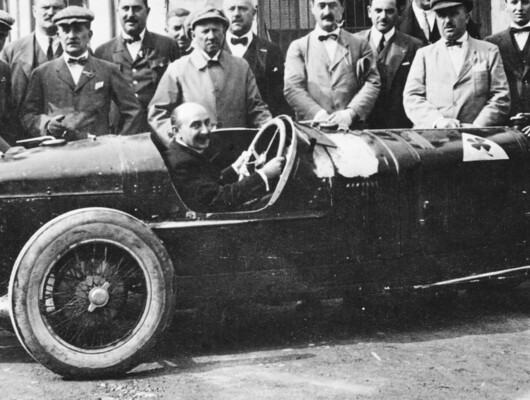
At the end of 1921, the government took control of Alfa Romeo via the banks, effectively ushering in a new phase for the company. Nicola Romeo remained managing director and used his experience to guide the transition. In 1928 he resigned from this position and in 1929 he was appointed Senator of the Kingdom - a prestigious recognition for his contribution to Italian industry. He died on August 15, 1938 in Magreglio, where he had retired with his wife and seven children, leaving behind the memory of a determined and visionary figure in Italian industry.
Today, the vehicles designed and developed during the epic era under Nicola Romeo's leadership continue to shine, fascinate (and roar) in the Alfa Romeo Museum in Arese and at international events - as witnesses to an era of automotive engineering that made history.