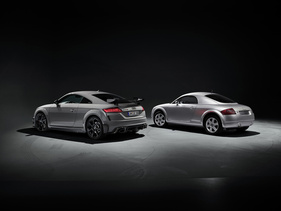
25 years, three generations: With the Audi TT, the brand with the four rings has written design history. Since its premiere in 1998, the sports car has thrilled drivers worldwide with its driving pleasure and clear design language. In 1999, "Auto Europe" voted it the best new car of the year.
In the mid-1990s, the Audi A8 full-size model marks the upward positioning of the Audi brand and the gradual renaming of the model series: The Audi 80 became the Audi A4, the Audi 100 the Audi A6. The Audi A4 presented in 1994 was the first model to represent the new Audi design language, as did the Audi A3 premium compact car, available since 1996, and the second generation of the Audi A6 presented in 1997. In the course of this emotionalization of the brand through fresh, progressive design, the American designer Freeman Thomas, under the then Head of Design Peter Schreyer, created a purist sports car in the form of the Audi TT Coupé.

Audi presents the concept car to an enthusiastic trade fair audience at the IAA in Frankfurt am Main in September 1995. The model designation "TT" is a reminiscence of the legendary Tourist Trophy on the Isle of Man, one of the oldest motorsport events in the world, in which NSU and DKW celebrated great successes with their motorcycles; at the same time, the name "TT" is reminiscent of the sporty NSU TT of the 1960s. The deliberate departure from the usual Audi nomenclature in the Audi TT Coupé underlines the fact that something completely new is coming.

Designer Wenzel: "In the Audi TT, every shape has a clear function"
In December 1995, the decision is made to produce the Audi TT Coupé in series. Torsten Wenzel, Exterior Designer at Audi, helped bring the study to series production and remembers: "For us, the greatest praise was when the trade press noted appreciatively that not much had changed from the study to series production, although of course we did have to adapt a lot of details due to the technical specifications for the series version - including the proportions." The most striking feature is the integration of a rear side window, which stretches the side line of the car and gives the sports car greater dynamism. For Wenzel, the Audi TT is still "a moving sculpture, the highest quality in surfaces and lines". The body of the Audi TT looks as if it is made from a single piece, the front without classic bumper overhangs emphasizes its clear form.

Another design element contributes to the unmistakable silhouette of the Audi TT Coupé: the circle - "the perfect graphic form", as Wenzel says. Both the exterior and the interior of the sports car are adorned with numerous elements based on the circle. Inspired by Bauhaus design, every line in the Audi TT has a purpose, every shape a function. "We at Audi Design always follow the philosophy of 'less is more'. Working out this unique character of the Audi TT Coupé by reducing it to the essentials was really challenging and something very special for us designers."

Two anniversaries in one year: Audi Hungaria also celebrates with the Audi TT
The Audi TT Coupé goes into series production in 1998. One year later, Audi launches the TT Roadster. Like the show car and the Audi A3 presented in 1996, the sports car is based on the transverse engine platform of the VW Golf IV. Right from the start, the TT is produced at Audi Hungaria Motor Kft. in Hungary: the painted TT bodies are transported overnight by rail from Ingolstadt to Győr, where final assembly takes place. This cross-location production between Ingolstadt and Győr is unique in the automotive industry at this time. Audi Hungaria, a wholly owned subsidiary of AUDI AG, also celebrates an anniversary in 2023: its 30th anniversary. Founded in February 1993 as an originally pure engine plant, Audi Hungaria took over the assembly of the Audi TT in 1998 in a production network with the Ingolstadt plant; in 2013, the company developed into a fully-fledged automobile plant. Since its foundation, Audi Hungaria has produced more than 43 million engines and almost two million vehicles.

The range of engines in the first-generation Audi TT is wide-ranging and always sporty, of course: the first-generation TT is available with four-cylinder turbo engines with 150 to 225 hp as well as a V6 unit with 250 hp. A highlight in the engine range: the four-cylinder engine in the Audi TT quattro Sport, with an increased output of 240 hp, of which 1,168 units will be delivered. The special equipment lists offer customers of the first TT generation plenty of choice: In addition to exclusive colors such as papaya orange or nogaro blue, customers can equip the TT with factory-fitted special accessories. The leather seats of the Audi TT Roadster in baseball glove design, for example, make it from an eye-catcher in the show car to series production. In eight years of production, a total of 178,765 first-generation Audi TT Coupés (Type 8N) rolled off the production line by mid-2006, while exactly 90,733 Audi TT Roadsters were built between 1999 and 2006.

The RS versions are added to the TT portfolio in the second generation
In the following two generations, the designers retained the reduction to the essentials as the dominant design element, recognizable for example by the minimalist design of the exterior or the no-frills, driver-oriented interior. The round shape, the circular motif, remains typical and runs through the exterior and interior design as a connecting element - such as the aluminum fuel filler cap, the round air vents, the surround of the shift gate and the striking shift knob.
The second TT generation is presented in 2006 (Coupé) and 2007 (Roadster) and is based on the platform of the second generation Audi A3. The adaptive damper system "Audi magnetic ride" is used for the first time. It is available as an option and continuously adapts the operation of the shock absorbers to the profile of the road and the individual driving style. 2008 sees the launch of the TTS sports model with a 2-liter turbo engine and 272 hp, followed a year later by the TT RS with a 2.5-liter five-cylinder turbo engine with 340 hp and 360 hp in the Audi TT RS plus. In 2008, the brand with the four rings launches the TT 2.0 TDI quattro - the first production sports car in the world to be powered by a diesel engine.

The third generation of the Audi TT will be launched in 2014 - and Audi is once again reducing the weight of the TT generation change: the TT Coupé with 2.0 TFSI engine and manual transmission weighs just 1,230 kilograms, which is up to 50 kilograms less than before. The designers have interpreted the unmistakable lines of the original TT from 1998 in a modern way in the new TT and TT RS and added many dynamic facets, while the round fuel filler cap with typical TT lettering remains true across all generations. Many details in the profile are also deliberately reminiscent of the first-generation design classic. In technical terms, the third-generation TT offers a range of innovations: this model marks the debut of the Audi virtual cockpit, a fully digital instrument cluster with highly detailed, versatile displays, which replaces the analog instruments and the MMI monitor.

2016 marks the beginning of a new era for lighting technology in the automotive industry in the Audi TT RS: Audi is using OLED technology, organic LEDs, for the first time. The sports car's engine range also has a lot to offer: The top model is initially the Audi TTS with a 2-liter turbo engine and 310 hp, followed from 2016 by the TT RS with the 2.5-liter five-cylinder turbo engine, one of the most emotional units in the Four Rings: With its 400 hp, this engine not only provides a sporty sound, but has also been named "International Engine of the Year" nine times in a row. With the Audi TT RS Coupé iconic edition special model - in Nardo gray and limited to 100 units - Audi is bringing together the design and technology highlights from a quarter of a century of the Audi TT in the anniversary year 2023.