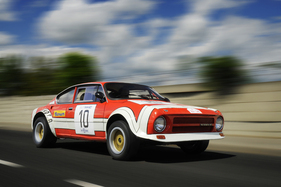
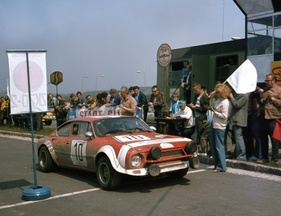
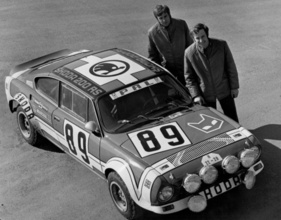
In the early 1970s, Mladá Boleslav realized that it would not be possible to achieve long-term success in the demanding rallies against the international competition with engines of up to 1,300 cc displacement - such as in the Škoda 120 S Rallye. Soon afterwards, the decision was made to develop a rally car with a correspondingly large displacement.
The Škoda 110 R Coupe with the Š 720 aluminum engine served as the basis for the implementation of this ambitious project. This had a modern OHC valve control system and was created in the second half of the 1960s for the prototype of the same name. The designers also made use of the experience gained from building the Škoda 120 S Rallye:
The technology of these two vehicles was to be combined in a new model. The first prototypes were ready to drive as early as 1971 and used the bodies of the Š 1000 MB and the Š 100 L. The five-speed gearbox from the Tatra 603-2 racing cars of the time was used for testing purposes. Jaroslav Bobek and Bořvoj Kořínek drove these prototypes on race tracks, while Oldřich Horsák and Jiří Motal drove them on rally tracks.
The main responsibility for the development of the body was borne by designer and driver Jiří Šedivý, who built the Š 110 R B5 for the 1973 season. The vehicle had a roof that was 7.5 centimetres lower and a lower windscreen. The roof and hood were pressed from 0.7 millimetre thick sheet aluminum, and the vehicle weighed a total of 85 kilograms less than the standard version.
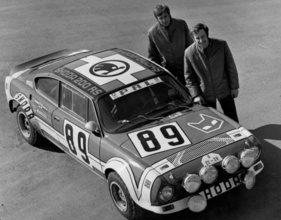
During the development phase, however, the designers faced a number of challenges with the project. For example, the engine installed in front of the rear axle proved to be a disadvantage when testing the Škoda 110 R on the racetrack. The drivers' impression that the car was prone to significant understeer was also confirmed by computer simulations of the center of gravity shift. After the final evaluation of the tests, work began in October 1973 and the first car was on the starting grid just seven months later.
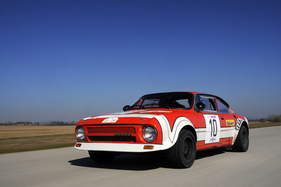
The skeleton of the Š 110 R - with the already proven lowered roof and side panels, which were shortened accordingly at the height of the sills - formed the basis of the new rally coupé. The safety cage was integrated here, which stiffened the structure, increased torsional rigidity and protected the occupants in the event of a collision. Modifications were also made to the front end of the car so that an air-tube radiator with air vents could be installed on the hood. The designers also opted for a front spoiler, which they referred to scientifically at the time as a 'buoyancy spoiler'.
The roof riveted to the body was pressed from sheet aluminum, and the hood was made of the same material. For the hood, the developers used glass fiber-reinforced plastic, which made it possible to
the rear section of the coupé with ventilation openings and to model the typical wing with a tear-off edge. The widened fenders were particularly striking: wide rally tires measuring 7-8 inches x 13 inches at the front and 7-10 inches x 13 inches at the rear on two-piece magnesium rims were fitted in the wheel arches. Girling disc brakes at the front provided the necessary deceleration, while the standard drum brakes of the Škoda 110 were used at the rear. These were also replaced by disc brakes from the British manufacturer Girling in one of the models during the course of development.
The front axle was based on the counterpart of the Škoda 120 S, the wishbones were lengthened and reinforced for a wider track, and the steering was also adapted. The rear wheels were suspended on triangular wishbones, allowing the camber and toe to be adjusted. The suspension of the Škoda rally car was provided by classic coil springs,
The custom-made telescopic shock absorbers from Koni Sport were adjustable.
The Š 720 engine made it possible to design one engine, but to keep the displacement variable, which the designers exploited accordingly. The smaller of the four-cylinder engines had a displacement of 1,772 cc, the larger 1,997 cc. This was ensured by an identical bore of 87 millimetres and a different crankshaft stroke of 74.5 and 84 millimetres respectively. The engines had dry sump lubrication and the model designation was derived from the displacement in each case: the car with the smaller engine, which achieved a maximum output of 154 hp at 6,250 rpm with a Weber 45 DCOE 2 twin carburetor, was given the designation 180 RS. The vehicle with the two-liter engine, which achieved 163 hp at 6,000 rpm, was given the name 200 RS. In the search for a suitable gearbox, the designers opted for the manually-shifted Porsche five-speed gearbox type 915.003.133 and a single-plate clutch with diaphragm spring from Fichtel & Sachs.
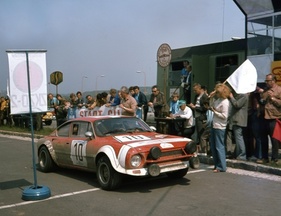
As a result, the very light rally cars weighed just over 800 kilograms and achieved top speeds of up to 240 km/h, depending on the overall gear ratio. The 200 RS had its first outing at the IDA Rally in what was then Czechoslovakia in May 1974, followed by the Barum Rally with two vehicles and the Škoda Rally in Mladá Boleslav, in which the three red and white-painted vehicles started together on June 1, 1974.
A total of two Škoda 200 RS vehicles and one Škoda 180 RS were built. At first, there was every indication that the designers had developed a top rally car that would have stood comparison with the most successful vehicles in motorsport. But things turned out differently: changes to the regulations put an abrupt end to the career of the 180 RS and 200 RS: the new regulations ruled out the homologation of rally prototypes, and vehicles based on production models were to compete instead.
Subsequently, the designers in Mladá Boleslav built the successor 130 RS. They used the Škoda 110 R as a technical basis and also drew on their knowledge and experience with the 180 RS and 200 RS. Weighing just 720 kilograms, the rear-wheel drive vehicle with a 140 hp 1.3-liter engine quickly became a successful model and left the competition behind on rally tracks as well as on the circuit until 1983.