


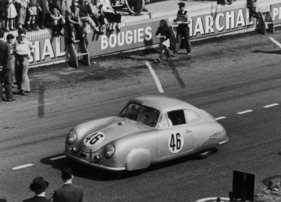


For more than six decades, Porsche has been associated with the 24 Hours of Le Mans, the largest and most traditional motorsport event in the world, with a total of 19 overall victories, countless class wins and indescribable emotions. On June 14, 1970, Porsche achieved its first overall victory there with the 580 hp 917 KH sports car. 50 years later, on the weekend of June 13 and 14, 2020, the Porsche Museum is presenting the original winning car in its exhibition.
A long road to Olympus
Ever since Porsche took part in this endurance classic for the first time in 1951 and immediately clinched a class victory with the 356 SL, this race has become indispensable for the sports car manufacturer. But it was a long road to the first major triumph. Until the late 1960s, Porsche skillfully played the role of the underdog and successfully concentrated on the smaller displacement classes. The sports car manufacturer thus initiated a change in strategy.
In 1969, in the closest Le Mans finish in history, Porsche was only 75 meters or a good second short of victory. However, much of what had been learned in the previous years was already incorporated into the preparation phase for the 1970 race: In addition to the first overall victory, Gérard Larrousse and Willy Kauhsen in the Martini Porsche 917 LH followed by Rudi Lins and Helmut Marko in the Porsche 908/02 made the triumph perfect for Porsche with second and third places.

Great confidence in the Zuffenhausen team
The first victory had a signal effect: 33 of the 49 starters relied on sports and racing cars from Stuttgart-Zuffenhausen just one year later, in 1971 - a record that still stands today. A Porsche 917 KH also won in 1971. In 1974, Porsche ushered in the turbo era at Le Mans with the launch of the 911 Carrera RSR Turbo 2.1. In 1976, Porsche achieved the first turbo victory in the history of the race with the 936 Spyder. The following year, the works team won again with the 936 Spyder. Two years later, a customer team entered the list of winners for the first time. The success with a Porsche 935 K3 marked the first victory of a rear-engined racing car at Le Mans - and of a production racing car based on the Porsche 911.

The longest winning streak in the entire history of Le Mans
From 1981 to 1987, Porsche racing cars remained unbeaten at Le Mans. The longest winning streak in the history of the 24 Hours began with the third and final success of the Porsche 936 Spyder. In 1982, the works team brought the new Porsche 956 to the finish line in the first three places at its Le Mans debut. The 956 featured Porsche's first aluminum monocoque chassis and groundbreaking aerodynamics, which enabled strong downforce without significantly increasing drag. With the 956 and its successor, the 962 C, the sports car manufacturer drove forward the development of electronic injection and ignition systems as well as the now highly popular Porsche PDK dual-clutch gearbox. From 1983, Porsche customers also started using the 956 and the 962 C. In 1983, nine Porsche 956s made it into the top ten, and in 1984 and 1985 there were eight each.

Customer teams as winners
The factory and Porsche customers achieved four overall victories in the 1990s with three types of racing car. It all started in 1994 with the Porsche 962 Dauer Le Mans GT developed in Weissach on the basis of the 962 C, followed by the TWR-Porsche WSC Spyder, with which a customer team won in 1996 and 1997 after development at Porsche. Finally, in 1998, the Porsche 911 GT1 '98 with the first carbon-fiber monocoque constructed at Porsche and carbon-fiber brakes used by the works team for the first time rolled onto the starting grid - and thus won on the 50th anniversary of the general operating license of Porsche's first sports car, the 356 "No. 1" Roadster.

Hat trick!
Following this success, Porsche dedicated itself to the development of production-based racing versions of the Porsche 911 and the support of private teams. At Le Mans, this commitment was rewarded with eleven class victories between 1999 and 2018. The works team returned to the race for overall victory in 2014. The Porsche 919 Hybrid developed in Weissach "from a blank sheet of paper" was characterized by unique technical solutions. Only the Porsche generated electricity for a high-performance battery by converting kinetic energy during braking and additionally using a turbine-generator unit in the exhaust gas flow of a V4 turbo engine. The overall system of electric motor and combustion engine delivered around 900 hp. The avant-garde solution proved to be a success: from 2015 to 2017, Porsche achieved the hat-trick at Le Mans.

With 108 class and 19 overall victories, Porsche is the most successful manufacturer in the almost 100-year history of Le Mans. In 2020, the unique tradition of Porsche sports cars competing at Le Mans every year since 1951 will continue: the newly created Porsche Esports Team will line up at the virtual 24 Hours of Le Mans on June 13/14 with four 2017 Porsche 911 RSRs. The Twitter channel @PorscheRaces will provide you with the latest information about the race. A historical review of the 1970 race can be followed on the anniversary weekend on the Twitter channel @PorscheNewsroom.
Hans Herrmann and Richard Attwood remember their race
After exactly 4,607.811 kilometers or 343 laps, Hans Herrmann and Richard Attwood crossed the finish line first in 1970 in the Porsche 917 KH under the Porsche Salzburg entry with starting number 23. "It was a really rainy race, so we felt we had to change the tires all the time and adapt them to the situation. It wasn't wear and tear that forced us to change tires, but the constantly changing weather conditions. The fact that we harmonized so well as a team of drivers ultimately led us to victory. Because competing in a 24-hour race with just two drivers is really hard work," says Hans Herrmann, looking back today.

Many competitors - including numerous Porsche cars - gradually dropped out of the race. "Le Mans is a race that either works or it doesn't. Back then, the 24 Hours was more of an endurance drive than a race," recalls Richard Attwood. "Winning Le Mans with Porsche and Hans was completely unexpected, because our car didn't have the right set-up for the speeds. Hans and I were simply a dream team."
Work continued on the car during training. Hans Herrmann: "The 917 was a very difficult racing car to start with. It drove more with us than we did with it - until we had transformed it into a winning vehicle by optimizing the aerodynamics." At home in Stuttgart, the team celebrated with a motorcade through the city centre and on the market square. "In retrospect, the victory has become much more significant. Who would have thought that Porsche would one day become the record winner of this race," said a delighted Attwood. And the Briton unknowingly had a personal challenge to overcome: "I couldn't eat anything during the race, I could only drink milk to stay fit to drive. Because what I didn't know was that I had mumps."

