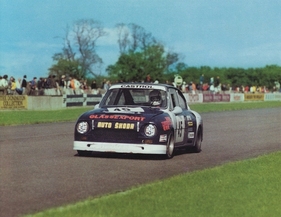
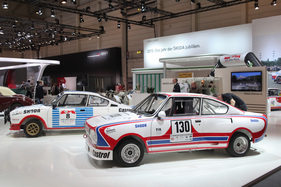
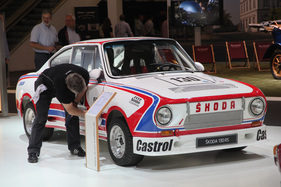
Since 1976, Group 5 and Group 2 vehicles were allowed to compete in the European Touring Car Championship. While the silhouette racing cars of Group 5, which were developed exclusively for this purpose and were therefore very expensive, disappeared from the motorsport stage after a short time, the near-series vehicles of Group 2 aroused great interest among manufacturers and fans.
Back then, hundreds of thousands of spectators followed the European Touring Car Championship on legendary race tracks such as the Nürburgring-Nordschleife, Silverstone in England and Monza in Italy. The Brno Grand Prix in what was then Czechoslovakia was one of the few events to host the international racing scene east of the 'Iron Curtain'.
The classification into the various divisions within the field of participants was based on engine capacity. For vehicles in Division 1, the maximum was 1,300 cc. In the manufacturers' classification, championship points were awarded exclusively according to the result within the respective division, regardless of the overall ranking. The European Touring Car Championship was therefore just as attractive for manufacturers of road cars with relatively small engines as it was for high-displacement vehicles.
The racing department developed the Škoda 110 R coupe with rear engine and rear-wheel drive into a thoroughbred racing car - the 130 RS. The Group 2 version was homologated for use in motorsport on May 1, 1975. When Škoda decided to take part in the 1980 European Touring Car Championship, the 130 RS had already enjoyed success in the World Rally Championship in a similar configuration, for example a double victory in its class at the 1977 Monte Carlo Rally. The Škoda 130 RS had also already celebrated numerous victories on Eastern European racetracks.
The weight limit for Division 1 vehicles was a very low 720 kilograms. The Škoda engineers therefore used light metal for the outer door skins, roof and hood as well as glass fiber reinforced plastic (GRP) for the widened fenders and hood of the 130 RS. With an engine block made of light alloy, the power unit derived from the Škoda 120 S was well prepared for use in racing: It was bored out to 1.3 liters, modified with a special cylinder head and had extra-long intake manifolds.
Two Weber twin carburetors with a diameter of 40 or 45 millimetres supplied the engine with fuel, enabling the water-cooled four-cylinder to produce between 125 and 142 hp, depending on the set-up. A dry sump lubrication system maintained the oil pressure even under demanding racing conditions. A five-speed gearbox - a four-speed version was later homologated - and a limited slip differential transferred the engine power to the racetrack. Girling brakes and Koni shock absorbers as well as Goodyear tires mounted on 13- or 15-inch alloy wheels completed the racing trim.
Over the years, the factory's own motorsport department produced 200 Škoda 130 RS cars, and many private teams also converted standard Škoda 110 R cars into 130 RS cars themselves. As a result, the model was particularly well represented on racing and rally circuits in Eastern Europe.
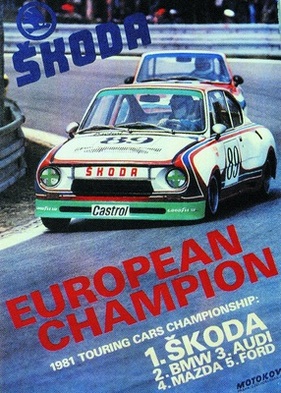
Successful right from the start in the European Touring Car Championship
When the first Škoda 130 RS competed in the European Touring Car Championship in the 1980 season, the competition in Division 1 relied primarily on models from Alfa Romeo and Fiat, with Audi later also joining in the fight for victories in the class. The Škoda 130 RS secured seven division victories in nine races in its debut year. As only the seven best results were included in the overall standings, Škoda collected the maximum 140 points - the same number as three other manufacturers. According to the regulations, the better eighth result had to be taken into account in such an ex-aequo situation, which meant that the Czech brand was classified in second place overall.
The 1981 European Championship season comprised eight races, most of which covered a distance of 500 kilometers. The factory-supported Škoda teams relied exclusively on Czech crews. In order to be prepared for possible retirements, the best drivers drove two cars in many races. Curiously, their names often appeared in several positions in the final results. For example, when Škoda started the season with victory in Division 1 at the four-hour race in Monza, Břetislav Enge and Zdeněk Vojtěch were classified both first and third. The duo were supported by third riders Václav Bervid and Jan Šenkýř and also won the division at the 500-kilometer races in Vallelunga near the Italian capital Rome, in Donington in the UK and in Enna-Pergusa in Sicily.
They also won their home race at the Brno Grand Prix and the Tourist Trophy on the legendary Silverstone circuit. Josef Michl, Oldřich Vaníček and Petr Martinovský took two more division wins at the wheel of the Škoda 130 RS, giving Škoda seven victories in the first seven races of the year. Only at the season finale, the EG Trophy in Zolder on September 27, 1981, was another team on the top step of the Division 1 podium.
In 1981, too, only the seven best results counted towards the overall standings. Škoda received a total of 140 points for seven division victories - the same number as BMW in Division 5, so once again the eighth result had to be decisive. Škoda nominated a third place from Zolder, a result that BMW could not beat. The manufacturers' title in the 1981 European Touring Car Championship therefore went to Mladá Boleslav. The European Touring Car Championship fundamentally changed its technical regulations for the 1982 season, which meant that the Škoda 130 RS was no longer eligible to compete. The brand shifted its motorsport focus back to rallying and developed its successor, the Škoda 130 LR.
Technical data of the Škoda 130 RS in Group 2:
- Engine: Four-cylinder naturally aspirated in-line engine, four-stroke, eight overhead valves, two twin carburetors with 40 mm diameter each (alternatively45 mm), water-cooled, dry sump oil lubrication, longitudinally mounted rear engine, inclined 30 degrees to the passenger side, bore x stroke: 75.5 x 72.0 mm, displacement: 1.289 ccm ; evolution version: 75.7 x 72.0 mm; 1,299 ccm, compression ratio: 10.0: 1
- Power: 125 to 142 hp at 8,500 rpm
- Gearbox: manual, 5 forward gears (from 1976: 4 forward gears), various ratios
- Body: two-door steel body; hood, outer door skins and roof made of aluminum; fenders, hood and front spoiler made of GRP; side windows and rear window made of Perspex plastic
- Suspension: front: double wishbones, coil springs, telescopic shock absorbers, stabilizer bar, rear: semi-trailing arm rear axle, coil springs, telescopic shock absorbers, stabilizer bar
- Brakes: front: discs, diameter 259 mm, brake callipers from Girling, rear: Drums, diameter 230 mm Wheels: size either 13 or 15 inches, width in the European Touring Car Championship max. 9 inches
- Dimensions: length: 4,020 mm width: 1,720, from 1976: 1,670 mm, wheelbase: 2,400 mm
- Weight: at least 720 kg in the European Touring Car Championship according to the regulations