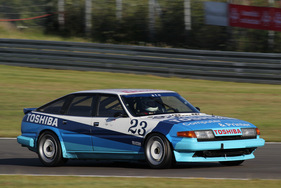
With the international TCR, a truly production-based and affordable touring car series has finally reappeared. Some of the races even take place in the prestigious environment of Formula 1 and thus form an attractive contrast to the premier class with its high-tech cars.
The TCR offers spectators a particularly varied field, in which they can find cars of different makes and types. Bilstein equips the cars from VW, SEAT, Alfa and Opel with 2-way dampers with adjustable rebound and compression damping in accordance with the regulations.
In its entirety, the touring car series is almost reminiscent of the early DTM, which emerged from the German Production Car Championship in 1986.
The winner of the debut year was a truly exotic car, which probably only very few people had on their radar, then as now. This was in stark contrast to the Bilstein gas pressure shock absorbers that were used by numerous teams and vehicles, just like in the TCR.
The underdog becomes champion
Of course, the outsider role described above does not belong to the world-famous Kurt Thiim, who won three out of nine races three decades ago and took the championship title. What is meant is his vehicle - a Rover Vitesse, the sporty top version of the crude Rover SD1.
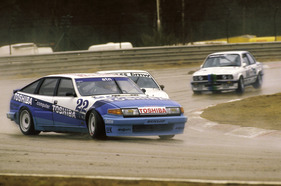
In a field that was peppered with Mercedes 190 2.3-16, BMW 325i and 635 CSi, Opel Manta GSE, Ford Sierra XR4 Ti, Volvo 240 turbo and many other cars, the Briton immediately seemed a stranger. Even when compared to other participating exotic cars such as the Ford Mustang, the Chevrolet Camaro or the Nissan Silvia.
Car of the year
This was not only due to the fact that the fast Briton was only sold in homeopathic doses on the roads in this country, but also due to its unconventional design and the simple age of the construction. The SD1 was named "Car of the Year 1977" - need we say more? Oh yes, another stumbling block was the rigid rear axle, which had long since given way to independent suspension in many competitor vehicles. Even the predecessor Rover P6 was more modern in many details. However, in conjunction with a solid damper setup including Bilstein components, the Vitesse really showed its teeth to its mostly much younger surroundings.

Prelude to the DTM
This comparison is in no way intended to devalue the ingenious SD1, which as a DTM racer ran at over 280 km/h top speed and sometimes produced more than 350 hp, but rather to show how exciting, varied and full of surprises the touring car scene was 30 years ago. The closeness to series production is also astonishing: the cockpit of the racing car even still had the precious wood paneling. And the Vitesse's victory also proves what could be achieved in those days with just a good driver and a successful chassis setup.

After all, Kurt Thiim has beaten the Brit to victory three times in one season - so a fluke is out of the question. After this grandiose highlight of his career, the SD1 could then retire with confidence: That same year, it was replaced by the more modern, but also somewhat arbitrary Rover 800.
Kurt Thiim, however, was destined for a long and successful career. But other names from the 1986 DTM season are still remembered today: Joachim Winkelhock as well as Roland Asch, Kurt König, Bernd Schneider and Kris Nissen. Only Volker Weidler, who finished second behind Thiim in his Mercedes 190E 2.3-16, has been somewhat forgotten.