


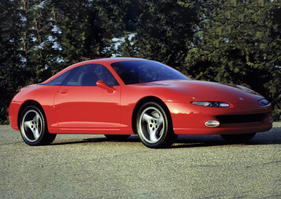


Since its founding in 1973, Toyota's CALTY Design Research Center has been at the forefront of creative automotive innovation. Thanks to the talented minds at Toyota's design studios in California and Michigan, many groundbreaking designs have emerged. Some projects are immediately put on the fast track to production, while others may remain in the archives.
Regardless of status, the ingenuity and brilliance behind the design or project should not be underestimated. It is never too late to celebrate innovation and these models are an example of unparalleled excellence.

From a future high-performance concept from the late 1980s to the Baby Lunar Cruiser, the following never-before-seen designs and projects from CALTY Design Research (Calty) are worth recognizing. After all, these designs helped pave the way for today's vehicles and also served as inspiration for future designs.

Towards the end of the 1980s, the Calty team gathered momentum. It brought out one radical design study after another, many of them taking the form of performance/sports cars.
The unique Future High Performance Concept, created in 1989 and pictured above, had an engine that came out of the body. At the push of a button, the center-mounted engine lifted out of the vehicle, providing a cooling effect while driving. Pretty sleek, right? Well, there's more. The windshield on the driver's side of the two-person vehicle could be completely closed when parked. The 1980s were all about glitz and flair, and this advanced concept was no exception.
Before the groundbreaking Prius and other electric vehicles (EVs) became commonplace on the world's roads, Calty created a pioneering EV concept so Toyota Motor Corporation could see what such a vehicle could look like.
Their design? A compact, lightweight vehicle with excellent aerodynamic properties that maximizes driving performance. The unnamed energy-efficient vehicle featured a streamlined profile and thin tires. The two-door/2+2 layout was ideal for small families and city commuting.
With the introduction of various electric cars from Toyota over the years, this car, although only an advanced design study, was one of Calty's first serious forays into the electric car genre.
After the launch of the Scion FR-S, Calty was inspired to further utilize the car's unique platform and package - namely the four-cylinder boxer engine and all-wheel drive.

The concept study created in 2012 - the X86D - essentially transformed the sleek coupé into a four-door Shooting Brake. A striking feature is the uniquely shaped rear section, which has a hot rod-like appearance when viewed from the profile and rear.
Based on the cockpit of a racing car, the cabin is centered around the driver. The low profile of the boxer engine allowed for a low hood, making the design look like a pure sports car.
Exploring future transportation trends in major cities was the inspiration for this 2012 NYC concept. The internal project featured several unique and innovative features, including a "fence seat" for the front passengers. Not familiar with this feature? You're probably not alone.

In the NYC Concept, passengers leaned against a support in a unique semi-sitting/standing position, just as they would lean against a wall or fence, so they weren't really sitting, but standing almost upright and pushing their hips against the supports.
This allowed them to be at eye level with pedestrians, which improved eye contact near busy sidewalks. In addition, the narrow rear seats could be folded down, providing ample space to transport sports equipment or a bicycle, for example.
The distinctive vertical proportions of the NYC Concept provided an extremely compact footprint with high utility - ideal for navigating busy streets.
In their search for a high-performance 4×4 for the year 2030, the Calty designers were inspired by the Lunar Cruiser. And why? Because it is designed for driving on the surface of the moon, of course. The Calty team felt that its advanced technological features were the perfect model to jump-start the futuristic off-roader.

The Baby Lunar Cruiser (BLC) is built on a conceptual EV platform with motors in the wheels powering all four airless tires. In addition, the body was designed from an engineer's perspective, so every component of the BLC is based on reason and functionality. Furthermore, the small car is controlled by "Drive Control" joysticks, which also operate the gas pedal and brakes. The rear seats offer space for two adult passengers and can be folded down to create additional cargo space.

What would an SUV of the future be without a self-driving function? Of course, the BLC offers this, but it also has an augmented reality-based "drivetainment" system whose gamification function transforms the vehicle into an interactive video game.
When the driver wants to take full control, Toyota's Mobility Teammate Concept becomes a practical co-pilot. It supports the driver and even suggests the best route to get to the destination safely and without detours. It also provides steering, accelerator and braking inputs as required.
Thanks to this innovative AI system, not only can drivers act like overland professionals, but the BLC can also handle tasks that were previously considered impossible, such as recognizing potentially dangerous terrain before it is in sight, or searching for new animal species in the area... Things that may prove useful here on Earth and beyond.
It's clear that continuous improvement is fueling Toyota's creativity, and the mobility company is ready for the future.

