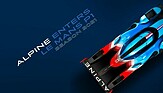


































Alpine is taking off in motorsport and will be involved in two top series in the future: The Alpine F1 Team will be on the starting line in the premier class in 2021 with two-time world champion Fernando Alonso and Esteban Ocon. In addition, the iconic brand will compete in the LMP1 class of the WEC World Endurance Championship next season under the name Alpine Endurance Team.

In the early years of Alpine, racing meant above all rallying. The name itself is reminiscent of Jean Rédélé's class victory in the 1954 Coupe des Alpes. As soon as he produced his first own vehicles, the passionate rally driver sent them onto the race track. The career of Rédélé's first car, the A106, began with a bang: winning the 750 cubic centimeter class at the 1956 Mille Miglia with Jean-Claude Galtier and Maurice Michy in the cockpit. In 1960, Jacques Féret and Jacques Rambaud won the Monte Carlo Rally with the A106 in the GT class for vehicles under 1,000 cubic centimeters.
The successor model A108 also performed excellently on the rally tracks, as demonstrated by the class victory at the Rallye des Routes du Nord in 1961, fourth place overall at the Coupe des Alpes in the same year and the class victory at the Tour de France automobile in 1962.
A110: Hot iron for rally use
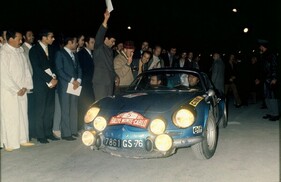
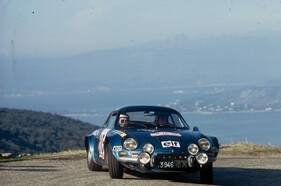
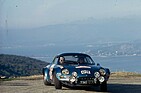
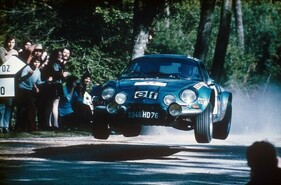
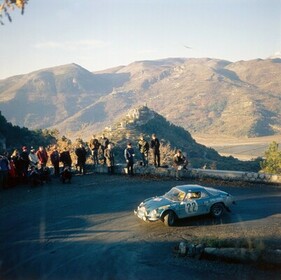
The A108 "Berlinette Tour de France" anticipated the design and important technical details of the Berlinette A110, which celebrated its premiere in 1962 and became Alpine's sporting success model par excellence. With class victories at the Rallye des Lions in Normandy, the Lyon-Charbonnières-Stuttgart Rally and the Tour de France automobile, the blue flounder celebrated a motorsport debut to perfection in 1963. Jacques Féret wins the runner-up title in the French rally championship in the GT class. The A110 demonstrated its potential the following year with a class victory at the Monte Carlo Rally and the Rallye des Routes du Nord. Here it achieved overall victory against the much stronger competitors from Ferrari, Jaguar and Aston Martin. At the end of 1964, it finished as runner-up in the overall standings of the French Rally Championship.

Ever stronger, ever more successful
The A110 became increasingly powerful in the following years. 1965 saw the launch of the A110 1300 S, which mobilized 120 hp from 1.3 liters of displacement without any turbocharging and reached speeds of 228 km/h. The Berlinette continued to cause a stir and achieve good placings on the French rally tracks. In the prestigious Critérium des Cévennes, for example, four A110s took first place in the prototype/sports car class. The toughest competitor for the team from Dieppe in these years is Renault with the R 8 Gordini. At the 1965 Corsica Rally, which the A110 finished in second place, the top five in the final classification were equipped with Renault engines.

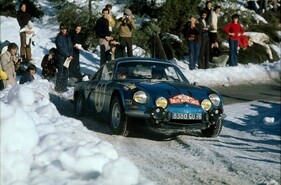
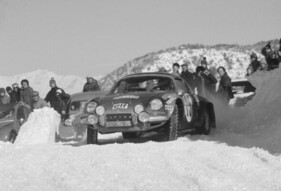
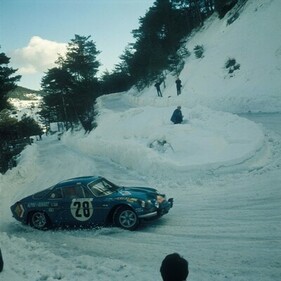
The following years are also characterized by numerous rally successes. In 1966, the A110 and driver Jean-Pierre Hanrioud took second place in the French rally championship, and from 1967 Gérard Larousse took the wheel for the team from Dieppe and quickly became the team's number one. Right at the start of the 1968 season, he narrowly missed out on overall victory at the Monte Carlo Rally. Thoughtless spectators shovel fresh snow onto the track directly behind a bend to create even more excitement. The result: Larousse, clearly in the lead, loses control and goes off the track. A failure, but also a foretaste of the A110's future rally successes.
Permanent subscription to the national rally championship
At national level, Alpine finally reached its goal in 1968: the second man in the team, Jean-Claude Andruet, won the French Rally Championship. The A110 would not relinquish this title until 1975. 1968 was also a special year for Alpine in another respect: Renault placed its entire motorsport activities in the hands of Rédélé's company. The focus is on rallying. Renault sets up an exceptional service. Even authorized workshops now support the works drivers. Alpine is present at the 1969 Tour de Corse with a total of 16 A110s. The 1969 season developed into an exciting duel between Alpine driver Jean Vinatier and Gérard Larousse, who had switched to Porsche. In the end, the French championship went to Dieppe. Jean Rédélé's team also achieved two important victories in the European one-make championship with the Coupe des Alpes and the Munich-Vienna-Budapest Rally.
With the A110 1600 S to the international top
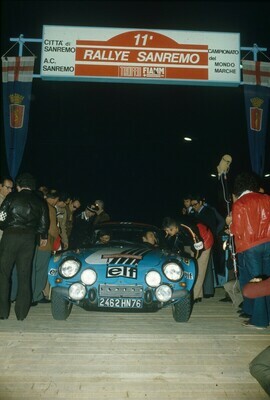
In 1969, Alpine once again turned the power screw and presented the A110 1600 S. Its 1.6-liter engine from the Renault 16 TS delivers 138 hp and accelerates up to 225 km/h, depending on the gear ratio. With the new power unit, the Berlinette proved to be extremely competitive. In 1970, Jean-Claude Andruet won the European Rally Championship with the A110 1600 S, the highest-ranking class in rallying at the time. With the San Remo Rally and the Acropolis Rally, the works team also won two prestigious rounds of the international one-make championship. Alpine has finally arrived at the top of the world in rally sport.

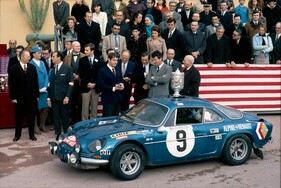
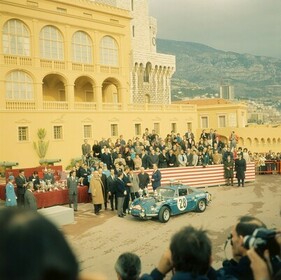
1971 is the big year for the French sports car brand: the A110 1600 S wins the international one-make championship with four victories by Swedish driver Ove Andersson. One of the highlights of the season was the triple victory at the Monte Carlo Rally. In addition to Andersson and his co-driver David Stone, Jean-Luc Thérier/Marcel Callewaert and Jean-Claude Andruet/Michel Vial completed the hat-trick.
Successful turbo premiere in the A110
In 1972, Alpine was unable to repeat the previous year's result despite various good placings, but the French team made history this year: Jean-Luc Thérier and Marcel Callewaert achieved the first victory for a turbocharged vehicle in European motorsport at the "Critérium des Cévennes". Alpine equips an A110 1600 S with a single turbocharger, which increases the power of the four-cylinder engine to 240 hp. To be on the safe side, the boost pressure is reduced for racing, so that "only" 200 hp is available. The late and brutal turbo boost nevertheless makes for a hot dance.

Triumphant march to the world championship title
After a rather disappointing previous year, the A110 experienced a real triumph on the rally tracks in 1973. For the first time, the FIA announced a World Rally Championship. Alpine took part in eight of the 13 races and won six of them. Alpine thus confidently takes the world championship title. The triple victory at the Monte Carlo Rally by Jean-Claude Andruet/Michèle Espinosi-Petit, Ove Andersson/Jean Todt and Jean-Pierre Nicolas/Michel Vial is outstanding. The "Musketeers", as the international press soon dubbed the Alpine drivers, landed another triple triumph at the Tour de Corse. Corsica is good terrain for the A110 anyway. Here, the flounder from Dieppe secured first place in 1968, 1970, 1972 and 1973. The A110 also became a real serial winner at the Lyon-Charbonnières Rally (1968, 1969, 1970, 1971, 1972), the Coupe des Alpes (1968, 1969, 1971), the Acropolis Rally (1970, 1971, 1973) and the San Remo Rally (1970, 1971, 1973).

Le Mans adventure
After winning the World Rally Championship and being taken over by Renault in 1973, Alpine set itself a new goal: victory in the 24 Hours of Le Mans. The Circuit de la Sarthe was no longer an unknown track for the sports car manufacturer. It had already competed here in the 1960s with the A110 and its own sports prototypes. Back then, however, it was only about class victories. The young brand still lacked the resources and engines required for overall victory.

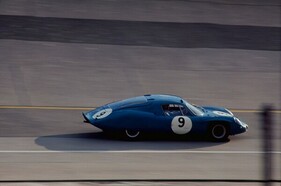
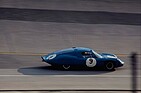
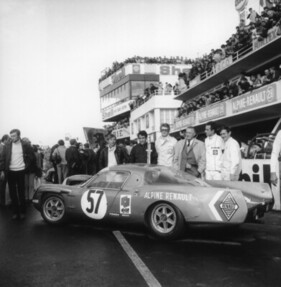
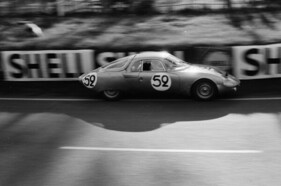
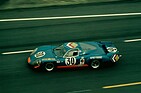
Alpine enters Le Mans for the first time in 1963 with three newly developed M63 prototypes. The M in the name stands for Le Mans, the 63 for the year. The vehicle in the 1,000 cubic centimeter class was originally commissioned by Lotus chief designer Len Terry. As the design did not comply with the Le Mans regulations, which had since been amended, it was thoroughly modified by Alpine and given its characteristic design with the long hatchback. The bodywork, optimized in the wind tunnel, is made of plastic, as is usual at Alpine. Underneath is a central tubular frame in the style of Alpine production vehicles. It is powered by a 996 cc engine developed by Amédée Gordini, which is derived from the power unit of the Renault 8 Gordini and produces 95 hp. The top speed on the long Hunaudières straight is 232 km/h.
The opening race at Le Mans ended tragically for the team from Dieppe: Alpine driver Bino Heins, race director of Willys Overland, where Alpine had the A108 built under license, skidded on an oil-slicked track and was killed in an accident. The other two M63s retire.
Class victory with the M64
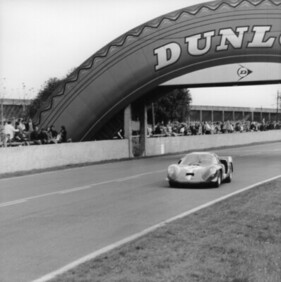
In 1964, Alpine ventures a new attempt at Le Mans. Despite its similarity to the previous year's prototype, the M64 was a completely new development. The chassis is now a particularly rigid tubular frame that weighs just 40 kilograms. The plastic skin of the racer is aerodynamically optimized and there is a choice of two engines: a 1,001 cubic centimetre and a 1,149 cubic centimetre unit, both again derived from the R 8 and tuned by Gordini. A top speed of 240 km/h is possible thanks to the car's outstanding wind slip.

Alpine starts with three M64s and one M63. In the end, the M64 of Roger de Lageneste and Henry Morrough finished 17th overall and thus won the class for prototypes 1,001 to 1,149 cubic centimeters. The duo also won the power-consumption formula classification for Alpine. Their M64 required 13.16 liters per 100 kilometers at an average speed of 163.176 km/h.
M65: One car, four engines
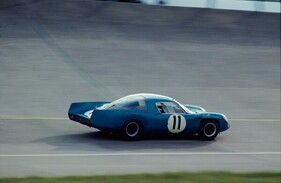
For the 1965 season, Alpine developed the M64 into the M65. The most striking features are two huge rear fins, which ensure better straight-line stability. In addition, the tubular frame and chassis were modified and the vehicle was fitted with new Gordini engines, which were no longer based on Renault standard units. Their special feature is the modular design. This allows Amédée Gordini to realize displacements of 998, 1,005, 1,296 and, in a later version, 1,470 cubic centimetres on a common basis. The 1.3-liter version is used exclusively in the M65. It mobilizes 135 hp and allows a top speed of 250 km/h.

Alpine is competing in Le Mans with a total of six vehicles: two M65 1300s, two M64 1150s, an M63 with M64 chassis and a Berlinette A110 with M64 bodywork. But despite the large contingent, the team came away empty-handed this time. However, class victories at the Twelve Hours of Reims and the 500-kilometer race at the Nürburgring ensured a conciliatory end to the season and demonstrated the potential of the M65 1300.
1966: Back on the road to success with the A210
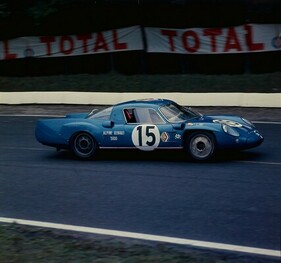
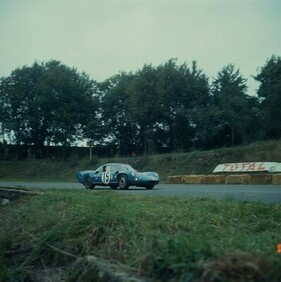
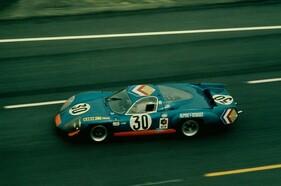
Alpine presented the A210, the successor to the M65, in 1966. The new sports prototype would remain in use until 1968 in many different engine variants. The most important changes compared to its predecessor concerned the suspension. There were hardly any modifications to the chassis and aerodynamics. For Alpine and the A210, the 1966 24 Hours of Le Mans became a triumph. Of the six A210s that started, four reached the finish line. Henri Grandsire and Leo Cella achieved an outstanding ninth place overall and a victory in the class for prototypes from 1,151 to 1,300 cubic centimeters. The other Alpine teams finished the race in 11th, 12th and 13th place, with A210 drivers Jacques Cheinisse and Roger de Lageneste taking first place in the power consumption classification. At an average speed of 171.852 km/h, their Alpine consumed just 14.79 liters of fuel per 100 kilometers. Their Alpine colleagues Mauro Bianchi/Jean Vinatier and Guy Verrier/Robert Bouharde came second and third in the index ranking.
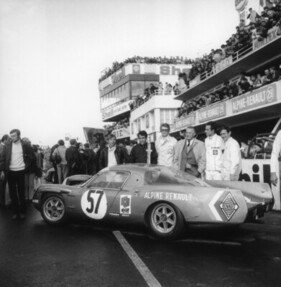
In addition to the 1.3-liter version, Alpine 1967 also launched the A210 with the large 1.5-liter engine from Gordini's modular kit. Depending on whether it was fitted with a carburetor or fuel injection, the four-cylinder engine provided 156 or 160 hp and accelerated the prototype to over 270 km/h. Jean Rédélé registers a total of eight vehicles for Le Mans. Four of them reach the finish line after 24 hours. The best Alpine driver was once again Henri Grandsire, who repeated his ninth place from the previous year together with José Rosinski in the Type 1300. With places 10, 12 and 13, the other A210 crews also almost repeated their 1966 result, although the team from Dieppe was not able to celebrate a victory in one of the index rankings this time.
A211 and A220: with V8 power for the first time
Alpine's success in the small displacement classes made Alpine and Renault hungry for more: overall victory at Le Mans. To this end, Gordini is commissioned to develop a 3-liter V8 engine that is suitable for both series production and prototype racing. The eight-cylinder engine of the legendary engine wizard had four overhead camshafts, a cylinder angle of 90 degrees and an output of around 300 hp, rising to 350 hp in later versions with fuel injection. It is understandable that the new engine requires modifications to the A210. The proven racer becomes the A211.

With the powerful 3-liter engine, it can reach over 315 km/h, but Rédélé and his team quickly realize that the car, originally designed for four-cylinder engines, is still too small for the new power unit. They therefore quickly developed the A220 with a specially adapted chassis and running gear as well as further modified aerodynamics. Compared to the A210 and A211, the new A220 is significantly longer, wider and lower. Two large air intakes in the rear flanks characterize the side view, huge headlight covers the front section.
1968: With a record line-up to Le Mans
To Alpine's great advantage, the student riots of 1968 forced the 24 Hours of Le Mans to be postponed to September, so that the A220s were ready just in time for the major motorsport event. After a third place for an A211 at the 1,000 kilometers of Monza, the Alpine Equipe drove to the Sarthe full of confidence about the potential of the new 3-liter engine. Rédélé has eleven vehicles starting there: four A220s, five A210s and two A110s. Jean Vinatier and André de Cortanze in the A220 achieved a passable eighth place, but the other 3-liter Alpines fell victim to teething problems and retired. Nevertheless, the tried-and-tested A210s finished in 9th, 10th, 11th and 14th place and won the index ratings for efficiency and the ratio of engine power to distance covered.

1969: Farewell to the long distance
The 1968 24 Hours of Le Mans showed that the gap to the competition from Germany, America and Italy was large. In addition, Alpine and Renault were faced with a national competitor on the racetrack in Matra, which was able to secure generous state subsidies for its motorsport projects. Renault, Alpine and Gordini were left empty-handed in the allocation process. Rédélé and his team therefore scaled back their hopes of a Le Mans victory and were confirmed by reality. Alpine traveled to the legendary 24-hour race at the Sarthe in 1969 with four A210s and four A220s. Seven of the eight starters dropped out, with only one A210 with a 1-liter engine finishing in twelfth place and winning its class. The consequence: Alpine patron Rédélé bids farewell to prototype racing. This was made all the easier by the fact that the A110 was just making a big splash on the European rally stage and it was worth investing his resources here.
1973: Successful return to prototype racing
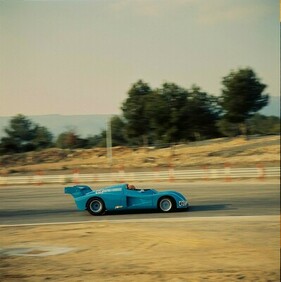
While the A110 was still dominating the rally scene in the early 1970s, Alpine and its new owner Renault were setting the course for a return to Le Mans. The sports car manufacturer in Dieppe and the large automobile manufacturer decided to re-enter endurance racing via the 2-liter European Sports Car Championship. In 1972, Gordini developed a 2-liter V6 engine with a 90-degree cylinder angle and around 300 hp and Alpine developed a new, open sports prototype, the A440. The package delivered good results in its debut season in 1973, but still struggled with reliability problems.

This changed the following year with the new A441. It is almost two centimetres narrower than its predecessor, has a modified frame, the engine moves even closer to the middle of the vehicle, directly into the driver's back and the oil cooler into the front. Alain Cudini wins the very first race of the 1974 season in Le Castellet, the start of an unparalleled run of success that culminates in seven consecutive victories in the second half of the year. Gérard Larousse, Jean-Pierre Jabouille and Alain Serpaggi, who also won the drivers' championship, joined Cudini on the list of winners.
Back to Le Mans with turbo power
The success of the A441 ensured that Renault gave the green light to equip the 2-liter engine with a turbocharger and to start one class higher in the one-make world championship and at Le Mans in 1975. The corresponding vehicle, named A442, is already in the starting blocks. Thanks to its turbo power, it produced 490 hp, more than any Alpine or Renault vehicle before it. However, the Automobile Club de l'Ouest, which organizes the 24 Hours of Le Mans, is putting a spanner in the works for the Renault Alpine Equipe and other teams by formulating regulations that contradict the rules of the FIA's motorsport department. This leaves the teams with the choice of competing either at Le Mans or in the one-make world championship.

Renault and Alpine opt for the latter and celebrate a victory right at the season opener, the 1,000-kilometer race in Mugello, Italy. Drivers Larousse and Jabouille were still driving an interim model called the A441T, which still largely corresponded to the Type 441 but already contained essential elements of the A442.
A rocky road to success
The success at Mugello is to be the last triumph of a Renault Alpine vehicle on the long distance for three years. Although the A442 subsequently achieved many podium finishes, it had to contend with strong competition and a good deal of bad luck. For example, A442 drivers Patrick Depailler and Jean-Pierre Jabouille catapulted themselves off the track at the Nürburgring in 1976. In Imola, the Alpine drivers in promising positions had to repeatedly leave the track to avoid collisions with slower, inexperienced drivers. The excursion to Le Mans, where the new race director Larousse only allows one A442 to start with Jean-Pierre Jabouille and Patrick Tambay at the wheel, also ends prematurely with a technical defect.

In 1977, the Renault Alpine Team concentrated fully on the 24 Hours of Le Mans. The appearance at the Circuit del a Sarthe is planned down to the last detail, nothing is left to chance. A total of four A442s are on the grid: three works cars and one car from a private team. With Jean-Pierre Jabouille/Derek Bell, Patrick Depailler/Jacques Laffite and Patrick Tambay/Jean-Pierre Jaussaud, the team sends three well-prepared driver teams into the race. However, a series of faults once again put paid to the Renault Alpine crew's dreams of victory. Particularly bitter: Jabouille/Bell were in the lead when they were the last works drivers to suffer an engine failure on lap 289. A Mirage racer was the only vehicle with the Renault Turbo to take second place in the final classification, proving the potential of the engine.
More stability with extensive tests
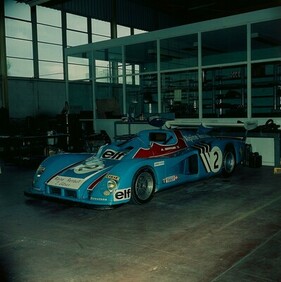
Another defeat at Le Mans is a bitter setback for Renault Alpine. This made the team all the more determined to prepare for the next attempt in 1978. In November 1977, the team carried out extra high-speed tests on a racetrack in the United States to prevent renewed piston damage on the Hunaudières, where the A442s raced along at top speeds of over 350 km/h for around 50 seconds. The findings lead to the modification of the existing engines and the construction of a completely new single engine, which, with a displacement of 2,140 cubic centimeters, is just within the limits of the regulations. The power unit will form the basis for the A443, which has also been newly developed and is actually intended to win the laurels at Le Mans. An aerodynamically shaped, transparent wind deflector, which also serves as a roof, is also intended to help with this.
Finally at the finish line: the Le Mans victory in 1978
In addition to the A443 driven by Jean-Pierre Jabouille and Patrick Depailler, Renault Alpine sent two A442s into the race. They will be driven by Didier Pironi/Jean-Pierre Jaussaud and Derek Bell/Jean-Pierre Jarier. They will be joined by A442 number three, run by the private Calberson team, with the trio Guy Fréquelin/Jean Ragnotti/José Dohlem at the wheel.

The race turned into a real thriller, with the Renault Alpines in first, second, third and fifth place at times, but then Bell/Jarier and Jabouille/Depailler, who were regarded as the team's internal favorites, had to retire one after the other. Didier Pironi and Jean-Pierre Jaussaud then took the lead and could no longer be caught. After 24 hours, they secured Renault and Alpine the long-awaited triumph at Le Mans. The two Frenchmen bring their A442 to the finish line with a five-lap lead. The Calberson team drove their A442 to fourth place.
Also successful in formula racing
Alpine patron Rédélé has the ambition to be present in as many racing series as possible. That is why he entered Formula 3 and Formula 2 in parallel with the Le Mans project in 1964. He also relied on proven Renault technology for the monoposti right from the start. The engines were "armed" by Gordini or the company Le Moteur Moderne and produced 80 hp (Formula 3) and 105 hp (Formula 2). While Alpine only allows works drivers to compete in Formula 2, Formula 3 is also open to private teams.

Alpine driver Henri Grandsire wins the title in the French Formula 3 championship in his debut season. In Formula 2, whose driver line-up is peppered with former Formula 1 world champions, works driver José Rosinski finishes a respectable 13th. The start gives hope, but in the coming years Alpine will have a difficult time against the superiority of the British teams and the Ford Cosworth engine. In Formula 3 in particular, however, the cars from Dieppe with young talents such as Patrick Depailler, Jean-Pierre Jabouille and François Cevert repeatedly achieved respectable successes. In 1971, the time had come: Depailler secured the French Formula 3 championship with the A360. Michel Leclère repeated this success in 1972.
From Formule France to Formula Renault
Formula 2 was not under a good star. In 1968, Alpine withdrew from it and instead turned to a new junior series below Formula 3: the Formule France. The Renault 8 Gordini engine served as the standard power unit for this entry-level series in monoposto racing. Alpine competed in the Formule France against a number of other French racing car manufacturers such as Elina, Grac and Martini. In 1971, the series was renamed Formula Renault and the Alpine drivers became works drivers. This marked the beginning of a success story in the promotion of young Grand Prix drivers that continues to this day. Numerous Formula 1 world champions such as Alain Prost, Sebastian Vettel, Fernando Alonso, Lewis Hamilton and Kimi Räikkönen will gain racing experience in Formula Renault.
A350: The dream of Formula 1
Formula 1 itself is also a topic at Alpine. In 1968, the sports car manufacturer even built its own Formula 1 car with a 3-liter V8 engine from Gordini and the internal coding A350. Works driver Mauro Bianchi undertakes test drives on the race track in Zandvoort, the Netherlands, under the strictest secrecy. A special feature of the car is the wheel suspension designed in collaboration with specialists from Michelin. It ensures that the wheels always remain in a constant vertical position in relation to the road surface. Bianchi therefore also attests to the monoposto's excellent handling. However, the engine from Alpine's Le Mans racers, which is optimized for reliability in endurance racing, lacks power. This was also recognized by Renault, who shied away from building a racing engine specially designed for Formula 1 and entering the premier class, and therefore put a stop to the project.
Turbo debut in Formula 1 with the help of Alpine
Renault's attitude towards entering Formula 1 would change fundamentally by the mid-1970s. In 1976, Renault bundled its motorsport activities in the Renault Sport department based at the Gordini engine center in Viry-Châtillon. Shortly after the sports department was founded, the decision was made to expand its motorsport activities to include Formula 1, not least because no constructor in the top league of motorsport had dared to use this technology before and Renault was able to demonstrate its technical expertise in this way. The company already had the right engine for this: the 2-liter V6, which caused a sensation in the Renault Alpine sports prototypes.
As the displacement for turbocharged engines in Formula 1 is limited by the regulations to 1.5 liters, the Renault Sport engineers reduce the volume accordingly. A single turbocharger is used to ventilate the combustion chambers, as in the Le Mans racers. All that is missing now is a test vehicle for the engine, and Alpine is building one. Under the factory designation A500, Jean-Pierre Jabouille tested the car on various French racetracks, in Spain and South Africa in 1976 and 1977. The focus was not only on the engine, but also on the chassis. As a direct descendant of the A500, the Renault RS01 was created, which was the first turbo car to compete in Formula 1 at the British Grand Prix in July 1977.
2021: Return to the premier class and endurance racing
More than 40 years later, Alpine is re-forming itself in two motorsport classes from 2021, underlining its ambitions as a sports car brand of the Renault Group: the Renault Formula 1 works team will start next season as the Alpine F1 Team in the colors of the French tricolor: the new Formula 1 car will be painted red, white and blue. Two-time F1 world champion Fernando Alonso from Spain and Frenchman Esteban Ocon will take the wheel.

Alpine will also be racing in the LMP1 class of the World Endurance Championship (WEC) next season under the name Alpine Endurance Team. In recent years, Signatech-Alpine has been successful in the LMP2 category and has won the LMP2 classification at the 24 Hours of Le Mans three times.
For the new commitment, Alpine will field an Alpine LMP1 prototype based on an Oreca chassis and a Gibson engine. The Alpine Endurance Team will present the LMP1 prototype and the driver line-up at the beginning of its test program in the coming months.
Patrick Marinoff, Alpine Managing Director says: "Motorsport is inextricably linked to the Alpine brand. After eight successful years in LMP2, it's time for the next step. The recent changes to the regulations for 2021 will allow the brand to showcase its technical expertise and racing experience in a competitive and fair environment next season. Through various cost control measures, we can ensure this with a manageable investment. Together with our partner Signatech, we want to write a new chapter in Alpine's history and compete with the French colors at the highest level of motorsport."