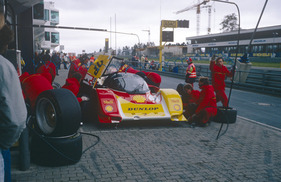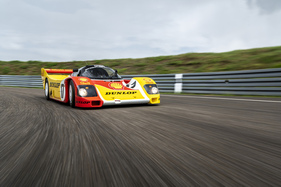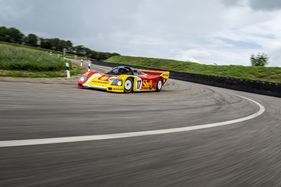
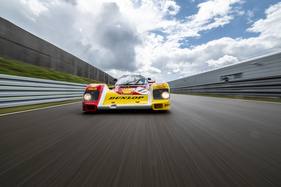
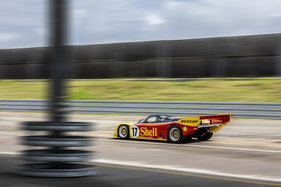
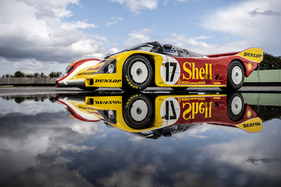
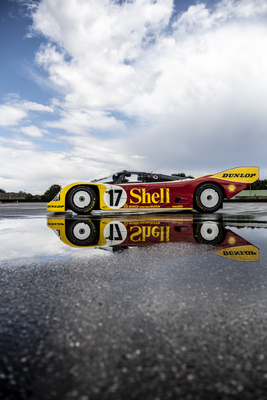
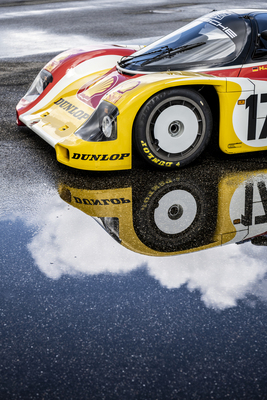
Hans-Joachim Stuck had to wait almost 35 years for the reunion and the first rollout with the 962 C. The surprise is all the greater when the silk cloth at the Weissach Development Center reveals the vehicle. The racing car from the Porsche Heritage and Museum department has been restored to its original 1987 condition over the past year and a half.
"It feels like coming home," enthuses Stuck, stroking the left fender. He has nothing but fond memories of the victorious racing car with the starting number 17. "We surprised Hans-Joachim Stuck with this reunion after more than three decades and at the same time took a little trip back in time. The history of the motorsport chapter surrounding the 962 C is unique," says Achim Stejskal, Head of Porsche Heritage and Museum.
At the Weissach Development Center, where the vehicle was once built and later restored to its original condition, Hans-Joachim Stuck also meets his former racing engineer Norbert Singer and designer Rob Powell, who is responsible for the livery design of the 962 C in black, yellow and red.
35 years ago, the now 70-year-old won the championship title in the prestigious and fiercely contested German "ADAC Würth Supercup". During the inaugural series for Group C sports car prototypes, he tested the then new Porsche PDK dual-clutch transmission at racing speed. The appearance of the vehicle changed for the second race, the 200 miles of Nuremberg at the Norisring, with the addition of sponsor Shell. The following year, Porsche also competed in yellow and red and Stuck did everything in his power to successfully defend his Supercup title.
The 962 C then began its second life as a test vehicle in the aerodynamics department in Weissach, later serving as a reference vehicle for the sports car manufacturer's corporate collection.
Armin Burger and Traugott Brecht from Historic Motorsport were jointly responsible for the restoration of the 962 C. "We kept walking past this vehicle in the warehouse. About a year and a half ago, we then decided to get it out of there, transfer it to Weissach and start the work," recalls Burger. He and his team had to rebuild many of the parts, as they were no longer available. "The cooperation with the other Porsche trades was great. We found almost everything we needed within a radius of just 30 meters," he explains.
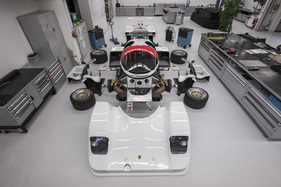
Right at the start of the restoration work, he invited Rob Powell and Norbert Singer to the historic motorsport workshop. "When you hear the right people talking about the vehicle, everything is immediately clear. We learned an incredible amount from our two contemporary witnesses," summarizes Burger. The experts completely rebuilt the underbody, changed the arrangement of the radiators and made many other body adjustments. They then presented the Supercup championship car to the European trade press as part of a journalists' workshop at the Weissach Development Center.
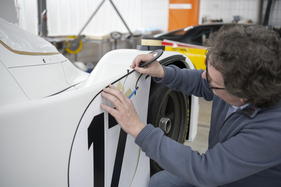
Rob Powell, livery designer of the 962 C, did not arrive 35 years later without various thicknesses of adhesive tape, stencils and design sketches from back then. "Strietzel Stuck immediately liked the design on my first sketch," he recalls. Hans-Joachim Stuck gives him an affirmative nod over the roof of the vehicle while the designer tapes over the lines and applies a stencil to the headlights: "This is very important in order to plan the cut-out correctly for the painters, for example. Incidentally, I still think the color combination of yellow and red is modern," says Powell, putting the rolls of tape over his arm.
Meanwhile, Hans-Joachim Stuck is ready for the first laps on the run-in and test track. "I'm a big fan of the Porsche PDK dual-clutch transmission and proud that I was able to test it in the 962 back then. Being able to keep my hands on the steering wheel when changing gear under full load felt really good right from the start," he sums up. Today, the PDK is available in every Porsche.
The second surprise for the Garmisch-Partenkirchen native awaits just a few meters from the proving ground: Hans-Joachim Stuck discovers his red racing suit from the eighties and is delighted that he still fits into it. "For me, the time with Porsche was the most successful of my entire career," he says, puts on his helmet with the white stars and climbs in.
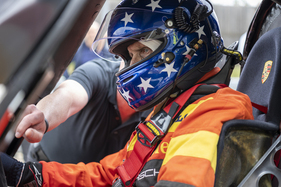
In contrast to the base model, the 962 C has a wheelbase extended by 120 millimeters and pedals mounted behind the forward-mounted front axle. "We gave Stucki a very warm welcome at Porsche. He was always one of the drivers whose feedback I could interpret exactly, like the feedback from a sensor," reports Singer, who introduced an aluminum monocoque for the first time with the 956 Group C cars and the successor 962 based on it, as well as the underbody with ground effect.
Stuck starts his first lap on the two and a half kilometer long test track in Weissach. All the spectators fall silent and look after the Group C car. "The car automatically takes me on a journey through time and brings back many fond memories. I'll never forget the atmosphere at the racetracks," says Singer and smiles.
The 962 C made its first public appearance a few weeks ago at the museum's digital sound night. In the coming year, it will be appearing in front of the public more often: to mark the upcoming "40 years of Group C" anniversary, the racing car will be taking part in a number of driving and presentation events. "The 962 C was one of the few cars that I was allowed to drive on my own, without teammates and with exactly the setup I wanted. You never forget a car like that," summarizes Stuck and promises: "We'll celebrate the fortieth in 2022!"