A few days before the opening of the Grand Basel motor show, the show's organizers are offering a foretaste of the automotive masterpieces that will soon be on display to the general public.
Among the 100 automobiles presented in Basel are racing and film legends, unusual one-offs, culturally significant classics and, for the first time, a hand-made contemporary special body.
The "Grand Basel" has already caused quite a stir in the run-up to the event. This makes it all the more exciting to see who the exhibitors will be who will be renting a standard stand space for a vehicle for an alleged CHF 25,000. And it will be just as exciting to see how many visitors (from CHF 45.00) will come to see the hundred or so cars on the public days (September 6 to 9) in Basel.
However, classic and modern cars that have already been announced certainly give a promising foretaste of the show:
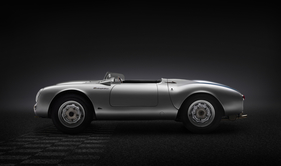
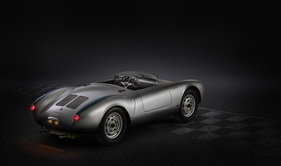
Porsche 550 1500 RS Spyder 1956
The Porsche 550, first presented at the Paris Mondial de l'Automobile in 1953, was a fantastically beautiful road racing car with clear, elegant lines and a highly efficient four-cam boxer engine with a displacement of 1500 cm3, developed by Austrian Dr. Ernst Fuhrmann. The mid-engined roadster proved to be extremely successful in competition, often outperforming much more powerful or more proven rivals. The car weighs just 550 kilograms and is so low that Hans Hermann managed to whizz under a barrier in it at the 1954 Mille Miglia - seconds before an express train raced through the level crossing.
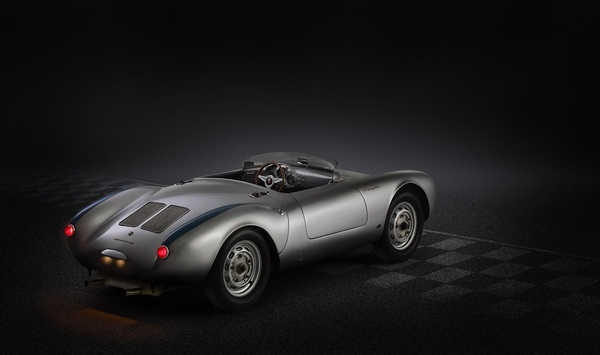
More than any racing success, however, the association with film star James Dean, who suffered a fatal accident in his "Little Bastard" on the way to a road race in California, made the 550 famous. This Porsche 550 1500 Spyder is considered an important piece of automotive history. It won its class at the 1956 German Grand Prix at the Nürburgring.
Cisitalia 202 SC 1947
Founded by the industrialist and amateur racing driver Piero Dusio, the car brand Cisitalia took its name from Dusio's company Consorzio Industriale Sportivo Italia. After his ideas for an agile, lightweight vehicle proved to be correct in the first Italian post-war race, Dusio presented his Model 202 sports car with a custom-made aluminum body by Pininfarina at the Villa d'Este in 1947 and a month later at the Paris Mondial de l'Automobile. The car was a masterpiece both aesthetically and technically - a design achievement that would completely transform the shape and style of post-war automobiles and influence the contouring of countless car bodies.
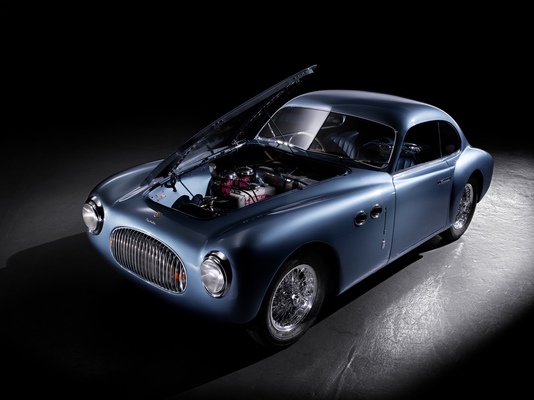
Nowadays, specialist articles in this context speak of the "creation story of modern automotive design", and this is no exaggeration. One example can be seen at the Museum of Modern Art (MoMa) in New York, where it is exhibited as a "moving sculpture" and one of the ten best automobile designs of all time. The vehicle on show at Grand Basel was in "barn condition" when it was discovered and was restored to exhibition standard. It was later featured on the cover of "The Classic Cars Book" published by teNeues in 2014.
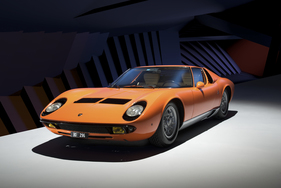
Lamborghini Miura 1968
On March 10, 1966, Lamborghini ushered in a new era in sports car history with the unveiling of the Miura. With its pioneering, timeless Italian design, the Miura is still the epitome of dolce vita and the swinging sixties today.
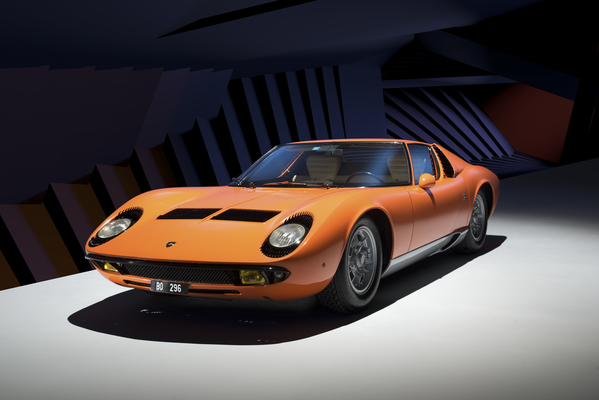
It was no coincidence that the Lamborghini Miura became the star of the legendary opening sequence of the film "The Italian Job" and was even given an identically painted "body double" to give the impression that it had been destroyed. During filming in June 1968, the film crew borrowed the Miura for the driving scenes. When the film was released in 1969, it radically changed Lamborghini's image. Thanks to its screen career, this very special Miura became one of the most famous cars of all time and a legend in film and cultural history.
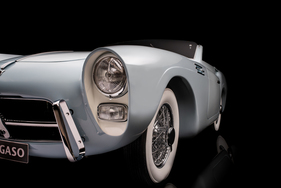
Pegaso Z-102 Series II Cabriolet Saoutchik 1954 U
ounded as a manufacturer of trucks and buses, the Spanish brand Pegaso made its first foray into the world of sports cars in 1951 with two prototypes of a new model - the Z-102. The vehicle had a V8 engine custom-built by Wilfredo Ricart, the former chief engineer at Alfa Romeo, and could be ordered with either the bodywork of the ENESA in-house team, the Milan-based Carrozzeria Touring or the French coachbuilder Saoutchik. In 1953, it was considered the fastest production car in the world and is still referred to as "Spain's supercar" today. The Pegaso Z-102, for whose individualized equipment no expense was spared, proved to be extremely expensive to produce. For this reason, not even 90 vehicles were built.
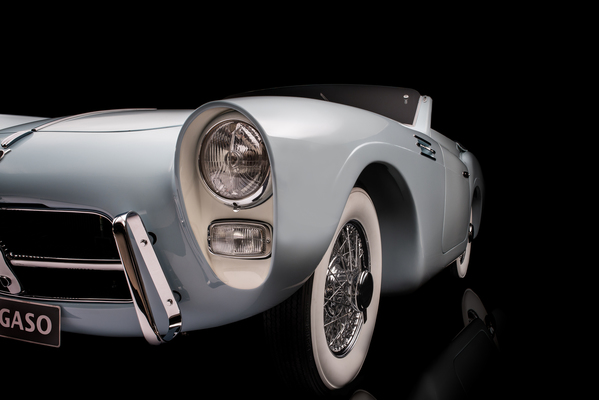
The Pegaso Z-102 Series II Cabriolet 1954 on display at the exhibition is a one-off model equipped by the French company Saoutchik, which had made a name for itself with its high quality and extravagant design. The car was first presented by Pierre Saoutchik at the 1954 San Remo Concorso d'Eleganza and in the same year at the Paris Mondial de l'Automobile. This unique design is an exceptional phenomenon in European automotive history.
Ferrari SP38 2018
The first car attributed to Ferrari's Special Projects department - the F430-based SP1 - was unveiled in 2008. Under the new banner of this special model program and ten years after the presentation of the first of these one-offs, Ferrari unveiled the incredible SP38 at this year's Concorso d'Eleganza Villa d'Este in Italy. Although the SP38 is based on the chassis of the 488 GTB, it has a dramatically different body. Some features such as the louvers on the hood and the integrated rear fenders are inspired by Ferrari's legendary F40 supercar. More aerodynamic side panels, narrower headlights and tightly enclosed rear lights are among the SP38's signature features, as are the bespoke alloy wheels and wide, distinctive rear diffuser. The SP38 is a unique contemporary automobile that preserves the tradition of classic coachbuilding.
Aston Martin DB4 GT Zagato 1961
The Aston Martin DB4 GT Zagato ultimately owes its existence to the bitter competition between Aston Martin and Ferrari in the early 1960s. Year after year, the two brands fought doggedly for every victory in the World Sports Car Championship - with a direct impact on success in the showroom. When Ferrari introduced the first variations of the 250 GT SWB Berlinetta, Aston Martin realized that its DB4 GT model needed to be more powerful. A partnership with Zagato was expected to result not only in a beautifully designed vehicle, but above all a more race-ready one. The result, a harmonious blend of Italian and British styling elements, was presented at the 1960 London Motor Show. Aston Martin and Zagato had not only completely redesigned the exterior, but also freed the vehicle from all unnecessary ballast. As a result, the Zagato model was almost 50 kilograms lighter than the regular DB4 GT.
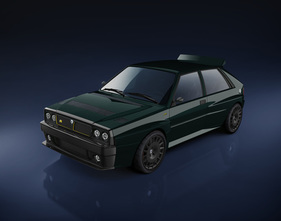
Automobili Amos Integrale Speciale 2018
The small engineering company Automobili Amos, founded by racing driver Eugenio Amos, has breathed new life into the legendary Lancia Delta Integrale. The Integrale Speciale takes up the familiar design of the Italian-built rally legend, but also features over 1000 new components - including a wider body made of hand-finished aluminum panels and a tailor-made front apron made of carbon fiber. Modern technology has been cleverly used to enhance the powertrain, chassis and suspension without compromising the character and flair of the original. According to Amos, it takes around four months to build such a vehicle. The appearance of the Integrale Speciale at Grand Basel marks the world premiere of a remarkable new automobile.
Benetton-Ford B194 1994
The legendary Michael Schumacher is regarded as one of the greatest Formula 1 drivers of all time. To this day, he has the most world championship titles (7) and also holds the records for the most Grand Prix victories (91) and the most fastest laps (77). The car that secured him his first world championship was the 3.5-liter V8 Benetton Ford B194, with which he won 8 of 16 races in the 1994 season.
Schumacher was supposedly the only one who could "tame" the Benetton. His team-mates in the 1994 season felt overwhelmed by the unpredictability of the car at the limit. As a tribute to his father's success, Schumacher's son Mick completed a few demo laps in a Benetton-Ford B194 at the 2017 Belgian Grand Prix.
Ferrari 250 GT SWB Berlinetta 1960
First presented at the Paris Mondial de l'Automobile in October 1959, the 250 GT Berlinetta on a short wheelbase - the "passo corto" - was Ferrari's vision of the archetypal road-legal racing car. The body designs were drawn by Pininfarina and realized by Scaglietti in Modena as aluminium or steel versions. The 250 GT SWB Berlinetta was the first Ferrari production car to be fitted with disc brakes as standard. The 3.0-liter V12 Colombo engine could be ordered in different versions, depending on whether the vehicle was intended for use on the road or on the race track. This particular 250 GT SWB - chassis 2111GT - is a very special exhibit, as it was driven by Enzo Ferrari himself from February to September 1961. The car became the prototype for the new body shape of 1961 and numerous photos from the same year show Enzo behind the wheel of the car.
Curation and exhibition in a unique format
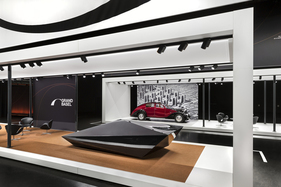
From September 2018, Grand Basel will be spotlighting exceptional automobiles in the context of art, design, architecture and lifestyle on a world tour. An independent panel of experts, consisting of authorities in the fields of culture and design, architects and artists, will curate the exhibits to ensure their uniqueness and authenticity. Thanks to Grand Basel's bold exhibition concept, exceptional automobiles are presented in an exceptional setting. Inspired by contemporary architecture, the homogeneous design dispenses with the often nostalgic ambience of conventional car shows and presents the vehicles in a setting reminiscent of modern museums.
The opening exhibition of Grand Basel will take place from September 6 to 9, 2018 in Basel, Switzerland. Further exhibitions will follow from February 22 to 24, 2019 in Miami Beach and in May 2019 in Hong Kong.
Further information can of course be found on the Grand Basel website.