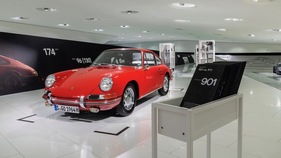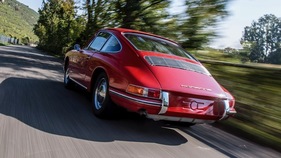
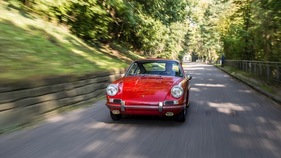
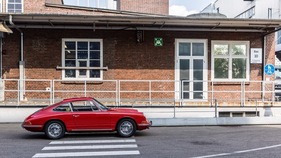
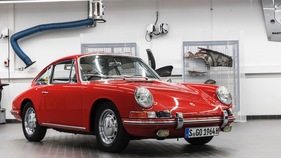
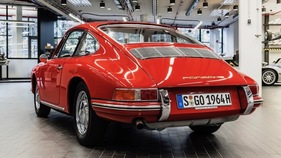
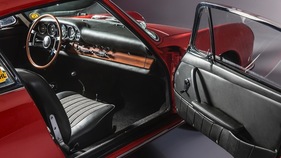
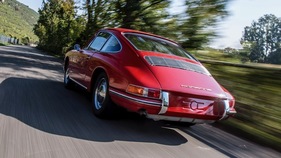
After three years of restoration, the Porsche Museum is now showing one of its youngest and oldest 911s in the collection in the special exhibition "911 (901 No. 57) - A Legend Takes Off" from December 14, 2017 to April 8, 2018. The red coupé was built in October 1964 as one of the first production models of the sports car under the type designation 901. Almost exactly 50 years later, the Porsche Museum bought back the accidentally found rarity and restored it to its original condition.
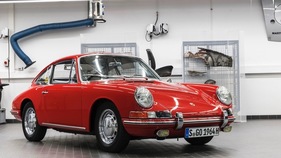
Porsche originally developed and presented the successor to the 356 under the type designation 901. Only a few weeks after the start of production, however, the coupé had to be renamed in the fall of 1964 due to a trademark objection and was henceforth called the 911. All customer vehicles produced up to that point had been built under the designation 901 but sold as the 911. One of these rarities was missing from the Porsche factory collection for 50 years.
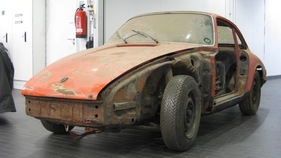
2014: TV team encounters barn find with historical significance
In 2014, the TV team from the documentary soap "Der Trödeltrupp - Das Geld liegt im Keller" came across two 911s from the 1960s in a barn while recycling a long-abandoned collection. On enquiring at the Porsche Museum, it turned out that one of the two sports cars with chassis number 300.057 was one of the rare examples built before the renaming. The Porsche Museum purchased both 911s at the estimated price of independent experts, thus closing an important gap in the brand's collection of important classics.
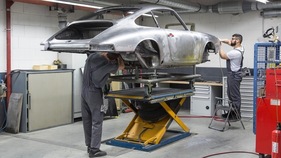
Preservation before replacement: time-consuming restoration with authentic parts
The unrestored condition of the early 911 was a decisive factor in the purchase, giving the museum's specialists the opportunity to rebuild the sports car as authentically and faithfully as possible. It took three years to restore the heavily rust-ridden sports car to its original condition using contemporary original panels from a donor body. The engine, gearbox, electrics and interior were repaired according to the same principle. In principle, the preservation of parts and fragments took precedence over replacement. This elaborate restoration method, which the Porsche Museum always follows, is the reason for the long duration of the revival of this historically significant sports car classic.
Further information can be found on the museum's website.