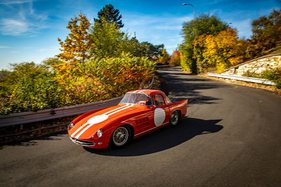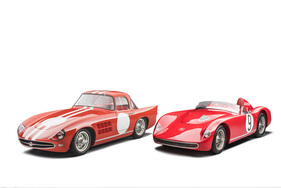
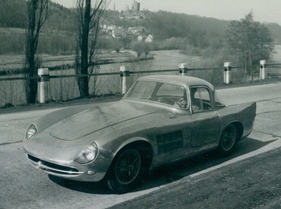
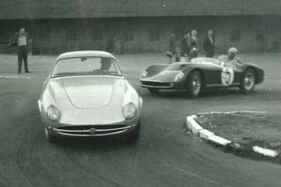
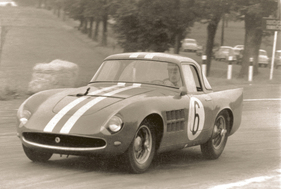
Planning for the Škoda 1100 OHC with the internal type designation 968, which was primarily intended to compete in endurance circuit races, began as early as spring 1956. The first of two examples with an open GRP body was completed at the end of 1957. The vehicle is still one of the highlights of the Škoda Museum exhibition in Mladá Boleslav today. It regularly competes in national and international classic car events. The second 1100 OHC is used by the importer Škoda UK for advertising purposes, particularly in the UK.
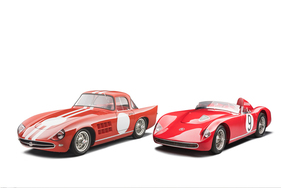
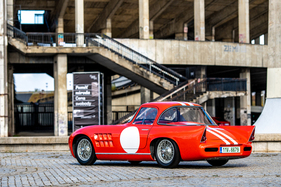
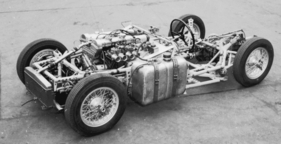
In 1959 and 1960, the designers continued work on the 968 project and developed two Škoda 1100 OHC coupés with a closed body. Proven elements of the Škoda series models were adopted. In contrast to the Škoda Sport and Supersport, which were created at the end of the 1940s, however, the basis of the vehicle was no longer the central tubular frame with forks for the installation of an OHV engine at the front. Instead, the Škoda 1100 OHC Coupé utilized the advantages of the lightweight yet rigid lattice frame, which was welded from thin-walled tubes. The front wheels were guided by a trapezoidal suspension consisting of two triangular wishbones arranged one above the other, while a coupling axle with trailing arms was used at the rear.
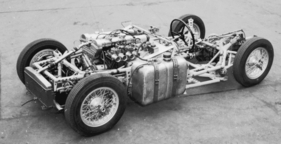
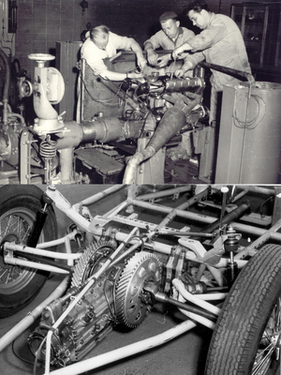
The engine was located behind the front axle and, with the assembly unit consisting of the rear axle differential and five-speed gearbox, enabled an almost ideal weight distribution. The handling of the dynamic racing car was impressive; the Škoda 1100 OHC Coupé was powered by an in-line four-cylinder naturally aspirated engine. The cylinder and crankcase were made of aluminum and came from the Škoda 440 'Spartak', as did the crankshaft. However, thanks to optimized combustion chambers and OHC valve drive, a compression ratio of 9.3:1, two carburettors, double Bosch dynamo-battery ignition, Scintilla Vertex magnetos and many other modifications, the racing car significantly exceeded the engine's output of 40 hp (29.4 kW) at 4,200 rpm. The power output was 92 hp (67.7 kW) at 7,700 rpm.
The liter output was 85 hp per liter of displacement. For a short time, the 1100 OHC Coupé reached up to 8,500 rpm. Depending on the overall gear ratio, which could be adapted to the character of the racetrack, the two-seater with aluminum body and an unladen weight of just 555 kilograms reached a top speed of around 200 km/h. Dual-circuit brakes ensured effective deceleration at all times, while the rear drum brakes were located on the differential gear to reduce the unsprung masses.
The racing career of the two Škoda 1100 OHC Coupé vehicles lasted from 1960 to 1962, when changes to the technical regulations meant the end for the category under 1,100 cc. When the vehicles were therefore no longer allowed to start, they were sold to private buyers in 1966. Both coupés were completely destroyed in road accidents. The owner of the first vehicle, whose surviving components were now used in the reconstruction, replaced the engine of his 1100 OHC with a standard four-cylinder engine with OHV valve control from a Felicia.
The vehicle's original engine was on display at the vocational school in Mladá Boleslsv for a long time before it was rebuilt and used in the 1100 OHC Coupé. The second coupe burnt out after an accident. The driver was able to free himself from the vehicle, but the aluminum body was irreparably damaged. The technically unique rear axle with integrated gearbox was removed and initially passed into the collection of the National Technical Museum in Prague before being handed over to the Škoda Museum 25 years ago. The Škoda Museum acquired the three-part tubular frame with complete front axle and other preserved parts from a private collector in 2014.
Rebirth of a special racing car
The ambitious restoration project would not have been possible without the experts at the Škoda Museum and their experience with the open-top Škoda 1100 OHC. The original technical documentation was also of great importance. It has been preserved almost completely in the Škoda car archive - including an explanation of all production cuts and an explanatory drawing for the installation of individual assemblies. The original mechanical components were hardly worn, as the car had only taken part in a few races. The renovation of the complete chassis with reconstructed radiator, fuel tank and other elements was completed at the end of 2015.
Originally, the chassis of the car was to be exhibited in the Škoda Museum next to the car with the open body. Instead, the decision was made to rebuild the coupé as a fully functional vehicle.
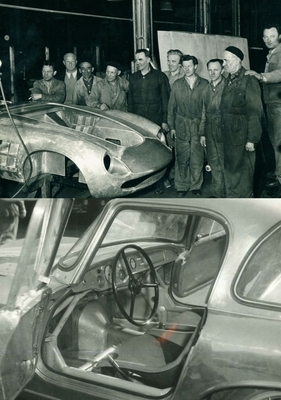
The most challenging task was the reconstruction of the aluminum body. The original design came from the former factory designer Jaroslav Kindl, according to whose documents a wooden model was carpentered at the time. Aluminum panels were first hammered out manually, then the individual parts were welded or riveted.
As part of the reconstruction work, the Škoda Museum's restoration workshop worked closely with colleagues from Škoda Auto's prototype construction center. Based on scans of the 2D drawings on a scale of 1:1, a three-dimensional mesh was created, which was then optically reworked. A great deal of effort was put into checking and correcting the shapes of individual elements, for example at the front of the vehicle and in the area of the rear lights.
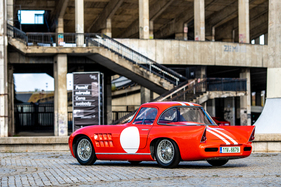
Historical photographs were compared with the drawn documentation and the 3D model. In the virtual studio, the experts were able to view the car from all sides and make corrections. In addition to scaled-down models, 1:1 scale models of the front and rear body components were also created. After the corresponding expert assessment, necessary adjustments and final approval, the Škoda AUTO designers worked on the partition walls, wheel arches and other body elements.
For the bodywork, 0.8 and 1 millimeter thick aluminium sheets were used, which were manually processed and welded as part of the reconstruction. Due to the anodized body surface, the two coupés were initially painted blue. However, this surface treatment did not prove itself in racing, so from the middle of the 1962 season both vehicles were painted red.
For the elaborate reconstruction, numerous components had to be procured that were identical to the parts from the production vehicles of the time. For example, the outer door handles of the coupé were roughly the same as those of the Škoda 1200 'Sedan'. Some switches and the ignition lock were also used in the Škoda 440 'Spartak' and the Octavia, and the three-spoke steering wheel covered in black plastic refers to the pre-war bestseller, the Škoda Popular.