


Concours d'Elegance as the presentation form of the future
As can generally be observed, the value of classic automobiles continues to rise. As a result, the owners of these precious cars are expecting less of their vehicles than before. At classic car rallies, the number of younger cars and youngtimers is increasing, while very old vehicles built before 1945 are no longer driven as often and are increasingly traveling in trailers. This is why show events in the style of the Concours d'Elegances are gaining in importance, as the vehicles are presented there in a well-kept environment so that they can be admired from all sides.
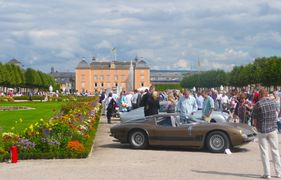
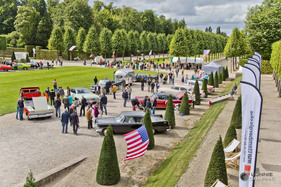
When the AvD Classic Gala Schwetzingen took place for the first time in 2001, it was the only Concours d'Elegance of this international kind in Germany. In the meantime, a whole host of similar events have been added, but most of them cannot compete with the Baden model in terms of venue alone. As assumed at the time, Schwetzingen is now synonymous with the only vehicle presentation in the world where the vehicles are arranged according to year of manufacture and theme in a French axle garden.

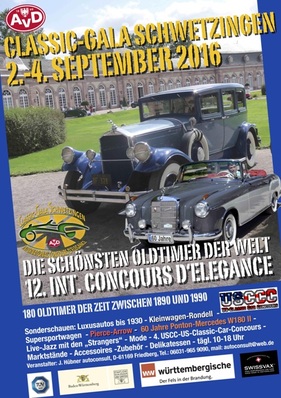
The table is set again for the 12th International Concours d'Elegance AvD Classic Gala 2016.
From September 2 to 4, 2016, more than 150 classic cars from all over Europe will once again meet in the unique palace gardens of Schwetzingen to face the vote of the 25-member jury of experts for the trophies in the regulations of the FIVA (Federation Internationale des Vehicules Anciens). For the public, Classic-Gala Schwetzingen presents itself as an open-air museum of automotive history, garnished with accessories, fashion, automobilia, accessories and literature, plus live jazz with the Strangers and the Austrian jazz pianist Burle Baumgartner in front of the art exhibition in the south wing of the palace.
Unique pieces of automotive history
It is astonishing that time and again cars turn up that were previously parked in private garages and sometimes even forgotten or have never made it to a public exhibition. Classic-Gala Schwetzingen presents a few of these rarities.
A royal Rolls Royce for a Swiss merchant

In the 1970s, the Rolls Royce Phantom VI was a 6.10 meter representative car for potentates. And yet there was a Swiss businessman who wanted the Alps to travel with him in his car. His order for the wickedly expensive chassis of the Phantom VI came in very handy for Rolls Royce, as the luxury brand was experiencing economic difficulties. It was bodied at Frua in Italy and the client insisted that the large radiator grille could not be reduced in size. The huge lime green convertible was the star of the 1973 motor shows and was driven more than 400,000 kilometers by its enthusiastic owner in the following years before disappearing for years in the garage of collectors and now being shown to the public for the first time again.
Formula 1 in a tailor-made suit
Formula racing cars with a streamlined body were only permitted for the 1955 season. Mercedes used the W 196 streamliner with Fangio and Lang, Maserati built a 250 F Aerodinamica that was on display in Schwetzingen in 2014 and the small British forge Connaught transformed its B-Type into the Streamliner - this car is a star of the AvD Classic Gala 2016.
A silverfish from the post-war era
Just two years after the end of the war, people wanted to see motor racing again and provisional race tracks such as the Grenzlandring near Aachen, the Schleizer and Dieburger Dreieck or the Dresden Autobahnspinne were built everywhere. But there were no cars! Ernst Loof used the remaining BMW 328s to build the Veritas, the Munich racing driver and designer Alex von Falkenhausen built the AFM 50-5 in 1949, which with its unpainted aluminum skin was successfully driven by racing driver Karl-Günther Bechem as late as 1953 before it fell into oblivion - now it adorns the garden in Schwetzingen.
Only one worldwide and yet 1, 2, 3 - mine
The Internet is sometimes a source of unexpected treasures. A Berlin collector was looking for an open Ford A from 1930 and happened to see a beautiful dark red convertible from the same period. It was called Rockne, completely unknown. He found information on the Internet that it was a special Studebaker model named after the then famous football coach Rockne. The car had been delivered in parts to Norway in 1930 and built there. The Berliner bought it and only found out later that he owned the last roadworthy Rockne and that this car was still completely unrestored. Another star of AvD-Classic-Gala Schwetzingen 2016.
The small car concours turns into the Micro Olympics
Following the public's great enthusiasm for the small car parade, the theme will be continued in 2016, because just as Schwetzingen was the world's first concours with a class H for unrestored originals back in 2001, the competition for small cars was invented here. In homage to the Olympics, it is now called the "Micro Olympics".

One highlight will certainly be the display of small cars from the aircraft manufacturer Messerschmitt. The Messerschmitt 175cc cabin, a Messerschmitt convertible and a roadster, the four-wheeled Messerschmitt Tiger and the world record-breaking racing car that set long-standing standards in neighboring Hockenheim in 1955 will be on display.
More than 30 small cars from the economic miracle era will gather under the southern arcades at the Hirschbrunnen and form a charming contrast to the fat road cruisers of the US Classic Car Concours, which is dedicated exclusively to original American cars. The small cars include the rare Kroboth as well as the Maico 500 or the Mopetta of the former racing driver Egon Brütsch, whose engine is almost as small as the single-cylinder 125cc ILO of the Kleinschnittger from Arnsberg in the Sauerland region, whose rims made of boiling pot lids hang on an axle suspended with rubber bands.
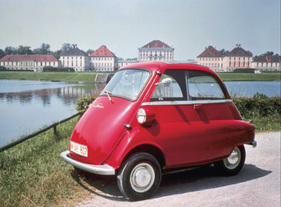
In addition to the legendary Isetta and many others, the Gutbrod brand will also be represented for the first time with the four-seater saloon, the rare convertible and the Atlas mini truck. Schwetzingen is the first Concours d'Elegance to offer a large forum for the smallest cars - the heroes of the economic miracle era will not leave a dry eye in the house.
Two ancient Mercedes
Two particularly old Mercedes come from the Auto- und Technikmuseum in Sinsheim: the Simplex built in 1906 with a 5.3-liter four-cylinder engine and chain drive, which reached 80 km/h with its two-seater racing body, although it only had around 35 hp. The Mercedes 630 Kompressor built in 1928 is reminiscent of the then new Nürburgring - a car fan had a unique convertible built on the chassis of the Mercedes racing car by the British company Park Ward. The 6.3-liter six-cylinder engine had 100 hp, with a supercharger even 140 - enough for 150 km/h in a world without freeways.
The Mercedes with the pontoon body turns 60

Cars with free-standing fenders and running boards were only slowly abandoned from around 1953 onwards. The new smooth-surfaced line was called the pontoon shape and after the new Mercedes saloon of 1955, a two-door version of the Type 220 appeared in 1956, which became the epitome of the economic miracle as a cabriolet and coupé. Mercedes itself had not expected so much interest, as a 220 S Cabriolet cost two years' salary for a factory manager, and so the sporty offshoots of the saloon were still mainly built by hand. At least 20 of the dream cars known as the W 180/2 meet in Schwetzingen for their birthday celebrations under the aegis of the Mercedes Benz IG.
100 years of BMW is a classic gala theme
Even though the time of the big centenary anniversaries is almost over, there are still anniversaries every year that raise the popular question "Do you remember" for ever different groups of visitors.

This time, it is BMW's centenary, which welcomes visitors with a juxtaposition of past and present in the courtyard of honor, as well as the legendary BMW 328 sports car in the park and, of course, other highlights such as the "bar car".The park also features other highlights such as the "Baroque Angel", which represents the 100th anniversary of the BMW automobile, motorcycle and aircraft engine factories based in Eisenach, Spandau and Munich and is presented in collaboration with the BMW branch in Mannheim and the BMW Krauth Group.
The Dampfkessel-Prüfverein even turns 150
After devastating steam boiler explosions in the early days, an association was formed in 1866 to test and inspect these technical devices - what began long before the invention of the automobile is now the best-known expert organization for automobiles. However, the "I have to go to the TÜV" has now become cooperation with competent experts who, with their decades of experience, also advise owners of classic vehicles in particular who are concerned with restoration and re-registration. On the occasion of its 150th anniversary, it makes sense for TÜV Süd and its experts to be involved in the Concours d'Elegance Classic-Gala Schwetzingen, where important reference objects from 130 years of automotive history are awarded valuable trophies, as well as providing advice to visitors and guests.
Rarities from all over the world and all eras
The appearance of one of the oldest French automobiles, the DeDietrich from 1896, which had its cradle in Alsace, is impressive. The enchanting Cadillac Imperial, built in the USA in 1930, comes from South Africa. The super sports cars are called Bizzarrini A3C, represented by the team car of the famous Scuderia Serenissima from Venice.

While the Americans opted for the powerful 10-cylinder engine of the Dodge Viper, South Africa tried its hand with the EB Tazio, which was to win over impatiently waiting Bugatti customers in 2001.
In Germany, two designers used the large engine of the Mercedes 600 to power their gullwing sports cars: Mladen Mitrovic created the Kodiak near Stuttgart in 1984 and in neighboring Leonberg, Porsche designer Eberhard Schulz created the Isdera Imperator, which doubled the output of the basic engine to 500 hp. It will be on display together with the other Isdera sports cars.
International jurors as experts
A Concours d'Elegance is only as good as its judges, because only the judgment of experts carries international weight. Under the direction of pre-war car specialist Ing. Robert Schramm, the judges include long-time Rosso Bianco museum owner Peter Kaus, long-time Mazda chief designer Peter Birdwhistle, Porsche designer Gabo Herczeg, FIA classic car expert Klaus-Peter Bender, Dutch VW designer OonaThe FIVA experts will be joined by Dutch VW designer Oona Scheepers and Swiss classic car expert and long-standing head of the Swiss National Automobile Commission, Mark Rufer, to discuss which vehicle in which FIVA class is particularly true to the original.
The designer Eberhard Schulz will be exchanging ideas with the well-known photographer and historian Werner Eisele before one of the 90 trophies is awarded to a winner on Sunday, September 6, 2015 at the Defilée of Candidates.
All this awaits visitors for the entrance fee of just 6 euros for the state palaces and gardens in Württemberg - AvD-Classic-Gala Schwetzingen deliberately wants to invite friends of architecture and garden art, culture and all families and fans of classic cars to enjoy this unique show of automotive history.
Further information can be found on the event website.