


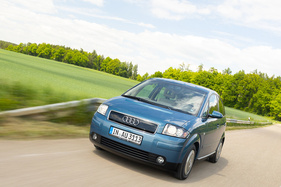

It came onto the market 25 years ago - and polarized: the Audi A2. With its innovative aluminum body, the compact car is light, aerodynamic and economical. Five engine variants are available; the A2 1.2 TDI causes a stir as the world's first four-door three-liter car and, since 2003, the special model "color.storm" with its special paint colors attracts attention. However, as sales fell short of expectations, Audi ended production in 2005 after around five years and 176,377 units built. The innovative Audi A2 was able to demonstrate its qualities in a "second career": As a youngtimer with a stable value, the A2 has a loyal fan base and is still present on the roads today as a daily driver.
The 3-liter car
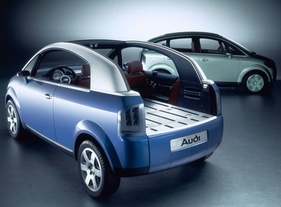
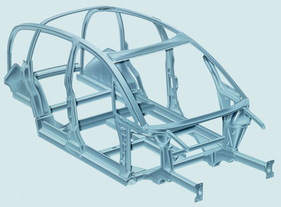
As early as the beginning of the 1990s, the three-liter car was announced as a development goal in the Volkswagen Group and at Audi, and the first work on the project began shortly afterwards. The designers in Ingolstadt work closely with the experts at the aluminum center in Neckarsulm. In May 1995, they present a concept study called "Ringo", whose Audi Space Frame (ASF) is less complex than the ASF of the Audi A8, which is largely produced by hand. The then head of the Audi design studio in Munich, Stefan Sielaff, took on the project and determined the interior, while the Belgian Luc Donckerwolke was responsible for the exterior design. Together with the future Head of Design Gerhard Pfefferle, they gave the "rolling cage" Ringo a two-door body that was already close to the later design. As work progressed, two studies were created: one was presented as a show car at the IAA in Frankfurt in 1997 and, in addition to the provisional model designation Al2, was nicknamed "Light Green" due to its color. Only a short time later, "Light Blue" was presented at the Tokyo Motor Show, a three-door version of the Al2 with a variable loading area and roll-up roof. Its name: Audi Al2 open end.

The public responded differently to the two studies. Some are enthusiastic about the progressive design, others don't like the designs. Twenty years later, Al2 project manager Harald Wester recalls in an interview with Dirk-Michael Conradt, author of the book "Audi A2 - Milestone and Cult Object", that the developers had fully expected their results to polarize opinion. Wester says: "Yes - that was clear to all of us right from the start! The car was supposed to be optimally wind-slippery. We slept in the wind tunnel, so to speak, in order to achieve optimum aerodynamics." In November 1997, the Board of Management approved series production. The world premiere of the Audi A2 is to take place again at the IAA - just two years later. The plan is ambitious, but the designers and engineers are able to keep to the ambitious schedule.
At the IAA in September 1999, the A2, which had been developed to production maturity, was presented to the world public - and with it the first compact car in recent automotive history with a body made entirely of aluminum. The bodyshell of the A2, including all four doors and the tailgate, weighs only around 153 kilograms, which is only around 60 percent of the bodyshell weight of a comparable saloon with a conventional sheet steel body. The 3.83 meter long, 1.67 meter wide and 1.55 meter high Audi A2, which offers its passengers plenty of interior space despite its small exterior dimensions, is produced in Neckarsulm. New production facilities are built there especially for the Audi A2 and inaugurated on November 15, 1999. On this day, Audi also unveils the A2 1.2 TDI, the world's first four-door three-liter car. A total of two petrol and three diesel engines are available for the Audi A2 during its production period. The two petrol models are powered by an in-line four-cylinder engine and are available with a five-speed manual gearbox and front-wheel drive. Combined fuel consumption is 5.9 liters per 100 kilometers. The A2 models with diesel engines have three-cylinder units with pump-nozzle direct injection. At the market launch on June 30, 2000, a petrol engine and a TDI with 75 hp each were available (see production statistics below).
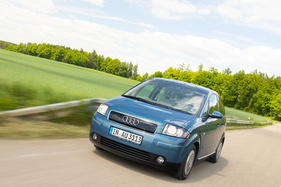
In the spotlight: The A2 1.2 TDI with a sensational drag coefficient of 0.25
The Audi A2 1.2 TDI, launched at the end of 1999, goes on sale in March 2001. It produces 61 hp and requires only 2.99 liters of diesel per 100 kilometers. Its direct-injection turbo diesel engine is made entirely of aluminum. An electro-hydraulic system takes over the clutching in the five-speed automatic gearbox. The use of additional vehicle parts made of aluminium, special forged aluminium lightweight wheels and weight-optimized rear seats make it possible to reduce the weight by 135 kilograms compared to the basic version - to an unladen weight of 855 kilograms. To further optimize the aerodynamics, the cooling air inlets in the front are partially closed, the tires are narrower and flow-optimized thanks to grooves in the flanks. Adapted wheel arch trims and rim covers as well as additional underbody cladding enable turbulence-free air flows. In this way, the engineers reduce the drag coefficient from a very good 0.28 cW on the basic model to a sensational 0.25 cW.
In 2002, Audi adds a 1.6-liter FSI engine to the A2 engine range. Its 110 hp gives the A2 a top speed of more than 200 km/h. Since March 2003, the brand with the four rings has been offering the Audi A2 as a special "color.storm" model - in the colors imola yellow, misano red pearl effect, sprint blue pearl effect and papaya orange. Color-coordinated interior fittings and matt black painted details, such as roof and wheel arch trims, create a striking contrast. The model can be combined with numerous optional extras and with four of the five engine variants - except for the 1.2 TDI engine. By July 2005, a total of 176,377 units of the Audi A2 had been built at the Neckarsulm plant. The small premium compact car therefore fails to meet the originally high expectations.

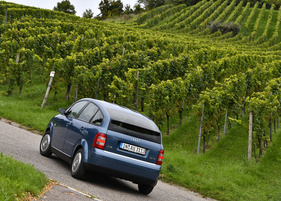
Around a quarter of a century later, however, the small space miracle still has numerous fans - many drivers value their A2 as an economical, reliable and attractive everyday companion. One of them is Felix Reber from Baden. His A2 has already covered over half a million kilometers - with the original engine. You can read a detailed report about the car on Zwischengas.
Models and deliveries of the Audi A2 at a glance
| Motorization | Production period | Number of units |
|---|---|---|
| 1.2 liter TDI 45 kW / 61 PS | 2000 - 2005 | 6.555 |
| 1.4 liter 55 kW / 75 hp | 2000 - 2005 | 81.649 |
| 1.4 liter TDI 55 kW / 75 hp | 2000 - 2005 | 69.676 |
| 1.4 liter TDI 66 kW / 90 hp | 2001 - 2005 | 7.416 |
| 1.6 liter FSI 81 kW / 110 PS | 2002 - 2005 | 11.081 |
