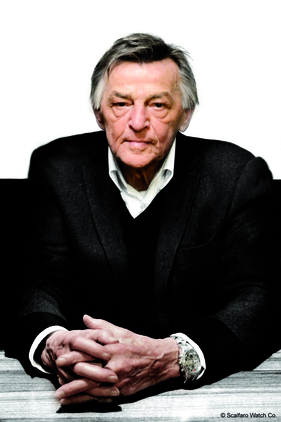
The designer Hans Mezger, long in the service of Porsche, passed away on June 10, 2020 at the age of 90. The sports car manufacturer from Stuttgart not only has him to thank for the air-cooled six-cylinder boxer engine of the Porsche 911, he was also responsible for the overall design of the 917 and its twelve-cylinder engine and is the creator of the TAG-Turbo Formula 1 engine.

For more than three decades, Hans Mezger was responsible for Porsche's most successful racing cars and racing engines. "We are deeply saddened by the news of his death. Our thoughts are with his family," says Michael Steiner, Member of the Executive Board for Research and Development at Porsche AG. "We would like to thank Hans Mezger for his extraordinary engineering achievements, what he did for motorsport in general and for Porsche in particular. His innovations for our production sports cars will remain unforgotten forever."
Not born to be a host
Hans Mezger was born on November 18, 1929 in Ottmarsheim, a small village near Ludwigsburg on the outskirts of Stuttgart. He was the youngest of five children and his parents ran a country inn. Art and culture are very important in the Mezger household. But the young Hans Mezger is also enthusiastic about airplanes and flying, and so he occasionally takes a trip to Kirchheim/Teck with a group of gliders from his neighborhood.
In the midst of his carefree childhood and youth and his attendance at grammar school, the Third Reich and the Second World War struck. And on April 18, 1945, just three weeks before the end of the war, 15-year-old Hans Mezger escaped the war only with luck and a fictitious certificate from a German commander. In the end, Hans Mezger continued to attend grammar school - up to the 6th grade in Besigheim, then the Schiller Gymnasium in Ludwigsburg until his Abitur. "In 1946, I experienced the first car race of my life. It was in Hockenheim, where old pre-war racing cars were at the start, including Hans Stuck, who I photographed with my old camera," Hans Mezger once reported on his first motorsport experience immediately after the Second World War.
Mechanical engineer out of passion
Hans Mezger decided to study mechanical engineering at the Technical University, now the University of Stuttgart. However, there was a huge rush at the universities at this time, as young men returning from the war were given preference when it came to allocating places. So Hans Mezger used the time for the twelve-month internship required by the university, which included numerous stations such as mechanical processing, welding, model making and a few weeks in the grey cast iron and aluminum foundry.
"At that time, I was riding a scooter, an NSU Lambretta. Apart from my brother's 250cc DKW, it was my first and last motorized two-wheeler. I rode the Lambretta until 1960, when I was able to buy my first car, an old and rather worn 356. It wasn't until years later that I came into contact with motorized two-wheelers again, when I had to develop new motorcycle engines for Harley-Davidson at the end of the 1970s."
Joined Porsche on October 1, 1956 in the calculation department
Graduating in 1956 was accompanied by a veritable flood of job offers at the time of the German economic miracle. "There were 28, but Porsche wasn't one of them. But I wanted to join Porsche, because I was enthusiastic about the Type 356 sports car. So I applied, was invited and was offered a job in diesel engine development. Until then, I didn't even know that there was such a thing at Porsche. However, I wanted to work on sports cars. They were understanding and so I started in the calculation department at Porsche," said Hans Mezger, describing his start at the Zuffenhausen-based sports car manufacturer. A little later, in 1958, Hans Mezger and his wife Helga married. This was accompanied by a move to their first shared apartment in Ludwigsburg. Their two children Daniela and Oliver followed shortly afterwards.
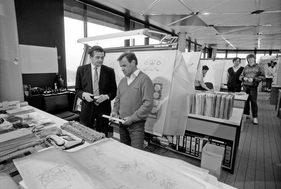
Then it's a case of blow after blow. Hans Mezger gained his first experience with the Type 547 four-camshaft engine, developed a formula for calculating cam profiles and became part of Porsche's first Formula 1 project in 1960. He was involved in the development of the 1.5-liter eight-cylinder Type 753 as well as the corresponding chassis of the 804. "This Formula 1 project taught me a lot about the design of combustion chambers. This also directly benefited the design of the six-cylinder boxer engine for the later 901/911. Over the course of time, Ferry Porsche became my role model with his visionary management, his human qualities, his dignity and his great commitment. His philosophy of racing in order to be able to build the best sports car for the road was convincing and shaped me and my work for the entire time I worked at the company," he reported from that early era at Porsche.
Design of the 911 engine and Head of "Racing Car Design"
Professionally, the world-famous "Mezger engine" for the 901 and 911 followed in the early 1960s and in 1965 he was promoted to head of the "Racing Car Design" department created by Ferdinand Piëch. It is the key to a new quality and dynamism for Porsche in motorsport. In 1965, the so-called "Ollon-Villars-Bergspyder" was created in just 24 days, followed shortly afterwards by the 910. With its design consisting of a tubular frame, fiberglass body and a layout based on the new tire technology from Formula 1, the car became the blueprint, so to speak, for all racing cars that were created in the years that followed.
From the 917 to the TAG-Turbo for Formula 1
Porsche also relied on this design principle for the development of the 917 in 1968. With the 917, the first overall victory for Porsche at Le Mans was finally possible and once again Ferdinand Piëch put his trust in Hans Mezger, who took over the overall design of the vehicle and its twelve-cylinder engine. In 1970 and 1971, the 917 dominated at Le Mans and in the World Sports Car Championship. In 1972 and 1973, the 917/10 and 917/30 also show the way on the winding tracks of the CanAm series thanks to a new type of exhaust gas turbocharging technology developed by Porsche itself.

For the first time, it was possible to give turbocharging a response behavior that allows racing cars and production vehicles to be used on all race tracks and public roads. A technology that made Porsche a pioneer in this field and which Hans Mezger and his team put on the road in 1974 in the form of the 911 Turbo. Many more victorious developments followed. For the 24 Hours of Le Mans, the World Sports Car Championship and the American Indy Series.

But probably the most outstanding project took off in 1981, when Ron Dennis and his McLaren racing team set out in search of a powerful turbo engine for Formula 1. Porsche was ultimately chosen and it was decided to design and build a completely new engine and also to provide on-site support at the races. Once again, Hans Mezger was the creative mind and creator of the 1.5-liter V6 engine with an 80-degree bank angle, which would later produce more than 1000 hp in races. Niki Lauda became world champion with it in 1984, followed by Alain Prost in 1985 and 1986. The TAG-Turbo achieved a total of 25 race victories, plus the two Constructors' World Championships in 1984 and 1985. "That was a great success and also the most important development contract from an external company for Porsche to date."
Always closely associated with Porsche
His attachment to Porsche made him turn down all offers from other manufacturers during his career and he owned a 911 Carrera 3.0 in Grand Prix white until the end - a coveted Porsche classic with "his" engine. His loyalty and connection to Porsche was unbroken. He was happy to talk to journalists, technicians and interested fans.

The Porsche Museum organized a celebration with family, friends and former companions to mark his 90th birthday. He accompanied Porsche events, trade fair appearances and festivities until the very end.
Career and highlights at Porsche
- 1956 - 1960
Technical calculation department within the design department.
Responsible for valve control of all engines, among other things. - 1960 - 1962
Joined the Porsche Formula 1 project team.
Collaboration in engine and chassis design. - 1963
Design of the 901/911 engine, responsible for the design and further development of all racing engines. - 1965
Design and project management of the Ollon-Villars Spyder.
Head of the newly founded "Racing Car Construction" department. - 1966 - 1970
Design of 910, 907, 908, 917, 2-liter four-cylinder engine for 914 production sports car. - 1971 - 1973
Can Am racing cars 917/10 and 917/30 with turbocharging. - 1974 - 1976
Design, development, further development of six-cylinder turbo engines and Type 935 and 936 racing cars. - 1977 - 1978
Development of water cooling and four-valve concept for six-cylinder turbo engines Type 935 and 936. - 1977 - 1980
Design of four-cylinder engine for Harley-Davidson. Development of the Indy engine based on type 935/936. Further development of racing cars and 935/936 engines. - 1981 - 1982
Development of 2.65-liter engine based on 935/936 for Group C (956/962). - 1981 - 1987
Design, overall project management and further development of Formula 1 engine "TAG-Turbo - made by Porsche". - 1987 - 1988
Construction of 2.65 liter engine type 2708 Indy. - 1990
Construction of twelve-cylinder Formula 1 engine Type 3512
Honors and awards
- 1974 The Starley Premium Award (UK) for the best presentation of the year in the automotive field on the Porsche Type 917.
- 1984 Behind the Scenes Award (USA) for the development of the TAG-Turbo Formula 1 engine.
- 1984 Trofeo Colin Chapman (I) for the development of the TAG-Turbo Formula 1 engine.
- 1984 Fürst Metternich Prize (D) for outstanding technical achievements in motorsport.
- 1984 Trophée de L'Exploit (F) for the development of the TAG-Turbo Formula 1 engine.
- 1984 Caschi d'Oro (I) for winning the Formula 1 Constructors' World Championship.
- 1985 Prof. Ferdinand Porsche Prize (A) from the Vienna University of Technology in recognition of his services to the development of the combustion engine. Hans Mezger is the only prizewinner from Porsche to date.
- 1987 Médaille Spéciale (F) for the development of the TAG-Turbo Formula 1 engine.