


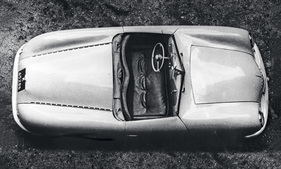
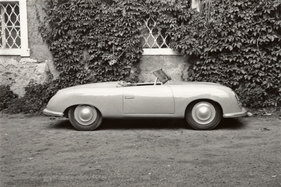
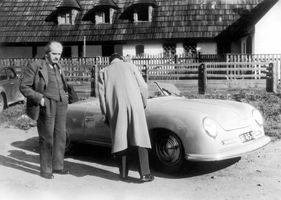
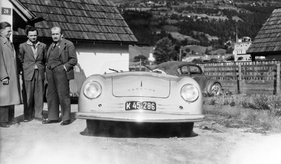
The "No. 1" has always worn tailor-made suits. It took tinsmith Friedrich Weber two months to dress the first Porsche in 1948. For a short time at least, because in the following years the roadster not only passed through many hands, the first Porsche was also battered and repaired, modernized and converted. The suit was always re-tailored, but the identity remained the same. Living history. Untouchable.
Placed next to the originals from 1948, clear differences became apparent. Originally, the body was narrower towards the rear. The front had a pronounced front end. The original one-piece rear lid, which was hinged at the rear, extended from the passenger compartment to just above the rear bumper. It was later replaced on the original vehicle: by a two-part construction with a cross panel over the engine and a shorter hood over the rear storage compartment.

The lost originality of the original can no longer be recaptured. But it can be recreated: only the bespoke suit, as true to the original as possible and thus also made with the same materials and using the same techniques. But even that turned out to be a task that could be accomplished by hand, but not in the blink of an eye. In order to create a true-to-detail and true-to-scale copy of the 1948 Roadster body, the experts from the Porsche Museum first measured the original using a 3D scanner. The computer superimposed the virtual result on the 1948 design drawings, which were also scanned in - and revealed numerous deviations. Step by step, radius by fixed point, the shape approached the original. Archive staff consulted all available original photographs, studied records and analyzed diaries. In the end, a computer-aided milling machine peeled a life-size model out of a block of hard foam.

Using true-to-original wooden molds as test tools, called gauges, the replica of the original "No. 1" body was finally created - made by hand from aluminum, just like 70 years ago. As in 1948, the sheet metal was bent, drawn and driven using hand tools. The originality extends all the way back to the paint formula: in order to match the color tone as closely as possible, layer samples were taken and analyzed under the dashboard of the original sports car, which had previously been repainted several times. Contemporary dashboards with dials exactly matching the original flank the steering column. Even the weave of the carpets corresponds to that of 70 years ago. But the replica cannot drive a single meter: There is no provision for an engine in the lattice frame, and the rear axle consists of a simple tube. The front axle, including steering and steering wheel, comes from a Volkswagen "Beetle", just like the original.

It took eight months to produce the new tailor-made suit with the classic cut - for a show car that not only has a historical significance for Porsche, but also a highly symbolic one: The brand essence of all Porsche sports cars goes back to its shape, its dynamic driving design and its lightweight construction concept. The 356 "No. 1" show car recently set off on a world tour.

The 356 "No. 1" Roadster and the show car on a world tour
As part of the "70 Years of Porsche Sports Cars" anniversary, the Porsche Museum is sending the 356 "No. 1" Roadster around the world, including to the following locations:
- June 8: Germany, Stuttgart-Zuffenhausen, Porsche Museum, ceremony
- July 12 to 15: Great Britain, Goodwood, Festival of Speed
- September 8 and 9: Canada, Vancouver, Luxury & Supercar Weekend
- September 27 to 30: USA, Laguna Seca, Porsche Rennsport Reunion
The 356 "No. 1" show car is also touring the world, for example to these locations:
- Until May 31: Germany, Berlin, DRIVE. Volkswagen Group Forum, exhibition
- June 9 and 10: South Africa, Johannesburg, Kyalami Grand Prix Circuit, Sportscar Together Day
- Mid-July to end of September: Germany, Stuttgart-Zuffenhausen, Porsche Museum, exhibition
- November 15 to 25: China, Guangzhou, Motor Show
