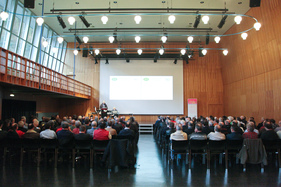
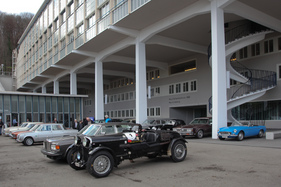
Winter took a break for a day in German-speaking Switzerland on January 10, 2015, with temperatures reaching almost 20 degrees. A fitting setting for the FSVA's technology day. And so a number of classic car enthusiasts came to Baden to find out about innovations relating to the FIVA card and the efforts of the IFGS.

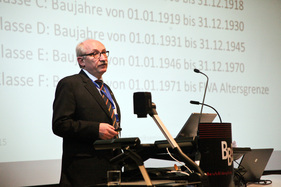
Felix Aschwanden, President of the Technical Commission, had big plans for the day. He presented and explained the revised FIVA Technical Code 2015 to the 140 or so experts from the Swiss classic car scene in attendance. The current assessment documents were followed by instructions, the administration with the supplementary documents was explained and the next steps in the introduction of the new FIVA Technical Code 2015 were determined.

Progress in the promotion of young talent
First, however, the Vice President of the FSVA, René Berset, welcomed those present. A silver lining on the horizon in his speech was the prospect of a single large Swiss classic car umbrella organization.

A highlight, then, to which he immediately added a second: "We have taken a huge step in the direction of professional classic car training. The IgFS, which was founded a few years ago on the initiative and with the financial support of the FSVA, has been so successful that an agreement was recently signed between the two professional associations Auto Gewerbe Verband Schweiz (AGVS) and VSCI (Schweizerischer Carrossierverband) with the IgFS and the IgFS patrons' association."
This means that the first training modules in the areas of mechanics/electrics and bodywork can now soon be offered. Further expansion is in progress, as is work with the Federal Office for the recognition of qualifications. So something is happening.
Innovations at the FIVA
With the new "Technical Code 2015", documents, processes and handling relating to the FIVA Identity Card are to be gently overhauled. It is important to note that the previous process based on the Technical Code 2010 will remain in force unchanged until the changes have been fully implemented. It is currently expected that the changes will take effect from the first quarter of 2016.
The reason for the changes included findings made by FIVA during the evaluation of previous FVIA cards. Not everything was always carried out correctly, there were gray areas, missing bases and inconsistencies between the individual countries. Improvements are now to be introduced here, but without increasing the complexity more than necessary.
For example, the future FIVA Identity Card, which will continue to be issued in folded A5 format with a photo, will no longer include a classification (e.g. A/2 or D/3) in all countries. However, Switzerland intends to continue to list the classification.
In general, more focus will be placed on comprehensive documentation and history.
With the new Technical Code 2015, the FIVA wants to clearly distance itself from individual, non-historical creations (e.g. street rods, specials, etc.), from "tribute cars", and from "specials".), "tribute cars" (conversions of normal standard models into well-known or rare (racing) vehicles), modernizations (conversion to disc brakes, installation of new engines or modern drivetrains) and replicas with the wrong year of manufacture (backdated recreations).
Furthermore, the FIVA defines a historic vehicle as one that must be mechanically driven, at least 30 years old, preserved and maintained in a historically correct condition, not in daily use and therefore part of our technical cultural heritage.
A new FIVA registration number will be introduced, which will be unique and permanent and will be assigned to a single vehicle identity during the application process. This number will of course appear on the new FIVA ID card, which will be slightly adapted in its layout and equipped with a field for special national features.
In future, the elements that give a vehicle its identity, i.e. manufacturer/builder, make/model/type designation, identification number and year of construction, will be defined and documented more precisely.
As in the past, a major topic is modifications, which are differentiated according to "in period" (i.e. during the normal useful life, which is normally set at 15 years, during special historical events).During special historical events and for certain vehicle types, longer periods are also conceivable), "period type" (modifications carried out at a later date) and "non-period type".
In the case of significant modifications, e.g. changes to the frame/chassis or extensive changes to the bodywork, the person or company that carried out the modification is now used as the manufacturer/builder and the year of construction is adjusted to the respective date. In addition, a car on which at least three of the five components engine/transmission/front suspension/rear suspension/body have been modified will also be re-dated.
The FIVA wants to focus even more than before on the documentation of vehicle history, be it changes of ownership,
participation in events, restoration work or modifications. Not all of these details will be printed on the new FIVA ID card, but the FIVA would like to file them together with the application.
There is still a lot to be worked out and detailed, but the aim is to be ready and able to issue the first new FIVA ID cards by the beginning of 2016.