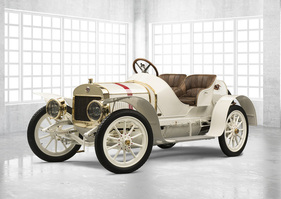
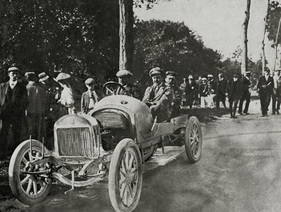
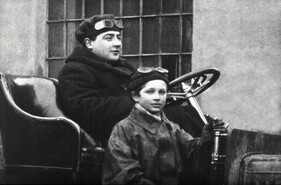
Laurin & Klement achieved its first motorsport triumphs at the beginning of the 20th century on motorcycles. These successes quickly made it clear: victories in motorsport boosted the business and thus also the development of the up-and-coming company from Mladá Boleslav. Immediately after the premiere of the Voiturette A, the company's first own automobile, Václav Laurin and Václav Klement therefore began building a racing car. With success: in 1906, the L&K Voiturette B vehicles used in the famous Semmering race in Austria finished first, second and fourth with an output of 9 hp and a top speed of up to 45 km/h.
Attention through success
The vehicles from Laurin & Klement subsequently held their own against the competition in races at home and abroad, thus attracting more and more attention to the car manufacturer. The FC model, which was based on the F passenger car series, was the main guarantee of success during this period. Between 1907 and 1909, designer, racing driver and chief engineer Otto Hieronimus designed a total of 19 vehicles of this type, which differed from one another both visually and technically. Depending on the class classification, the in-line four-cylinder engines of the L&K FC had displacements of between 2.0 and 2.5 liters with correspondingly different dimensions for bore and stroke. The rear wheels were always driven by a three-speed gearbox.

1908 was a particularly successful year for the up-and-coming car manufacturer. In March, it sent several vehicles to the track in various classes at the Zbraslav-Jíloviště hill climb, securing six first places, five second places and one third place. In Ries near Graz, Laurin & Klement celebrated a double success in the two-liter class. Otto Hieronimus himself took first place in his class on the 686-kilometre long-distance journey from St. Petersburg to Moscow, proving the outstanding reliability of the vehicles he designed. The L&K FC also left the competition behind on the challenging Prinz-Heinrich-Ride in Germany. Within nine days, the route covered a distance of 2,200 kilometers from Berlin via Kiel and Hamburg to Hanover, Cologne and Trier, before the participants reached the finish line in Frankfurt am Main.
Even more success with the Laurin & Klement FCS
However, this was not enough for Otto Hieronimus: he designed the Laurin & Klement FCS, which had an engine with overhead valves and a displacement of 3.5 liters. At the Austrian Semmering mountain race, the brand immediately took the first three places in its class. In 1908, Otto Hieronymus took the wheel himself at Brooklands in the UK on the world's first test track built exclusively for racing and test drives. He reached a speed of 118.72 km/h on the 5.2-kilometre oval track with two banked bends, setting a new speed record for the FCS vehicle class.
The most powerful and uncompromising variant of the FC was the FCR in 1909. It had a sleek body with an arrow-shaped radiator and an engine capacity of 5.6 liters with an output of exactly 100 hp (74 kW). The top speed at the time was an incredible 140 km/h. The vehicle made its debut at the Semmering, where Hieronimus immediately secured another class victory. He also won the overall classification at the Zbraslav-Jíloviště and Trieste-Opicina hill climbs in 1911.
Roman aristocrat behind the wheel
The successful racing driver Alexander Count Kolowrat-Krakowsky was one of the personalities who had a particular influence on the development of Laurin & Klement during this period. The Bohemian aristocrat, who grew up in the USA, decided against studying agriculture in Switzerland and instead spent his time in the workshop working on racing cars. Count Kilowatt', as his friends called him, always came up with unconventional solutions. It was precisely with this improvisational skill and wit that he drove to victory in the hill climb in Gaillon, France, in 1908.
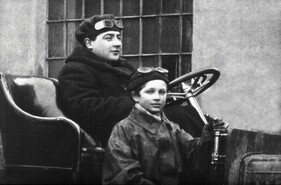
On October 10, Count Kolowrat had registered for the competition under the pseudonym Doconald, as he did not want his father in America to find out about his son's racing activities. However, Kolowrat waited in vain for his Laurin & Klement FC, which was to be delivered by rail in a wooden crate. However, it was out of the question for him to give up prematurely. So he decided to rely on the Laurin & Klement Type F that he had arrived in. The vehicle had already covered 18,000 kilometers at this point, which was an enormous mileage at the time. Overnight, 'Sascha' prepared his L&K FC with a mechanic for the race: Together, they removed everything from the vehicle that was not absolutely necessary for the race. They even removed the seats and fitted small wooden boxes without backrests instead. With this weight-optimized vehicle, Count Kolowrat was able to compensate for the performance deficit of his car. He beat all seven rivals in his class. For Kolowrat personally, however, this success had one small disadvantage: the secrecy towards his father was history...