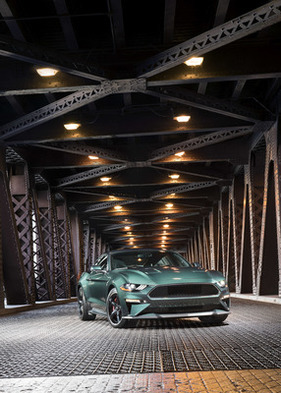
The original Ford Mustang GT Fastback, which starred alongside Steve McQueen in the 1968 film classic "Bullitt", is now officially part of the automotive heritage of the United States of America. The Historic Vehicle Association (HVA) has added the "Bullitt" Mustang to the National Historic Vehicle Register. The Ford icon is only the 21st vehicle to be included in this list of particularly historic automobiles. The National Historic Vehicle Register is a collaboration between the HVA, the US Department of the Interior, the National Historic Engineering Record and the archives of the US Library of Congress.
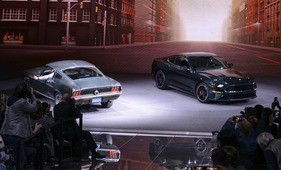
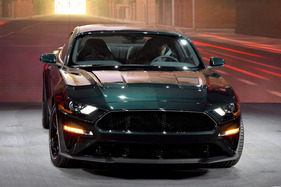
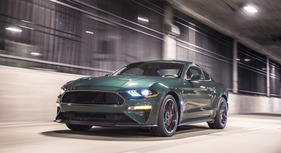
The original Mustang, which was seen as the so-called "Hero Car" with Steve McQueen at the wheel in the Hollywood classic "Bullitt", was long considered lost. Just in time for the 50th anniversary of the blockbuster, the historic model is back in the spotlight for the first time alongside the new Ford Mustang Bullitt™ at the North American International Auto Show (NAIAS) in Detroit.

Real action: "Bullitt" and the Ford Mustang change Hollywood
"Bullitt" was the first film that Steve McQueen's own production company Solar Productions realized for the film and television company Warner Bros. in 1968. McQueen had a great passion for motorcycles and high-performance cars. The actor had set himself the goal of thrilling the audience with action scenes that were as real as possible. In "Bullitt", he achieved this in a particularly impressive way: Together with director Peter Yates, he created a gripping police thriller that went down in film history with its spectacular car chases through the streets of San Francisco. What makes it special: The action scenes in "Bullitt" were actually 100 percent real. The thrilling manhunt at breathtaking speed was filmed on real streets, as were various stunts and crash scenes.
The extensive history of the "Bullitt" Mustang was precisely researched and documented in the course of its admission to the Historic Vehicle Association.
An almost unbelievable resurrection: Sean Kiernan's "Bullitt" Mustang story
"The original movie car from 'Bullitt' with the serial number 559 was in my family for more than 44 years," reveals the current owner Sean Kiernan. "There were two 'Bullitt' Mustangs: the car with the serial number 558 was the so-called 'jump car', which was used in the chases and especially in the famous jump scene and was badly damaged during filming. It recently resurfaced in Mexico. Our serial number 559 was the 'Hero Car' - the vehicle that Steve McQueen drove himself in many scenes."
A classified ad in "Road & Track"
"The 'Hero Car' is pretty much in the same condition today as when my parents bought it in 1974," says Sean Kiernan. "They discovered the Mustang in a classified ad in the October issue of Road & Track magazine. It said: '1968 Bullitt Mustang, driven by McQueen in the movie. With proof. For a bid'. The seller was a private detective from New Jersey. He said that my father Robert Kiernan was the only interested party. We don't know exactly what my dad paid at the time, but the price was probably between three and six thousand dollars, which was a lot of money for a used '68 Mustang Fastback at the time and, according to my research, a good four times the usual market price at the time," says Sean Kiernan.
Interestingly, the "Bullitt" Mustang with the serial number 559 was not used as a second car - it was the Kiernans' only car. "My dad commuted daily by train to the World Trade Center, where he worked for an insurance company. Mom drove the 'Bullitt' Mustang to St. Vincent Parish, where she taught elementary school kids. They never rebuilt the car, so it still has the straight exhaust pipes that make the sidewalk shake. For the life of me, I can't imagine what the kids thought when my mom rolled up. Mom must have seemed very cool," muses the current owner.
At the weekend, the "Hero Car" from the dream factory was transformed into an (almost) normal family car. The Kiernans went on many trips, often to Maine and the northern New York area - and probably with a deafening background noise. All the insulation material had been removed for the "Bullitt" filming, and there was a large hole in the trunk floor as an outlet for the smoke machine. "I have no idea what our luggage would have looked like if it had rained on our trips," says Sean Kiernan. "We only recently discovered that there were seatbelts for the back seat - only they had been hidden with gaffer tape. My sister Kelly apparently never drove with her seatbelt on. Dad eventually installed speakers that still work today. Then it was: no air conditioning, windows down, radio on. My family's 'Bullitt' trips in the 70s must have been a show."

1977: Steve McQueen wants "his" car back
The story took the next turn in 1977, according to Kiernan: "Steve McQueen himself called my dad. He had tracked down the previous owner and got our number from him. Steve wanted to buy the car. He was a guy who didn't often hear the word 'no' - but that's exactly what my dad said. 'No thanks, we don't want to sell the Mustang'. McQueen then wrote us a letter in which he once again made his interest clear. He said quite openly that he wanted the car back and offered a deal, but that it shouldn't cost 'too much monies'. Dad never answered the letter, because for him the 'Bullitt' Mustang was part of the family."
Sean Kiernan was born in 1981, and it was around this time that the movie and family car was retired. The fastback had around 46,000 miles - around 74,000 kilometers - on the clock. Sean's mother opted for a Plymouth Horizon that was much more suitable for everyday use - with seat belts...
After Steve McQueen's death in 1980, the search for the "Bullitt" Mustang really took off. "Dad didn't want to put the car up for sale, but he didn't take the time to work on it either. Over time, it became something of a family secret," explains Sean Kiernan. Dad and I first talked about restoring the Mustang in the late 1990s. When Ford presented the first 'Bullitt' Mustang in 2001, the thoughts became more concrete, because the anniversary model naturally fueled the rumors about the original film vehicle again."
Sean Kiernan begins the restoration
Robert Kiernan began to dismantle his gem until the Mustang filled the entire double garage in pieces. Unfortunately, he still had to run the farm "on the side". But just as father and son were about to tackle the project properly, fate struck: Robert developed Parkinson's disease. "We talked a lot about cars, but practically nothing else happened," regrets Sean. His father passed away in 2014. "Over the past two years, I have been working alone to restore the 'Bullitt' Mustang to its former condition. The engine has been rebuilt, the old carpets replaced, and a new steering wheel fitted, which is exactly the same as the movie version. Apart from that, I kept the signs of wear and tear from our family and the patina from years of use."
Sean Kiernan also decided against a new paint job. Many Mustang and "Bullitt" fans wish the number 559 had a high-gloss finish. "But the paint never shone," emphasizes Sean. "For the movie, the prop guys removed all the logos and lettering, and they used scouring pads on the paint to make it look as matte as possible. At the end of filming, the bodywork was given a thick layer of filler to cover up the damage and a single coat of paint in the typical 'Highland Green'."
The entire interior - seats, panels, the "perforated" trunk and even the camera mounts - remained unchanged during the careful restoration and corresponds exactly to its condition during filming. With tiny exceptions, as Sean Kiernan knows: "The guys who prepared the 'Hero Car' for sale put the aerial back on the right front fender and replaced the round wing mirror with the square standard part. The Hurst gearshift was fitted by the previous owner and we left it as it was."
"It's not a professional restoration, I did all the work myself"
The front bumper and front apron are new parts - the originals were demolished by Sean's grandfather in the 1970s when he backed into Kiernan's driveway. They have no artificial patina and are clearly identifiable as spare parts. "The car is honest, and that's how I wanted it," says Sean Kiernan and emphasizes: "It's not a professional restoration, I did all the work myself. As a tribute to my father and to our long-standing family secret."
Over the past 18 months, numerous experts have inspected the vehicle. Kevin Marti was the first to confirm that it was indeed the "Hero Car" with the serial number 559 from "Bullitt". Sean Kiernan then contacted the Historic Vehicle Association in Washington, D.C.. The classic car specialists took care of the authentication, documentation and conservation of the vehicle and the associated collector's items. They meticulously photographed and scanned the find and documented it for the National Historic Vehicle Register, assisted by staff from the Historic American Engineering Record maintained by the US Department of the Interior. All documents are archived in the famous US Library of Congress - the 'Bullitt' Mustang is only the 21st vehicle to receive this honor. The Historic Vehicle Association (HVA) also had a TV documentary made about the unique history of the movie car, which will be broadcast in 2018.
Sean Kiernan is happy with how things turned out: "We informed Ford about the project early on, just as my father had requested. Together with the Historic Vehicle Association, we decided to bring the 'Hero Car' back into the limelight for the 50th anniversary of its production and the 'Bullitt' film."
Further information can be found on the website.