


It is a rather unusual project, at least from today's perspective: the NSU from the Nile. As part of a supply and assembly license agreement, NSU exported parts of the NSU Prinz to Egypt in the 1960s and 1970s, where the NSU Ramses was built. Despite a construction period of 13 years, it remained a mini-series. And yet the Ramses caused great euphoria and enthusiasm in the land of the pharaohs, as it was ultimately linked to the dream of building up the country's own car industry. Audi Tradition presents the exotic car that bears the NSU brand in its name in this sixth installment of the NSU anniversary series.
From an agrarian state to a country with its own automotive industry: Egypt pursued ambitious economic goals in the early 1960s. As part of a reconstruction plan, the socialist state wanted to increase prosperity in the country and reduce its dependence on foreign countries. Numerous consumer goods that had previously been imported, such as refrigerators and televisions, were to be manufactured locally in Egypt in future.
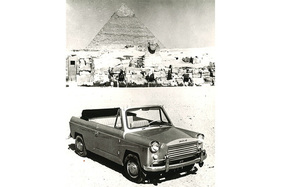
A car industry is also to be created: The construction of automobiles promises prestige and employment. At the foot of the pyramids of Giza, a small, initially very provisional car factory is being built. Parallel to the Egyptian government's plans, NSU is looking for additional sources of income - so the emerging opportunity to export parts packages of the successful Prinz model from Neckarsulm comes in very handy. In the spring of 1960, representatives of Egyptian industry arrive in Neckarsulm for talks. The aim was to reach an agreement to supply chassis and engines for the NSU Prinz to the fledgling Egyptian Automotive Company. Both parties quickly reached an agreement: NSU delivered the first components to the country on the Nile as early as June 1960.
How the "little prince" becomes an Egyptian king
In Egypt, a small open-top off-road vehicle is created by hand as the first work of art. The four-seater uses the Prinz engine with 30 hp and a displacement of 586 cubic centimetres. The chassis, also supplied by NSU, was fitted with a handcrafted body, and the interior was also painstakingly produced by hand. As there was a lack of machinery and typical industrial tools in Egypt, the result was a rather unconventionally shaped car that, from the outside alone, hardly seemed to meet the European standards of automobile construction at the time.
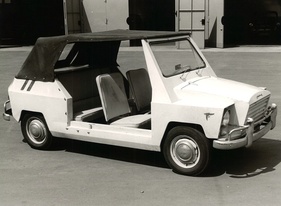
And yet: in May 1961, the car is put through its paces in the desert - and is convincing. Egypt thus had its first car manufactured in its own country, which could also bear this pride in its name. Because the "little prince" becomes a king in the land of the pyramids: the NSU Ramses. Daily production initially remains manageable, often only three to four cars. However, the plans for the little car are big: The Egyptian government wants to boost production so that annual sales of 10,000 units are achieved in the foreseeable future. Other variants of the Ramses are also being added: the off-road vehicle, which will be given the type designation "Utilica", will soon be joined by a limousine, a sporty convertible and government vehicles. The Egyptian postal service, for example, drove a pick-up version of the NSU Ramses, while the Egyptian army used it as a military off-road vehicle.
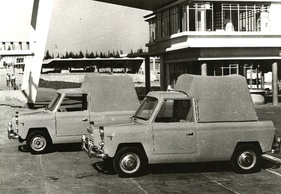
In July 1973, production of the NSU Prinz 4 ended in Neckarsulm - and with it the license agreement with the now renamed Egyptian Light Transport Manufacturing Company. It is no longer possible to determine exactly how many parts packages NSU delivered to Egypt. One thing is certain: despite its ambitious goals, the NSU from the Nile was not a great commercial success. Nevertheless, the NSU Ramses made history in Egypt and still has some loyal friends today who keep the memory of the car and its history alive. After all, the NSU Ramses symbolizes what the "Egyptian dream" of the 1960s promised: its own automobile production, economic prosperity and independence.


