Like most other museums, the Dr. Carl Benz Automuseum in Ladenburg is open again and can be visited on Wednesdays, Saturdays and Sundays from 14:00 to 18:00.
A talent for improvisation and tinkering
After the Second World War, there was hardly an automobile left that belonged to a private owner. Most of what the authorities had not confiscated for the glorious "final victory" had fallen victim to the hail of bombs.
In those years, only a talent for improvisation and great tinkering skills helped to get something back on the road from worn-out and destroyed remnants.
This is how the strangest vehicles were created back then. However, they only survived for a few years.
When the one millionth VW Beetle rolled off the production line in 1955, the last "tinkerers' boxes" also ended up in the car graveyard.
At that time, however, there was a young photographer who captured many of these "Rappelkisten" in time for eternity.
The photographer and the jalopies
Paul Simsa always had his camera to hand at the right moment. In 1969, he published the book "Dies alles fuhr alles auf unseren Straßen" with his snapshots.
In this work, you can see them once again, the Adler Trumpf Junior with BMW bodywork, sporty humps on the rear end and bored-out Opel P 4 wheels. The DKW with a stately Mercedes-Benz radiator grille or the legendary Bugatti 37 with a pre-war Peugeot engine.
Special exhibition with survivors
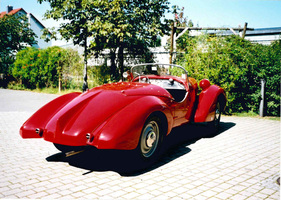
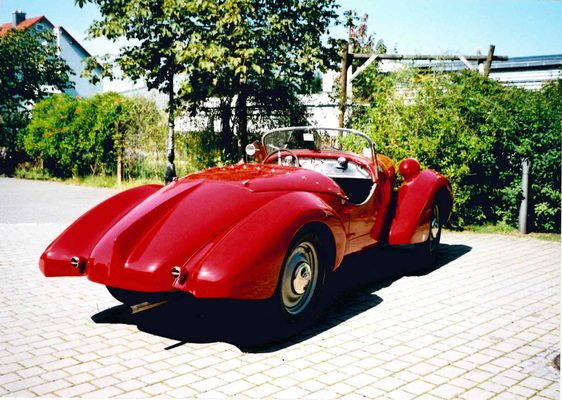
However, there were also a number of smaller companies that tried to conquer a place in the automobile market with rather peculiar new designs. All these vehicles have long since disappeared. And yet we have now discovered one of these bizarre vehicles. From the front, it appears to be an Adler Trumpf Junior. The engine compartment houses a DKW F1 engine and the steering wheel comes from a BMW 327, while the body tapers towards the rear to the centrally mounted rear wheel.
Alongside other examples of improvisation from those years, this "sports prototype" will be the focus of a special exhibition at the Dr. Carl Benz Automuseum in Ladenburg from May 23 to October 10, 2020
Another vehicle from this period has been preserved. Only around 20 of the Mercedes-Benz 170 VS were built before the war for sporting applications.
After the war, a French general is said to have secured one of these cars as "booty".
He then had the bodywork modified according to his wishes by the Spohn company in Ravensburg.
The result was a very elegant, two-seater roadster, which can also be seen in our exhibition.
Further information can be found on the museum's website.