


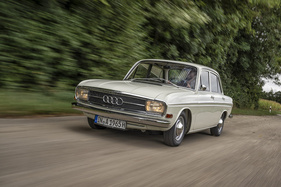
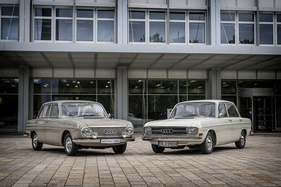
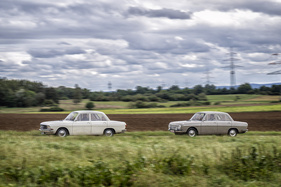


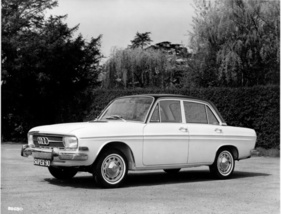
A new era begins 60 years ago in Ingolstadt: the first Audi after the Second World War rolls off the production line on August 13, 1965. With this model, Auto Union GmbH revives the traditional Audi brand name after a quarter of a century. The name itself is intended to show that the model represents a new technical beginning: The Audi is the brand's first automobile with a four-cylinder, four-stroke engine. The Audi, known internally as the F 103, was a resounding success and established an entire model series, which - further developed in terms of design and technology - was produced until 1972.
When the "new Audi" - as it is called in the press release for the world premiere at the IAA - is launched in 1965, Auto Union GmbH, the predecessor company of today's AUDI AG, finds itself in a difficult economic situation. After all, the new start after the Second World War was anything but easy: Germany was in ruins, Auto Union AG in Saxony was broken up and had no future. In this post-war turmoil, former Auto Union employees went to the West and founded a central depot for spare parts in Ingolstadt, followed by Auto Union GmbH in 1949. The young company starts producing vehicles; its first models, DKW motorcycles and vans, sell well during the period of reconstruction and the economic miracle.
As the population becomes more affluent, the demand for automobiles soon increases. By the mid-1960s, the DKW models based on pre-war technology were no longer considered contemporary - the DKW brand was "out". In particular, the long adherence to the two-stroke engine caused sales figures to fall continuously: Auto Union's last two-stroke model, the DKW F 102, remained a slow seller despite its modern design. As a result, Auto Union GmbH in Ingolstadt was in crisis in the 1960s. At the same time, there were also changes in the company structure. Daimler-Benz AG, the owner of Auto Union from 1958 to 1964, gradually sold its shares to Volkswagenwerk AG in Wolfsburg, which led to better utilization of production capacity. The VW Beetle proves to be the first savior in these days: between 1965 and 1969, almost 348,000 units of the Volkswagen 1200/1300 are assembled in Ingolstadt.
The "New Audi"
A decision made by the old owner Daimler-Benz AG at the beginning of the 1960s proved to be even more decisive for the future of the company: it provided the subsidiary with a four-stroke engine at the beginning of the 1960s. The Stuttgart-based company also sent engineer Ludwig Kraus to Ingolstadt, where he later became chief developer. Kraus brings the new engine to production maturity at Auto Union and thus creates the conditions for the first car from Ingolstadt with a four-stroke engine. The "new Audi" was launched in 1965 - 25 years after the last Audi 920 had left the assembly line in Zwickau, Saxony, in 1940 as a result of the war-related production stoppage, and 55 years after the first Audi automobile ever had been delivered, the Audi Type A 10/22 PS.
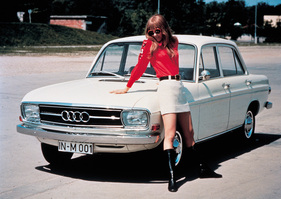
Ingolstadt also wanted to make the technical change visible with the name of the new model. The brand name "DKW", which has always been closely associated with the two-stroke engine, will therefore no longer be used for Auto Union GmbH vehicles in future. Instead, the new car was given the name "Audi", familiar from the pre-war period - initially without any further addition and without its own type designation. The car is sold as the Auto Union "Type Audi"; internally, the nomenclature is quickly changed: The DKW F 102 became the F 103, and this "newcomer" became the founder of an entire model series.
And another detail is important from the historian's point of view: the name for the new car is purely a model designation; the name of the company in 1965 is still Auto Union GmbH. It was not until 20 years later, in 1985, that AUDI AG was founded; since then, the company and its products have borne the same, short and memorable name: Audi.
From the original Audi to a family of vehicles
With the emergence of further models and performance levels, the new Audi is joined by the Audi 80, Audi Super 90, Audi 75 and Audi 60. Only the first Audi is denied the "72" throughout its entire production period. It was only unofficially called "Audi 72" or "Audi (72 PS)" by customers and the press. The new Audi rolled off the production line in August 1965 - and from spring 1966 it was also available as an estate car, known as the "Variant" as at Volkswagen. The saloon models are available in two- and four-door versions, with upscale equipment on request - with the suffix "L". In 1966, the Audi 80 with an output of 80 hp was added to the model series, followed shortly afterwards by the top-of-the-range Audi Super 90 with its extensive equipment. It differed from the other models in terms of appearance with chrome-plated trim strips on the wheel arches as standard and, with its larger displacement engine and an output of 90 hp, reached a top speed of more than 160 km/h - a respectable figure at the time. In 1968, the Audi 60 volume model with 55 hp rounded off the range and the Audi 75 replaced the 72 and 80 hp versions.
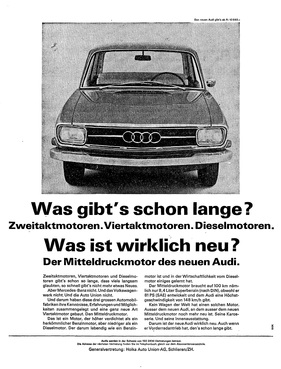
In the advertising, the post-war Audi is referred to as a "medium-pressure engine", as the 1.7-liter engine with its compression ratio of 11.2 : 1 lies between a typical petrol and diesel engine of the time. It was also longer than the DKW three-cylinder engine - which is why the DKW F 102, which served as the basis for the new Audi, had to be lengthened by 100 millimetres and the radiator installed at an angle next to the engine on the left-hand side. Instead of the round headlights as in the chrome-plated grille of the F 102, the Audi was fitted with rectangular headlights in a slightly wider black radiator grille. A four-speed gearbox with steering wheel gearshift was fitted as standard; an automatic gearbox was not offered in this model series. Like its predecessor, the DKW F 102, the new Audi had disc brakes mounted on the inside of the transmission. The move away from the two-stroke engine has a signal effect: 16,000 new Audi cars can be built in the first three months.
During its seven-year production period, the F 103 is only slightly modified. For the 1970 model year, all models were given parallel-running windshield wipers instead of counter-rotating ones, as well as a redesigned dashboard. For an extra charge, customers could now also order a center gearshift instead of the standard steering wheel gearshift. In the summer of 1970, the fuel filler neck is moved from the rear of the saloon to the right rear side panel. The rear lights are stylistically aligned with those of the Audi 100, which has been built since 1968 and establishes the successful C series at Audi.
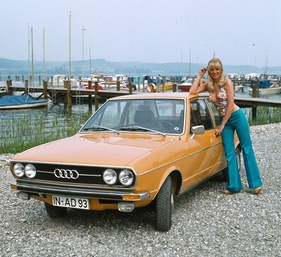
The Auto Union "Audi type" is produced until the summer of 1972. It is succeeded in mid-1972 by the completely newly developed Audi 80. The smallest model in the F 103 family, the Audi 60, becomes the most successful; more than half of all first-generation Audi cars built (416,852 vehicles) are Audi 60 and Audi 60 L: a total of 216,987 units. The sales figures alone show how important this car is for the brand with the four rings. It marks a technical and economic turnaround. Between 1965 and 1972, the new Audi and its family members met with such great interest that they not only laid the foundations for a forward-looking Audi model range, but also put Auto Union back on the road to success, thus contributing to the long-term independence of the Audi brand within the Volkswagen Group.
Lecture on July 23 on the "F 103"
On Wednesday, July 23, Audi historian Ralf Friese will explain how the first Audi came about after the Second World War and why this "original Audi" was to become so central to the further development of the company with the four rings. The event at the Audi museum mobile in Ingolstadt begins at 6 pm. Admission is free, registration is required by e-mail to [email protected] or by telephone on 0841 89-34433. Registration closes on Monday, July 21. The lecture evening begins on Wednesday, July 23, at 6 p.m., with admission starting at 5:30 p.m.