


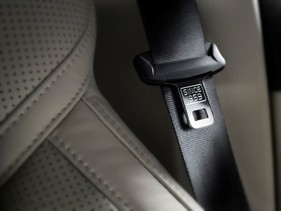
No invention has had such a lasting impact on the automotive industry as the seat belt. The idea, which took shape in 1930, is still in use today. And it will very probably be indispensable in the future too.
Seat belt as a lifesaver
Experts estimate that more than one million people owe their health or even their lives after a car accident to the three-point seat belt, an invention by Volvo. This very invention is now celebrating its 60th anniversary. The rescue potential of this belt was first presented in Germany at the IAA in 1959. The purpose of this was to popularize this innovative potential even more quickly. The release of the patent to the general public also contributed to its rapid spread. At the same time, a contribution was also made to general road safety. Two birds with one stone, so to speak.

Since March 2019, Volvo has been sharing all its safety experience in accident research in a digital library that is accessible to everyone. This makes all the knowledge gathered since 1970 available to the whole world. The idea behind this is very simple, but of immense importance for the automotive industry: the aim is to make cars safe for all occupants, regardless of their physical attributes, gender or physical condition. "Equal Vehicles for All" (E.V.A) is the name of this initiative.

High-risk demonstration of the seat belt
The three-point seat belt was first produced as standard in 1959. At that time, a heated debate began between German doctors, car buyers and the specialist media. Everything revolved around the question of how safe seat belts are and should be.
To set an example, Volvo organized a live demonstration at the Frankfurt exhibition grounds together with stuntman Orvar Aspholm. He rolled over in a Volvo PV544 four times in succession, but then climbed out of the wreckage unharmed, as the three-point safety belt had protected him.
Aspholm had already practiced this stunt around 30 times beforehand without injuring himself (all figures according to Volvo). The last skeptics were finally convinced by the so-called "28,000 Accidents Report", which was based on data from all accidents in Sweden. The result was that seat belts save lives and reduce the number of injuries by up to 60 percent (according to Volvo).

Former aviation engineer achieves breakthrough
In the 1930s, American doctors called for the introduction of seat belts in all car models. However, the first restraint systems were not very popular. It was not until the former aeronautical engineer Nils Bohlin, who was hired by Volvo in 1958, that a breakthrough was achieved. He knew that a seat belt had to absorb the forces of a collision where the body is strongest. This applied to both the pelvic and chest areas. He was able to transfer this knowledge into the design of a harness, which is a fusion of a pelvic harness and a diagonal body harness.

Furthermore, this system had to be both easy to operate and simple to adjust. The Volvo three-point safety system was born. Although this system was patented, anyone interested could use the concept behind the restraint system. To this day, the seat belt is the be-all and end-all when it comes to the safety of a car's occupants. However, the potential of the seat belt is far from exhausted, as the use of seat belts varies from country to country.

Special honor for Nils Bohlin
Nils Bohlin was honored in a special way in Germany for his invention: In 1985, the German Patent Office selected the three-point seat belt as one of the eight inventions of the last 100 years that have brought the greatest benefit to mankind and also have a lasting effect on the future. An honor that is by no means bestowed on every invention.

In 2019, Volvo is celebrating the 60th anniversary of the three-point safety system. The "Equal Vehicles for All" initiative mentioned above was also launched to mark this anniversary. The E.V.A shows, for example, that women are much more frequently affected by whiplash injuries than men due to their physical anatomy. To mark the occasion, Volvo has developed virtual crash dummies that can be used to design safety systems that provide optimum protection for both men and women.

In short: no invention has had such a lasting impact on road safety as the seatbelt.
Further information
Further information on safety innovations, technology, etc. can be found on the Volvo website.

