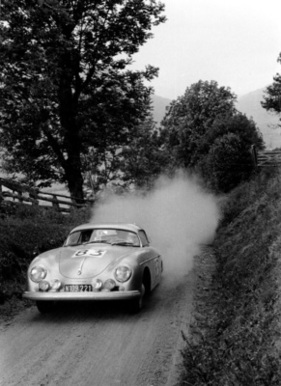


Open-top driving pleasure combined with distinctive driving dynamics: this is what Porsche's Speedster models have stood for for more than six decades. The 356 America Roadster is considered the forefather.

Thanks to the handcrafted aluminum body, it weighed 160 kilograms less than the 356 Coupé and, with its 70 hp four-cylinder boxer engine, reached an impressive top speed of 180 km/h for the time. With its plug-in windows for the doors, emergency folding top and lightweight bucket seats, the sports car developed for the US market in 1952, of which only 16 were built, was already shaping the key features of all subsequent Speedster models.
US importer paves the way for the Speedster
It is the US importer Max Hoffman who challenges the Zuffenhausen-based company and puts it on the right track. He wanted an affordable Porsche with reduced equipment that cost less than 3,000 dollars. In the fall of 1954, Porsche launched a version that was significantly cheaper than the 356 America Roadster, bearing the term "Speedster" in its model name for the first time and quickly causing a sensation in motorsport. It combined the sheet steel body of the convertible with a flat windshield, reduced interior fittings and an emergency top.

In the USA, the 356 1500 Speedster costs just 2,995 US dollars and is a big hit in the sunny coastal states. Hollywood icon and amateur racing driver James Dean also opted for this purist model, which was dedicated solely to driving pleasure. Further generations of the 356 Speedster followed. The 356 A 1500 GS Carrera GT Speedster represents a temporary highlight in 1957: Its 1.5-liter, king-shaft engine delivers 110 hp. It is the first production model from Porsche to reach a top speed of 200 km/h.
Rebirth in 911 guise
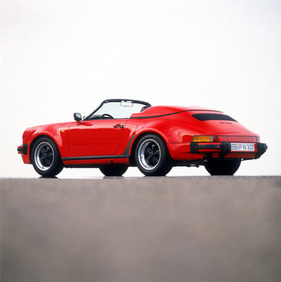
A Speedster variant enters the 911 model series in 1988 and crowns the discontinued G-series. The most open of all 911s was created on the basis of the 231 hp 911 Carrera with a wide turbo look. It is also optionally available with a narrow body in export markets. This resulted in 161 units with a slim Carrera body. The windshield is shortened and a manually operated emergency soft top disappears under a large plastic hood painted in the color of the car. Unlike the "911 Speedster Clubsport" study shown at the IAA in Frankfurt in 1987, the production Speedster did not make its debut until 1988, with prices starting at around 110,000 marks. A total of 2103 G-series Speedsters were built.

The opposite was true of the successor model: 930 units of the "narrow" 911 Carrera Speedster of the 964 generation rolled off the production line between 1992 and 1993. There were also 15 vehicles with a turbo-wide body. The new Speedster models were equipped with a revised soft-top mechanism designed to make manual opening and closing easier. The locking mechanism for the large plastic cover at the rear has also been optimized. Body-colored bucket seats from the 911 Carrera RS and special leather upholstery set visual accents. At market launch in February 1993, the Speedster cost 131,500 marks. However, the buyer had to do without air conditioning, electric windows and, initially, an airbag.

Only two examples
Even rarer is the 911 Carrera Speedster based on the 993 generation: exactly two examples exist. The first was developed by the Exclusive department in 1995 especially for Ferdinand Alexander Porsche. It is green, has 17-inch alloy wheels and a Tiptronic S gearbox and is based on the Carrera body. Later, a second model was built for the American actor Jerry Seinfeld. The sitcom star - an ardent fan of the company and owner of a considerable Porsche collection - receives a silver Speedster with manual transmission and as a turbo-wide 4S model with 18-inch wheels.

The last Speedster version of the 911 to date will not be available to customers until 2010: it is a variant of the 997 model generation. The 911 Speedster marks the 25th anniversary of Porsche Exclusive Manufaktur, which will be celebrated in 2011. In the best tradition of purist sports cars, the 60 millimeter lower, more steeply inclined windscreen, the flat contours of the sportily cut manual soft top and the characteristic double scoop on the soft top compartment lid form the striking profile of the new 911 Speedster. This makes the 44 millimeter wider rear body of the rear-wheel drive two-seater stand out even more impressively.

The Porsche 911 Speedster celebrates its world premiere at the Paris Motor Show at the beginning of October. The sports car with a 300 kW (408 hp), 3.8-liter six-cylinder boxer engine will be produced in a limited edition of 356 units. The Speedster will be launched on the German market in December 2010 at a price of 201,682 euros.
The 911 Speedster Concept: sporty and puristic
The 911 Speedster Concept - the ready-to-drive study of a particularly open and exciting sports car - celebrates its world premiere in Zuffenhausen in 2018 to mark the "70 years of Porsche sports cars" anniversary. The one-off shown in the "Heritage" version builds a bridge from the early years of the company to the modern era.

With its purist design and historically correct execution, the 911 Speedster Concept reflects Porsche's brand essence. For the first time in modern times, it was once again racing experts who developed this two-seater Speedster, based on a GT model. The concept car has already made inspiring appearances at the Goodwood Festival of Speed and the Rennsport Reunion VI in Laguna Seca, California, as well as at the Paris Motor Show. The concept study is now going into series production as the 911 Speedster*, strictly limited to 1948 units.