




In the early days of the automobile, cooling the engine was one of the biggest challenges. One of the first solutions was the tubular radiator invented by Wilhelm Maybach in 1897. It consisted of a flat water box with open tubes running through it. The airstream flowed through them. A fan coupled to the engine shaft ensured effective cooling even when idling. It was the tubular radiator that made the construction of more powerful engines possible.
The final breakthrough came in 1900 with the "honeycomb radiator" in the Mercedes 35 hp. It consisted of more than 8000 tubes with a square cross-section and a side length of around six millimeters. The square tubes enabled a significantly higher cooling capacity due to the larger frontal area and the increased air flow rate. They were brazed together to form a new type of rectangular cooler with an integrated reservoir. A fan behind the radiator improved temperature regulation at slow speeds. The 35 hp engine of the first Mercedes required only nine liters of water instead of the previous 18 liters. One year and numerous improvements later, it was down to just seven liters.

The face of the Mercedes 35 PS, with its radiator grille standing upright in the airstream, set a precedent in the automotive world. Almost all production cars had a similar radiator face until the mid-1930s - with slight variations towards a pointed radiator. The radiator grille with the distinctive kink in the middle was created in 1911 and allowed for a slightly larger cooling surface, but was more expensive to produce. For this reason, it was usually only used on expensive vehicles with powerful engines.
The radiator grille as a protective functional component
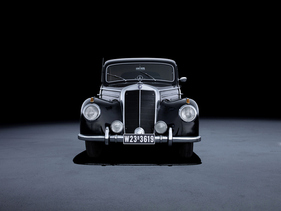
In the first 40 years of automotive history, the radiator had a purely practical function. Initially, car manufacturers did not regard it as a unique selling point of a brand. The first Mercedes-Benz with a radiator protected behind a grille was the 170 (Type W 15) in 1931. The new component was part of the hood and was modeled on the radiator. At the same time, it was enhanced by a wide chrome frame. The Mercedes star found its place twice on the new cladding: as a badge on the upper edge and as a proud radiator figure on top.

The fine honeycomb pattern not only fulfilled aesthetic but also functional tasks. It kept dirt and stone chips away from the actual radiator. This was because stones hitting the cooling fins could cause damage, and dirty radiator fins had less cooling effect than clean ones. The radiator grille of the Mercedes-Benz 170 V retained its tall, slim basic shape in 1937. However, it was tilted slightly backwards and was narrower at the bottom. This made the new saloon somewhat more dynamic visually. The slightly pointed radiator grille subtly enhanced this effect.
Chrome grille and sports car face
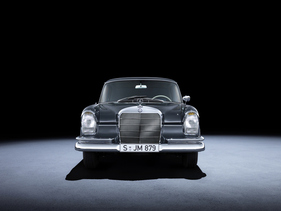
The chrome grille subsequently became a central distinguishing feature of the brand. Until the 1960s, the Mercedes-Benz designers only very cautiously adapted it to the general change in shape. Then the Mercedes-Benz radiator grilles grew in width and became lower at the same time. The emphasis on width made the cars look more powerful and muscular. However, it was also due to the trend of making the hoods ever flatter in order to improve aerodynamics.

In the 1950s, a second form of radiator grille was developed at Mercedes-Benz. The 300 SL and the smaller 190 SL were given a modern alternative to the saloon face, known internally as the "sports car face". A large, central Mercedes star was placed in front of the wide and flat radiator opening, flanked on the right and left by horizontal chrome bars. This design became the hallmark of the sports cars.
The customer has the choice
With the model offensives of the 1990s and 2000s, the front sections of the Mercedes-Benz models also changed to become more sporty. Special features such as the Formula 1 nose of the second-generation SLK or the SLR McLaren remained the exception. In 2007, however, the decision to leave the choice to the customer for the C-Class 204 model series proved successful: Depending on the equipment line, the classic or sporty radiator grille adorned the front of the car. The concept was transferred to the E-Class and is still valid for both model series today.

The modern AMG-specific radiator grille with its downwardly widening contours and vertical louvres is reminiscent of the 300 SL racing car that won the 1952 "Carrera Panamericana" road race in Mexico.
The evolution continues
Thanks to the battery-electric drive, the radiator is no longer required in its previous position. This means that the air intakes - which are still necessary - can be arranged differently and front views can be redesigned. The former surface of the radiator grille is used in the EQ models to cover various sensors that are essential for future highly automated driving.


