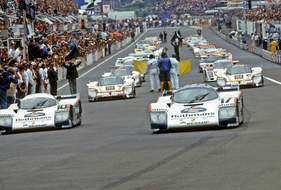
In just over a week, the queen of all long-distance races will awaken from her annual deep sleep and start for the 85th time.

The 24 Hours of Le Mans, first held in 1923, is still one of the most important events in the motorsport calendar today and boasts countless works teams from many car brands from the USA, Europe and Asia. Due to the long duration of the actual race, it is much more than just a normal car race, with fans staying up late into the night along the track and following the exciting race on big screens and radios. But it's not just the race that is important: during Le Mans week, the small town of Le Mans south-west of Paris is transformed into a hotspot for the motorsport sports car scene. This was also the case in the past.

Le Mans vehicles in comparison
While there were just 33 vehicles at the start in 1923, this year there are 60. How do the vehicles actually compare over the different eras? We dared to compare a few Le Mans winners:
| Jaguar D-Type XKD (1955) | Porsche 917 KH (1971) | Porsche 956 (1982) | Porsche 919 Hybrid (2016) | |
|---|---|---|---|---|
| Top speed | 280 km/h | 354 km/h | 355 km/h | 340 km/h |
| Weight | 880 kg | 800 kg | 840 kg | 870 kg |
| Engine | 3.4 liter petrol engine 6 cylinders | 4.9 liter petrol engine 12 cylinders | 2.65 liter twin turbo 6 cylinders | 2 liter turbo 4 cylinders |
| HORSEPOWER | 270 HP / 204 KW @ 6,000 rpm | 600 HP / 448 KW @ 8,300 rpm | 620 HP / 463 KW @ 8,200 rpm | 500 PS + 400 PS (electric) |
| Torque | 325 Nm @ 4,000 rpm | 563 Nm @ 6,400 rpm | 600 Nm @ 5,000 rpm | n/a |
| Number of laps | 300 | 397 | 359 | 384 |
At first glance, the very similar figures are surprising, as the weight of all candidates is within a 10% band. The top speeds are also fairly close together, even if these are probably limited by the regulations for the newer racing cars. The engines actually underwent the biggest change, with everything from 12 to 4 cylinders to be found on the track.
The lap figures have to be compared with caution, because the Le Mans track layout has changed several times. In terms of lap times, the change in 1990 was probably the most important, when the two chicanes on the long straight "Les Hunaudières" were added. However, the 397 laps of the Porsche 917 are still pretty impressive.
Winners of the past
If you go back in decades and look at the winners of the 24 Hours of Le Mans, you can literally see the evolution in racing:
1927: Bentley 3 Litre Super Sport
The "Bentley Boys" should actually be celebrating their 90th anniversary this year, as 1927 was the first time a Bentley won the endurance race.

1937: Bugatti Type 57G Tank

1947: no race (track was still being rebuilt after the 2nd World War)
1957: Jaguar D-Type

1967: Ford GT40 Mk IV

1977: Porsche 936/77

1987: Porsche 962C

1997: TWR Porsche WSC-95
2007: Audi R10 TDi
2017: Porsche 919 hybrid, Toyota TS050 Hybrid or will there be a surprise winner?
Overview of the 2017 edition: LMP2 faster than LMP1
Last year, the pit lane was extended by four more places, so 60 cars will start again this year. However, for the first time since 1991, all participating vehicles will have a roof this year. The days of open-top racers such as the Porsche RS Spyder seem to be over.
The vehicles are still divided into four categories: LMP1, LMP2, GTE Pro, GTE Am. LMP1 is still the premier class, from which the overall winner is expected. Because Audi announced its withdrawal last year, only two manufacturers will be competing in this category this year: Porsche versus Toyota. However, the duel should be exciting if you remember last year.
However, the LMP2 cars are now much faster thanks to changes to the regulations. On the long straight, the Hunaudières, the LMP2 cars will probably overtake the LMP1s, but in terms of lap time they will be around 10 seconds slower. The LMP2 regulations allow four models and a single engine. For the first time, all four models will be on the grid: Oreca 07, Ligier JS P217, Dallara P217 and Riley Mk30. The engine will be supplied by Gibson (4.2L V8).
In the GT class, road-going cars from Porsche, Ferrari, Aston Martin, Corvette and Ford will compete.
Last year's winner is Porsche. Until a few minutes before the end of the race, however, everyone was sure that Toyota would take the win. Driver Kazuki Nakajima suffered a loss of power and had to relinquish what he thought was a certain triumph. A tough change of heart, but this is exactly what characterizes an endurance race like Le Mans: no one can be sure of victory unless they have reached the finish line. A well-known saying of Le Mans drivers is therefore "To finish first, you must finish first" (if you want to win, you have to finish the race first).
All Le Mans winners from 1923 to 2016 in a graphical overview
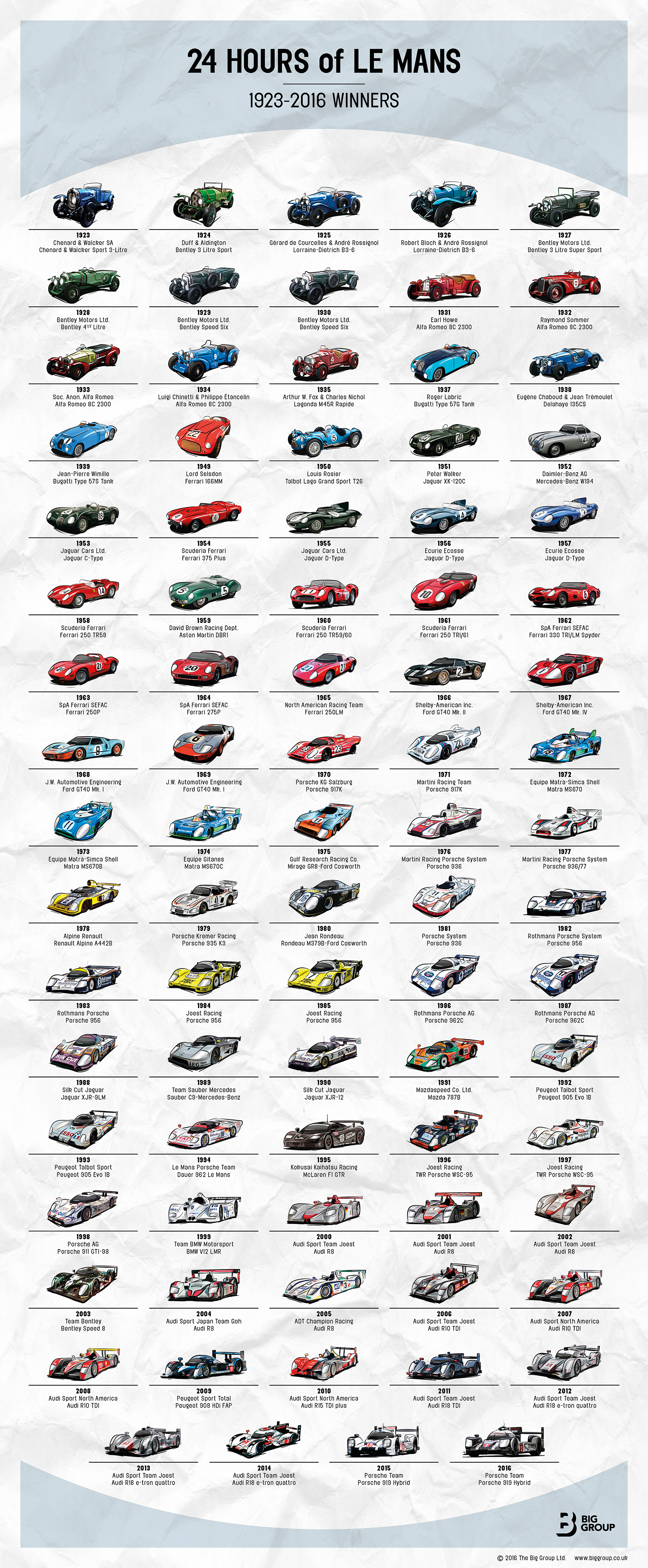
Infographic © Copyright The Big Group Ltd.