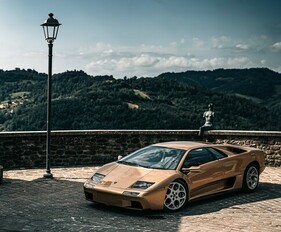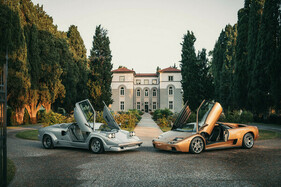
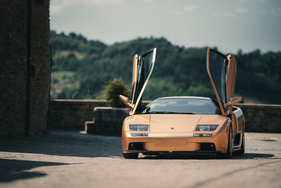
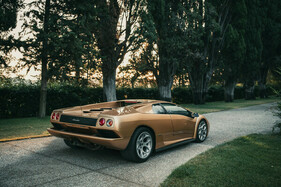
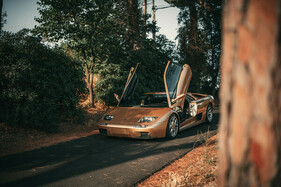
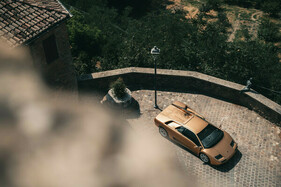
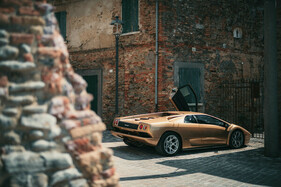
Lamborghini celebrates its V12 in 2022. The legendary twelve-cylinder engine has been powering the brand's most iconic models for almost 60 years. These undoubtedly include the Diablo, Lamborghini's first super sports car to be offered in an all-wheel drive version. When it made its debut, the Diablo was so far ahead of its time that it was described as a production hyper sports car. It was officially presented on January 21, 1990 as part of the Lamborghini Day at the Sporting Monte-Carlo. Its twelve-cylinder engine initially had a displacement of 5.7 liters, later increasing to 6.0 liters. The Diablo thus produced a maximum output of almost 600 hp in the road versions and over 655 hp in the GT1 Stradale racing version, of which only two examples were produced.
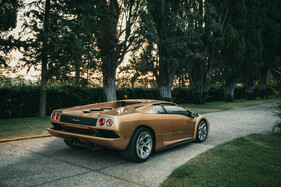
Production of the "pure" V12 combustion engine in its final development stage will come to an end at the end of 2022, when the last Aventador Ultimae will be produced: From next year, the successor to the Aventador will be equipped with a new plug-in hybrid version of the V12 engine.
A sales success that lasted for eleven years
The Diablo holds a special place in the history of Automobili Lamborghini and in the hearts of fans, and not just because of its performance and driving experience. It is the model that catapulted the car manufacturer into the modern age. Project 132, as it was known within the company, was launched in 1985 with the aim of replacing the Countach and had to convey the concentrated power of the car manufacturer from Sant'Agata. It had to be sporty and muscular, yet pleasing at all times, conveying the aesthetics for which Lamborghini had always been known. It also had to be future-proof in order to remain the fastest production car in the world for many years to come.
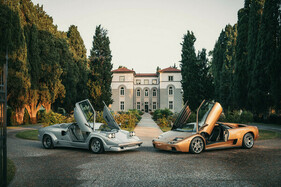
Its driving behavior during the first tests was astounding - a success that was due to the intensive development work involving former world rally champion Sandro Munari. During its product life cycle, which lasted until 2001, the Diablo also demonstrated its ability to transform and adapt to market demand and customer expectations. With 2903 units produced in eleven years, the Diablo was a huge success.
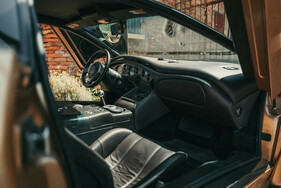
The development of the V12 engine
The technical cornerstone of the Diablo remained the V12 engine with a 60-degree bank angle, which was derived directly from the 3.5-liter engine from 1963. Over the years, the displacement was increased to 5.7 liters. The Diablo made its debut with the latter engine size. In this configuration, the longitudinally installed mid-engine with catalytic converter developed a maximum output of 492 hp at 6800 rpm and a torque of 580 Nm at 5200 rpm. It also featured Lamborghini-Weber Marelli LIE electronic direct fuel injection. In 1999, the Diablo's engine was expanded to six liters, first in the Diablo GT and then in the 6.0 SE. Thanks to better calibration of the fuel injection, it achieved 525 hp and a torque of 605 Nm.
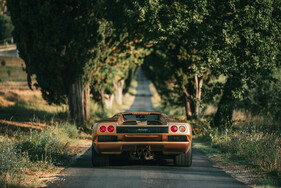
1993: the year of the Diablo VT, the first Lamborghini with all-wheel drive
The original mechanics of the Diablo were sophisticated but traditional: longitudinally mounted mid-engine, four chain-driven overhead camshafts, electronic fuel injection, rear-wheel drive and mechanical transmission. Power steering was not introduced until 1993, while the electronics were solely responsible for engine control. The Diablo VT was the first all-wheel-drive super sports car to be presented by Lamborghini in 1993. It became the benchmark in terms of road holding and driving safety in every situation.
The abbreviation "VT" stands for Viscous Traction, as torque is transmitted from the rear to the front axle via an intermediate viscous coupling. As part of this system, the VT is normally a rear-wheel drive vehicle that transfers up to 20 percent of the power to the front axle when the rear wheels are spinning. This takes place via a viscous coupling and a drive shaft connected to the front axle differential. The VT also introduced another innovation at Lamborghini: the electronically controlled suspension with five preset operating programs to choose from.
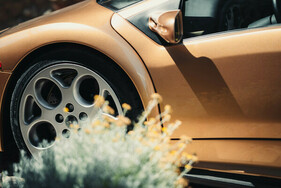
1995: Debut of the Diablo Roadster, the first open-top twelve-cylinder from Lamborghini
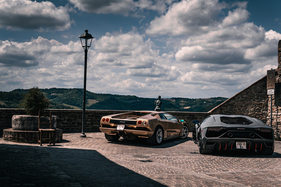
The fact that the V12 Diablo was also produced in an open-top version established a new tradition. In fact, a few tentative attempts had already been made in the preceding years, but they remained one-offs. In December 1995, the Diablo Roadster made its debut with a Targa-style carbon fiber roof that could be stowed above the engine cover.
Second series Diablo: even faster and stronger
The turning point in Lamborghini's history came in 1998 with the takeover by Audi. The car manufacturer finally had the resources to create a more precise business plan and gained access to components and technologies that it had never dreamed of before. The new owners also saw the Diablo as a product worth preserving and developing. Thus the second series of the Diablo was created, designed in the company's brand-new Centro Stile. The model was faster and more powerful than ever before thanks to the V12 engine, which was enlarged to six liters. It also boasted a more luxurious interior and improved reliability in everyday use thanks to strict quality controls during development, testing and production.
Motorsport
Lamborghini celebrated its return to racing with the Diablo thanks to the Super Sport Trophy, later Super Trofeo, one-make championship. It made its debut in a support race at the 1996 24 Hours of Le Mans. 34 Diablo SV-Rs with 550 hp were made available for amateur drivers to compete against each other in one-hour races.
Film appearances of the Diablo
The Diablo has appeared in numerous films. One of the most memorable scenes is the one in the US film "Dumb and Dumber" with Jim Carrey and Jeff Daniels, who arrive at a hotel in a red Diablo.
The Diablo also appeared in the 2001 film "Exit Wounds - The Cop Hunters" by director Andrzej Bartkowiak, starring "DMX" Earl Simmons and Anthony Anderson. Here, a 1999 Diablo VT Roadster steals the show by being bought for cash in a scene at a car dealership after a splashy revving of the engine.
Finally, the Diablo SV is the star of the game "Need for Speed III: Hot Pursuit".