


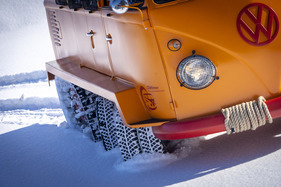


Volkswagen Commercial Vehicles Oldtimer has just restored a 60-year-old one-off to new condition: the Caterpillar Fox. This T1 was produced at the Hanover plant in May 1962 and sent on its journey to its buyer in Austria. After a short period of life as a normal T1, it was transformed into an alpine specialist under the hands of a resourceful Viennese Volkswagen mechanic: Kurt Kretzner converted the Bulli into a T1 with four axles - two of them equipped with a track drive, two of them steered by twin tires. The result was probably the most off-road capable Bulli ever seen in the high mountains of this world.
Historical sources say that he was an enthusiastic skier. He noticed that there was a shortage of highly off-road capable vans in the mountains of Austria. Those that were easy for anyone to drive and yet could easily climb up to the highest mountain pasture. "An ideal helper for everyone: Hut owners, hunters, foresters, doctors, maintenance personnel for lift systems, television and radio systems, pipelines and the like," as Kretzner later wrote in the sales documents for the Caterpillar Fox. "In the beginning, I looked around but couldn't find the car I was dreaming of. So I decided to build it myself." Just as Ferry Porsche had once said and done, Kurt Kretzner did the same. The inventor spent more than four years designing and building the Gipfelstürmer. Two "Foxes" were probably built by 1968, but production of the third came to a standstill. What survived, however, was at least one example of the Caterpillar Fox.

Under the orange-painted Bulli body, the Viennese inventor had planted a steered double axle with coarse-profiled 14-inch twin tires at the front and a double axle with chain drive at the rear. The chains were mounted on 13-inch wheels and were a proprietary construction made of aluminum elements with two-centimeter-thick rubber blocks to save the asphalt.
The double front axle steering resulted in a turning circle of less than ten meters. Each wheel was equipped with a brake. An automatic limited slip differential ensured evenly distributed propulsion even in deep snow. The T1 drew its power from its standard 25 kW/34 hp boxer engine with a displacement of 1,192 cubic centimeters. The caterpillar fox reached 35 km/h and was therefore only slightly slower than its namesake from the animal world.
Kurt Kretzner wanted to build a tracked vehicle that was very easy to steer. It was precisely for this reason that the mechanic did not opt for steering via chains on all axles, as on a bulldozer, but for a half-chain (only on the drive axles) and an almost normal, albeit double, front wheel steering. And this is how the inventor advertised the Caterpillar Fox: "The new, ideal, easy-to-operate tracked vehicle with which you can safely and comfortably master any difficult terrain. You can drive on snow, sand, stones, alpine meadows, moors, small streams and forests with this device."

The caterpillar fox was rarely seen over the years. In 1985, the T1 appeared in Vienna for the last time before it was bought by the Porsche Museum in Gmünd in the early 1990s. At some point, the Caterpillar Fox became the property of the Bullikartei e.V. - a community of enthusiasts of the first generation of Bulli. They made a first attempt to restore the high alpine special vehicle in 2005. Unfortunately, the restoration could not be completed due to logistical reasons on the part of the club members scattered throughout Germany.
At the end of 2018, the Caterpillar Fox joined the Volkswagen Commercial Vehicles Oldtimer collection. The goal: to get the Caterpillar Fox back on the road. Under their motto "Remember. Experience. Preserve.", the classic car experts therefore embarked on an elaborate rebuild. As with all factory restorations in Hanover, the 60-year-old bodywork was stripped of paint, repaired, cathodic dip-paint coated and repainted in a largely original shade of orange. The intention at the time was to make the Caterpillar Fox immediately recognizable in the snow-covered landscape and rough terrain.

The team from Volkswagen Commercial Vehicles Oldtimer also restored the technology to new condition, as well as the interior. Here, the team was able to give free rein to its creativity, as there were no strict specifications. Beech and pine timbers were individually adapted to the space in the Caterpillar Fox and practical tool holders were installed. In spring 2022, the time had finally come - the caterpillar fox was once again making its way through the snow. And with an unusually good climbing ability: after the extensive restoration of the four-axle vehicle, the Volkswagen Commercial Vehicles Oldtimer team was able to see for themselves that the driver capitulates much sooner on steep slopes than the Caterpillar Fox.
Anyone who would like to see this unique vehicle live will have the opportunity to do so on Saturday, May 28, at the annual meeting of the Bullikartei e.V. at Meinhardsee near Eschwege. More information about the meeting can be found on the association's homepage.

