


On February 24, 1983, Peugeot celebrated a major success with the launch of the Peugeot 205. The brand took a step into the modern age - in terms of product, marketing and motorsport. The 40th anniversary is an opportunity to look back at a fascinating history and the origins of a long line of successful Peugeot city cars.
The Peugeot 205 has left its mark on automotive and motorsport history. It remains Peugeot's "holy number" and celebrates its 40th birthday today.

The history of a vehicle is often first and foremost the story of the men and women who designed it. The development of the Peugeot 205, for example, is inextricably linked to Jean Boillot, who was a member of the Peugeot board in the late 1970s. At a difficult time for the company, he developed the ambitious project of a new small car that was to be much more than a city vehicle. It was to be a multi-purpose vehicle that could be used in the city as well as in the countryside, that could transport a small family and was also affordable. In short, it was to be a vehicle that could cover many everyday requirements.

The design: Peugeot compared to Pininfarina
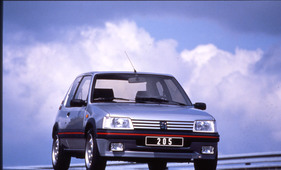
The Peugeot 205 not only changed the design, but also the technology and marketing. While most previous vehicles had been designed by Pininfarina, it was Peugeot's in-house designers, led by Gérard Welter, who won the in-house competition with a more modern and flowing design.

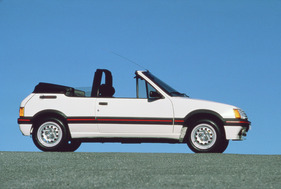
Pininfarina took over the design of the Peugeot 205 Cabriolet. It was a design that introduced some distinctive features that would be found on future Peugeot cars, such as the radiator grille with horizontal bars and the band between the rear lights. Paul Bracq, a well-known name in automotive design and member of the Peugeot design studio, also designed the interior of the Peugeot 205.
The first small, powerful diesel
From a technical point of view, the Peugeot 205 marked Peugeot's entry into the modern era: compact but spacious, practical with a hatchback, efficient and economical at the same time, the model was suitable for any use. In particular, it was the first Peugeot vehicle to be equipped with torsion bars at the rear to create more space in the passenger compartment.
With the XUD7, a four-cylinder engine with 1,769 cm3 and 44 kW (60 hp), the Peugeot 205 was also the first vehicle to be equipped with the new XU engine range. This made the Peugeot 205 the first small French diesel car and the first small diesel model to offer the same performance as its gasoline version, but with lower fuel consumption (3.9 l/100 km on average).
From 45 to 200 hp
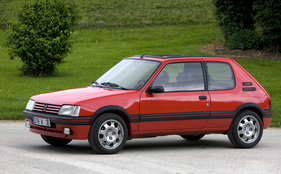
The Peugeot 205 was the brand's first small car with such a wide and varied range of engines, with outputs from 33 kW (45 hp) to 147 kW (200 hp) and an automatic gearbox, which was still rare on the market at the time. At the market launch in 1983, there were four petrol engines and one diesel engine. The following year, the range was expanded to include the legendary GTi version, the Peugeot 205 Turbo 16 and a three-door version. A number of other versions followed: more affordable ones, such as the 1986 Junior with its fabric seats, and more chic ones, such as the Lacoste or the Gentry.

When advertising invented the "holy number"
The Peugeot 205 was marketed with a marketing strategy that matched its characteristics. Even at its market launch, the nickname "holy number" hit the nail on the head. The television commercials that used this nickname were effective and contemporary. One example is a well-known commercial in which the Peugeot 205 is chased by a military aircraft on a frozen lake, James Bond-style. This commercial was directed by Gérard Pirès, who a few years later made the famous feature film "Taxi" starring a Peugeot 406.

The true champion
Motorsport was to become an effective tool for promoting the Peugeot 205 and the Peugeot brand. In 1984, on the initiative of Jean Todt, Peugeot entered the premier class of the World Rally Championship, the famous "Group B", with the Peugeot 205 Turbo 16. In this first season, Ari Vatanen made a strong impression and won three rallies. In 1985 and 1986, the Peugeot 205 Turbo 16 enabled the brand to win the Manufacturers' World Championship title and Timo Salonen (1985) and Juha Kankkunen (1986) to win the Drivers' Championship.

As there was no longer a "Group B" category at the end of 1986, Jean Todt suggested that Peugeot enter the Peugeot 205 T16 in the legendary Paris-Dakar Rally. Challenge accepted, challenge won: in 1987 and 1988, the Peugeot 205 T16 was specially adapted and won the famous Rally Raid, first by Ari Vatanen, then by Juha Kankkunen.
In 1998, after a long and successful career of 15 years and 5,278,050 units produced, the Peugeot 205 said goodbye. In the minds of car fans, it will forever remain Peugeot's "holy number", laying the foundations for an exceptional range of successful city cars, the Peugeot 206, Peugeot 207 and the current Peugeot 208.
Important milestones for the Peugeot 205
- February 24, 1983: Peugeot 205 is launched as a five-door model
- 1984: Market launch of the three-door Peugeot 205 and the Peugeot 205 GTi 1.6 l (77 kW, 105 hp), marketing of the Peugeot 205 Turbo 16 and first victory in the World Rally Championship (Finland)
- 1985: The Peugeot 205 Turbo 16 becomes World Rally Champion (with Timo Salonen), the one millionth Peugeot 205 leaves the Mulhouse plant
- 1986: Introduction of the Peugeot 205 Cabriolet, the Peugeot 205 GTi 84 kW (115 hp) and 95 kW (130 hp), the Peugeot 205 Turbo 16 becomes World Rally Champion (with Juha Kankkunen)
- 1987: The Peugeot 205 gets a new dashboard, the Peugeot 205 Turbo 16 wins the Paris-Dakar Rally
- 1988: Introduction of the Peugeot 205 Rallye, second victory of the Peugeot 205 Turbo 16 at the Paris-Dakar Rally
- 1989: Launch of the Peugeot 205 Roland Garros
- 1990: Slight redesign (indicators, rear lights...), introduction of the Peugeot 205 Diesel Turbo (57 kW, 78 hp)
- 1993: End of production of the Peugeot 205 GTi
- 1995: End of production of the Peugeot 205 Cabriolet
- 1998: The Peugeot 205 is replaced by the Peugeot 206
The Museum Aventure Peugeot in Sochaux opens a large exhibition on February 23, 2023 with extensive photo and video archive material and the presentation of numerous models of the Peugeot 205, more information on the website.


