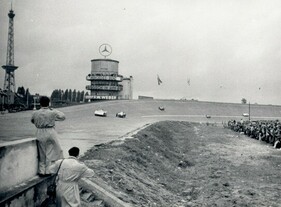
From September 12, the PS.Speicher in Einbeck, Lower Saxony, is expanding its offerings: a special exhibition with original vehicles commemorates the "Avus" race track and road.
It is older than the Nürburgring, was faster than any other race track and is one of Berlin's landmarks. The Avus, once intended as an "automobile traffic and practice road", is now a symbol of German history. This year it celebrates its 100th birthday. Many myths surround the route, which was once up to 19 kilometers long.

The PS.Speicher and the "Avus100" initiative are celebrating the anniversary of this historic site with a special exhibition. From September 12, the classic car museum in Lower Saxony will be showing numerous vehicles that once livened up the route. "The Avus is not just Berlin history, it is also a German cultural asset and enjoys a worldwide reputation. We are presenting a unique selection of exhibits that have never been seen together in this form before," promises exhibition director Sascha Fillies. The exhibition also provides information about the details of this symbol of automotive history and recalls countless anecdotes. Avus100 initiator Ulf Schulz explains why Einbeck was chosen: "With the PS.Speicher is a partner that knows how to bring legendary stories closer to visitors with heart and hand as well as a good sense of exhibition aesthetics. Although PS.Speicher is not located in the capital, it is centrally located in the middle of Germany."
The exhibition at PS.Speicher is just one part of the Avus anniversary: Ulf Schulz's book of the same name "Ein rasantes Jahrhundert" will be published in September. The book was written in collaboration with co-author Sven Wedemeyer and is published by Prestel-Verlag. In addition, a public event will take place on September 24/25 on the old north curve of the Avus in Berlin. The arte television channel is also working on a documentary and Deutsche Post is launching a special stamp to mark the 100th anniversary. The radio play "Leo and the Adventure Machine" rounds off the Avus100 activities. In the episode, the actors introduce children to the invention of the car and the Avus as a race track in Berlin. The Avus is thus on everyone's lips throughout Europe.
Kaiser Wilhelm II conceived the Avus as early as 1909. As a friend of industry, he was convinced that the fast track on the outskirts of the city at the time could strengthen the fledgling German car industry. International motorsport had long been dominated by France, Italy and England. From 1913, a long track was cut through Berlin's Grunewald forest on imperial orders, but the First World War prevented a punctual start. The first race on the Avus did not start until 1921. From then on, it was the world's first pure car road, while the public still traveled by carriage or bicycle. On two long straights, connected by north and south bends.
The Avus first gained international significance in 1926, when the premiere of the German Grand Prix attracted many famous drivers. The public came in droves. But a tragic accident with four fatalities threatened the end of motorsport before the Avus could even make history. From then on, however, the long straights were used as a venue for breathtaking record-breaking drives. The Opel rocket car or the "Silver Arrows" came just in time as Germany tried to make a name for itself on the world stage. Soon records of around 400 km/h were being set.
These were the early glory days of the Avus. In the years that followed, spectators cheered not only for sports cars and motorcycles, but also for Formula 1, Formula 3 and the DTM.
In the light of the growing city and stricter regulations, the decline of the Avus as a race track became increasingly clear. In 1999, over 20 years ago, the flag fell for the last time. A modern highway had long since been built around the Avus. But the Avus is still an important part of Berlin, as the dead straight journey on the A115 proves. Even though it has rarely moved with the times, the Avus has survived what was probably the fastest century in history and is a genuine bridge from the 1920s to the here and now.

PS.Speicher provides information about other events, opening times and admission prices on its website.