


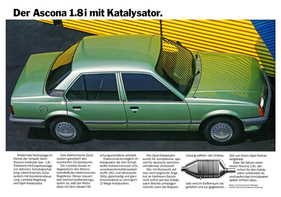
The era of the catalytic converter began at Opel 35 years ago. In 1985, the Opel Ascona 1.8i was the first German car with a catalytic converter specially developed for the European market. Prior to this, only modified catalytic converters from the USA had been installed.
In police action
The police in Rhineland-Palatinate took delivery of the first Ascona 1.8i produced with a regulated three-way catalytic converter on December 7, 1984.
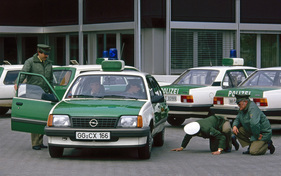
Over the course of the following year, Opel introduced catalytic converters for the entire model range - from Corsa, Kadett and Ascona to Rekord, Monza and Senator. The German manufacturer was the first European brand to offer three-way catalytic converters as standard equipment.

Catalytic converters are not all the same
It was clear to Opel engineers from the very first minute that European traffic conditions also required customized technologies for Europe. They therefore developed a catalytic converter specifically for European driving conditions - just as has long been the case with bodywork, suspension, engines and brakes. For Opel, it was about more than just installing a catalytic converter in the exhaust system. Reducing emissions via a catalytic converter was also a complicated operation on the "internal organs" of the car.
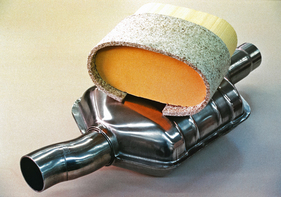
Compared to a conventional car, the design of a vehicle with a catalytic converter required numerous changes. For example, the converter radiates a lot of heat when it reaches its operating temperature of 600 degrees Celsius. Heat-sensitive components and the passenger compartment therefore had to be protected by heat shields.
In order for the catalytic converter to work efficiently, an electronically regulated injection system and a variety of control systems were required, which necessitated further modifications. Even the filler neck of the fuel tank had to be redesigned to prevent drivers from accidentally filling up with leaded instead of unleaded gasoline.
One billion German marks for catalytic converter technology
Opel invested more than one billion German marks (DM) and hired hundreds of engineers for the development of catalytic converters and low-emission drives. The company invested DM 100 million alone in new test benches and test equipment for durability and high-speed tests.
The new facilities also include a 13-storey, hermetically sealed "Soak Tower". More than 130 vehicles can be prepared for emissions testing in this building at the same time. Prior to the actual tests, certain standards must be met to ensure that the results are comparable. For example, each car had to be parked in the tower for at least twelve hours at a temperature of 20 to 25 degrees Celsius.
Opel not only offered vehicles with a factory-installed three-way catalytic converter, but also a retrofit kit for older vehicles. The carmaker was not satisfied with developing innovative technologies - Opel also broke new ground in its public relations work.

The company offered customers the opportunity to actively inform themselves about catalytic converters and retrofits. Interested parties could call a daily telephone hotline and receive first-hand answers to their questions from the company's experts.
No standstill
Today, 35 years after the introduction of the three-way catalytic converter in the Ascona 1.8i, Opel continues to take its responsibility for the environment seriously. Following the Opel Grandland X as a plug-in hybrid and the battery-electric Opel Corsa-e, the brand recently introduced the new Mokka-e, Vivaro-e and Zafira-e Life - all with purely electric drive and therefore locally emission-free.
