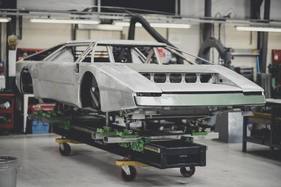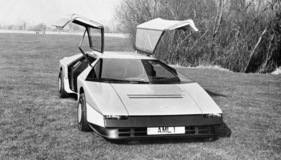

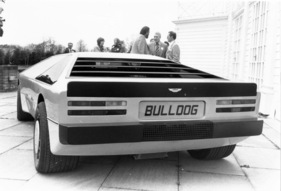

The Bulldog was to usher in a new era for Aston Martin. With the introduction of the Lagonda, Aston Martin had already given a foretaste of where the development of future vehicles was to go. The Bulldog now had the task of continuing this line of futuristic straight lines.
Corners and edges, too many for the client
The straight lines designed by William Towns had already earned the Lagonda some critics, but it still looked elegant and sporty at the same time. The Bulldog, on the other hand, lost all elegance.
The car appeared stiff and unbalanced. The Arab customer who had commissioned the Bulldog felt the same way and backed out before the car was completed. The decision was made to continue with the project anyway and to produce the Bulldog in small series of 12 to 25 units. However, this never happened. Executive Chairman Victor Gauntlett decided instead to auction off the prototype in order to at least recoup the money invested.

It was sold to the highest bidder to another Arab buyer, allegedly for a sum in excess of 100,000 pounds. The car initially spent some time in the USA before being brought back to England. The original two-tone silver paintwork was swapped for a two-tone green paint job and the Bulldog was given more angular exterior mirrors.
Fully functional
However, the Bulldog prototype was fully functional. Official details were never published, but according to reports, the car had around 600 hp and was capable of a whopping 300 km/h top speed. It drew its power from a 5.3-liter aluminium V8. This was transmitted to the rear wheels via a ZF five-speed gearbox.
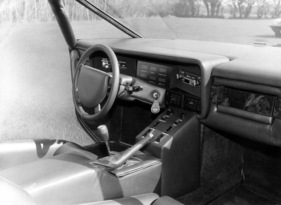
Entry was made possible by electro-hydraulic gullwing doors. Inside, you were greeted by a Panasonic radio cassette player, air conditioning, Connolly full leather upholstery, Wilton carpets and state-of-the-art three-point seat belts from Sweden. A reversing monitor in the center console was added later.

Originally, the interior was a sophisticated shade of brown. It was later changed to a light beige. The gearshift gate was also gold-plated during this renovation. A matter of taste...
Further information about the Bulldog can be found in our (historical) vehicle report, which can be found here.
Breathing new life into the Bulldog
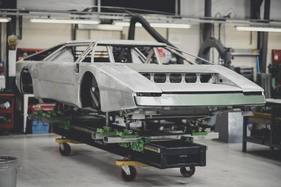
The prototype has now been undergoing restoration at the British company Classic Motor Cars in Bridgnorth for six months. Managing Director of Classic Motor Cars, Nigel Woodward, said of the Bulldog: "The car is dramatically designed in every aspect and has inspired the team like no other car we've worked on before. When we took the car apart, its history was revealed to us and often left us wondering why a certain part was built in the way it was."