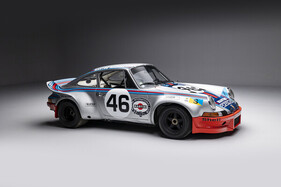
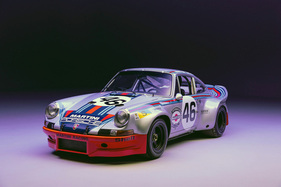
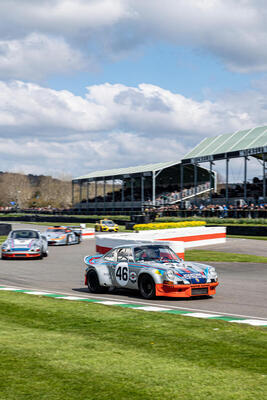
One of the most remarkable racing Porsches will be auctioned at Bonhams Cars' Goodwood Revival Sale on September 9 and 10.
The 3-liter coupé based on the Porsche Carrera RS became known in the works team as the "R7". The car finished a memorable fourth place in the 1973 24 Hours of Le Mans, beaten only by three Formula 1 cars with open cockpits disguised as sports prototypes. The class-winning and fourth-placed RSR was driven by the highly experienced and capable Swiss Herbert Müller, a compact cigar smoker with a brush haircut, and his amiable Dutch team-mate Gijs van Lennep, a former Le Mans winner.
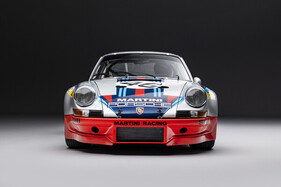
Their visually road-going Martini-Porsche RSR with a closed cockpit was only beaten by three special sports prototypes, all of which were powered by 12-cylinder 3-liter engines: the winning Matra-Simca MS670B of French stars Henri Pescarolo/Gerard Larrousse, a Ferrari 312PB of the works team in second place and another Matra-Simca in third place.
Based on the production type
The Porsche RSR Coupes really were the surprise package in the '73 racing season. The sheer investment in manpower, manufacturing effort and cost to produce a brand new sports prototype for the 1972/73 season had prompted Porsche to focus instead on improving on the long-established racing successes of the tuned and upgraded versions of the already revered production type 911 Coupé.A new European Grand Touring Championship provided a new boost for the 911s, which were used almost entirely in the racing series. In the autumn of 1972, Porsche launched the new 911 "Carrera", whose displacement was increased from 2.4 to 2.7 liters. In order to achieve sporting approval (homologation) of the new variant, a series of 500 911s were built in lightweight construction.
Three versions were offered - RS (RennSport), RST (Touring) and the ultimate racing RSR, of which the 'R7' now offered at Bonhams is one of only four surviving works team cars.
While the RS was the latest road-going version, the RST featured luxury touring equipment and fittings, while the RSR was the fully-fledged competition model - weighing 60 kg less than the RST.
At the start as a prototype
As the new Carrera could not be homologated in the international GT racing category until April 1, 1973, two early RSRs, which were sent to America for the Daytona 24 Hours on February 4, were entered in the more liberal prototype (sports) category. They were equipped with 3-liter engines that produced around 300 hp, and the privately entered new RSR of the Brumos team with drivers Peter Gregg/Hurley Haywood won the Floridan 24-hour race with a lead of no less than 22 laps over the second-placed Ferrari 365GTB/C. With this success, Porsche took the lead in the one-make world championship after the first race in 1973.
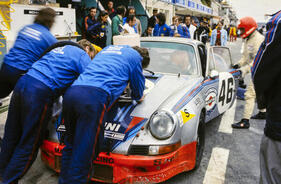
Despite being classified in the prototype class, they naturally had no chance against the 250 kg lighter genuine sports prototypes from Matra, Ferrari, Alfa Romeo and Gulf-Mirage, which originated from Formula 1. But Porsche's hard-earned tradition of combining speed and reliability was to triumph once again. Developments such as the installation of Porsche 917-type disc brakes and the addition of a full-width aerodynamic spoiler or "wing" at the rear - popularized by Mary, Queen of Scots - in the style of the strengthened medieval ruff.The addition of a full-width aerodynamic spoiler or "wing" at the rear - nicknamed the "Mary Stuart" wing after the strengthened medieval ruff popularized by Mary, Queen of Scots - made the Martini-Porsche works RSR extremely fast and agile, yet stable in all kinds of corners.
By mid-season, the Martini-Porsche RSR was being touted as the likely winner of the 24 Hours of Le Mans, as the reliability of the much faster thoroughbred sports prototypes had been rather poor to date. Porsche took a more realistic view, and the fourth place of the "R7", which was only beaten by 12-cylinder specials with open cockpits, was a truly great result.
Survived
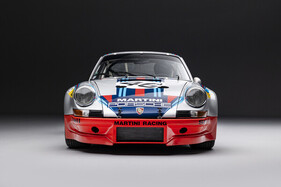
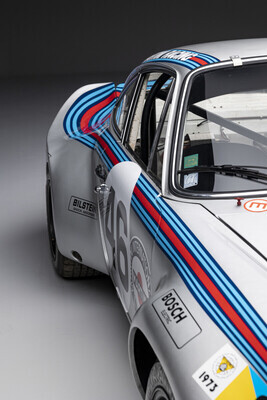
Today, "R7" is one of the best preserved and amazingly original of probably only three truly surviving cars from the original eight-strong group, only four of which - chassis "R5", "R6", "R7" and "R8" - ever wore the classic Martini Racing livery with its dark blue and red stripes on a German silver background.
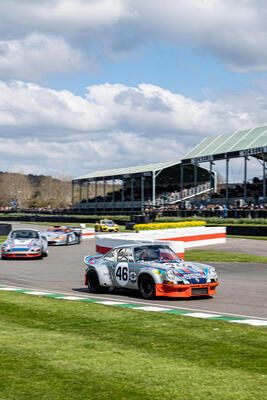
Following its success at Le Mans, the "R7", which is now for sale, took part in the last two rounds of the one-make world championship. It finished ninth in the 1000-kilometer race at the Österreichring and - with a long tail instead of the "Mary Stuart" - was seventh in the 6-hour race in Watkins Glen, USA, entered by Brumos Porsche-Audi Corp and driven by Peter Gregg/Hurley Haywood.
After the end of the season with the Martini Porsche works team, the "R7" was sold to the Mexican Porsche expert Hector Rebaque to be used in national races in his home country. After successfully competing there in the colors of the "Viceroy" cigarette brand, it was sold into the discreet long-term ownership of Italian collector-enthusiast Massimo Baliva. Not least because of the car's disappearance from the scene - Baliva essentially kept the car for himself - some circles in the classic Porsche world assumed it had been destroyed.
As is often the case, a replica was built, and when Massimo Baliva's car emerged from obscurity (he sold his collection due to its advanced age), litigation ensued. The lawsuit was dismissed and the case settled, with the replica being recognized as such. The authenticity of the car offered by Bonhams was confirmed by the legendary Porsche engineer Norbert Singer (team boss of the 1973 Martini Porsche team), whose forensically detailed examination revealed that it was indeed the original 1973 RSR team car "R7".
Further information about the auction at the Goodwood Revival in September 2023 can be found on the Bonhams website.