
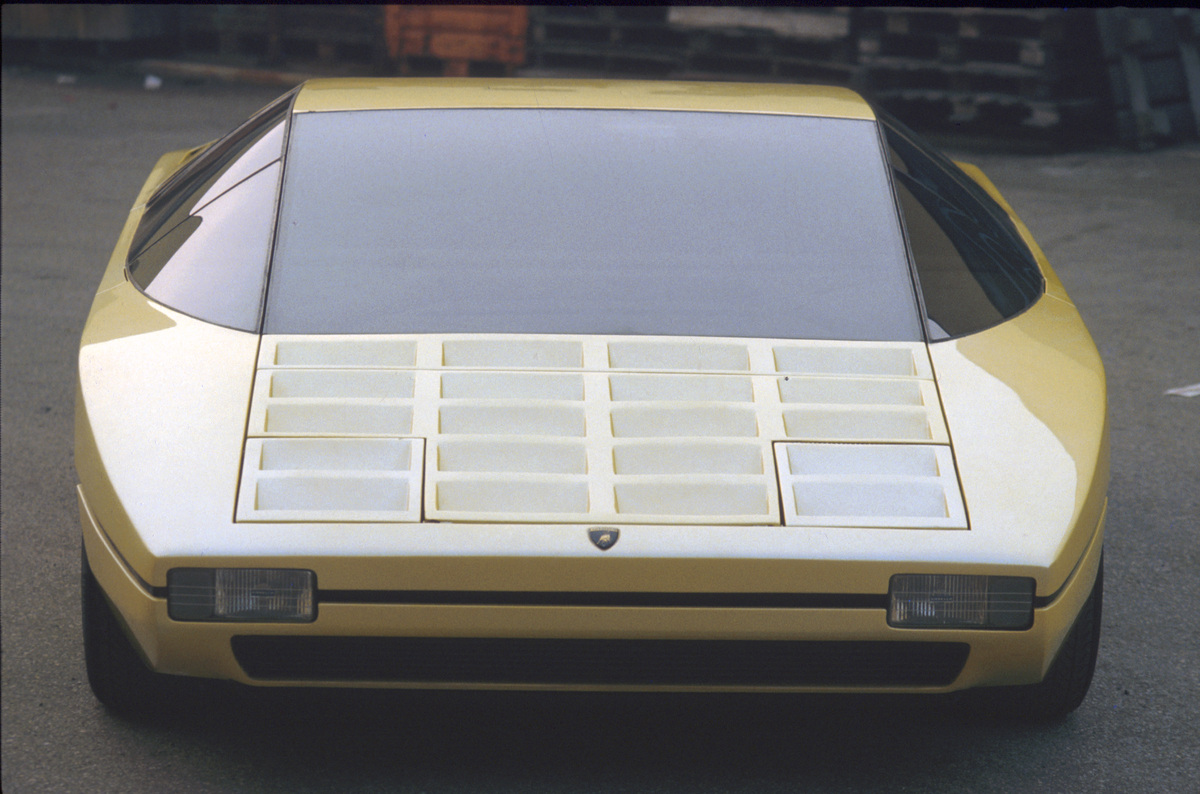









Since its foundation in 1963, Automobili Lamborghini has created unique vehicles that have set the technical and stylistic direction of the company for the near future. Prototypes that broke new ground in terms of design, technology or the testing of new concepts to drive the development of subsequent Lamborghini models. In the 1960s, these one-offs were often show cars that graced the motor shows of the time.
In the more recent past, they are known as One-Offs or Few-Offs, the name given to the category of vehicles created by Lamborghini for limited special editions, reserved for the most loyal customers and anticipating or focusing on the most advanced technical solutions to be used in later production models.
The same game will be repeated in a few days at Monterey Car Week in California, where Lamborghini will present the prototype of its first all-electric vehicle.
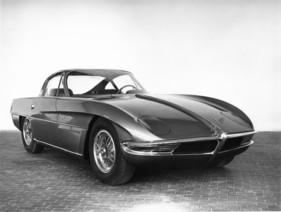
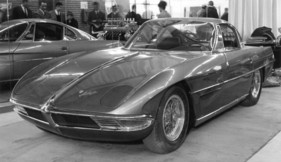
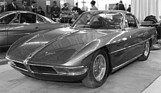
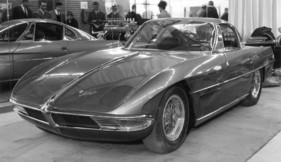
It all began with the 350 GTV
The first one-off from Automobili Lamborghini is the 350 GTV from 1963, which was the blueprint for the first production vehicle, the 350 GT.

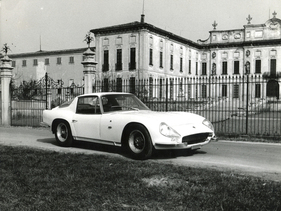
Within the 350-400 GT model series, two examples of the 350 GTZ were built by Zagato in 1965 on the basis of the 350 GT.
In the same year, Carrozzeria Touring, also based in Milan, built two convertible versions under the designation 350 GTS. The 400 Monza from coachbuilder Neri & Bonacini, which produced the tubular frames for the 350-400 GT model series, was also launched in 1965. Carrozzeria Touring's last work was the 400 GT Flying Star from 1966, an innovative estate car that would inspire the Espada with its practicality.
1965 saw the creation of the P400 Tigre by Carrozzeria Touring and the P400 by Giorgetto Giugiaro's newly founded design studio Italdesign, two styling models with rear mid-engines that would serve as a blueprint for the Miura. However, the concept does not work, as the revolutionary technical solution of the transversely arranged twelve-cylinder mid-engine is not shown to its best advantage. Production on a 1:1 scale therefore fails to materialize. However, Giugiaro's version was the first to feature doors that, unlike usual, opened upwards together with the roof. The first seeds of an idea that will become reality with the Countach.
The four-seater Marzal
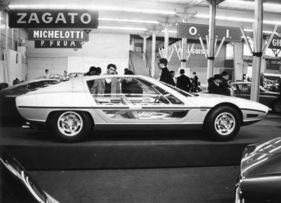
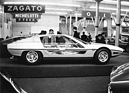
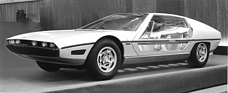
The fully glazed four-seater Marzal, which was presented in 1967, was destined to become one of the most famous show cars in the world and introduced numerous ideas that later found their way into series production. These included, first and foremost, four comfortable seats - a long-cherished wish of Ferruccio Lamborghini, the flat, sleek nose and the numerous hexagons, all of which can be found in the Espada.

The hexagons later became a characteristic Lamborghini style element that is still used today. The Marzal also boasts huge gullwing doors. "We did everything we could to adopt them in the Espada," recalls engineer Paolo Stanzani, "but the different installation spaces caused by the front arrangement of the V12 engine - in the Marzal we had a transversely arranged 6-cylinder in-line mid-engine - made it impossible."
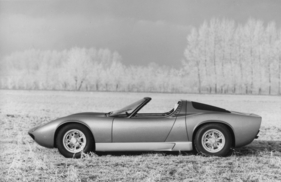
An open-top Miura
In 1968, the Miura Roadster was presented at the Carrozzeria Bertone stand at the Brussels Motor Show and immediately captivated the public. A dream car that unfortunately had no chance of going into series production.

Lamborghini already had two new projects underway at this time: the first four-seater (the prototype of the Espada was presented in 1967) and a "small" vehicle, the first prototype of which was unveiled in 1968, leading to the Urraco in 1969. Based on the Espada, the Faena from Carrozzeria Frua was created in 1981 as a four-door version of the Espada. In Sant'Agata Bolognese, the company gradually came to the conclusion that there could be a market for a Lamborghini four-door.
In 1970, Bob Wallace, the legendary Lamborghini test driver, presented the Miura Jota. His self-built creation, for which he used machines and parts from the company, was personally supported by Ferruccio, who recognized it as a fantastic experimental prototype. The Jota is a racing car through and through, meeting the requirements of Appendix J of the FIA regulations for touring cars. The myth that surrounds it makes Lamborghini realize that customers always dream a little bit more. The concept of special editions developed from the standard model, which is still of enormous importance to Lamborghini today, began with this prototype. In response to urgent customer demand, Lamborghini finally produces four Miura models inspired by this Jota, which bear the suffix SV-J.
The LP500 Countach is presented at the 1971 Geneva Motor Show as an Idea Car. With its futuristic look, it was intended to test the reactions of the public and potential customers. Thanks to its resounding success, the LP 400 Countach goes into series production with minimal modifications - including the legendary scissor doors, which are a characteristic feature of all Lamborghinis with a 12-cylinder mid-engine from 1973 onwards.
In 1973, Bob Wallace created the Urraco Rally based on the basic concept of the Miura Jota, which was based on the Urraco 250 and the new regulations for Group 5 racing cars, the so-called silhouette cars, and equipped with a three-liter engine. This prototype gave rise to the Urraco P300 with a chain-driven three-liter DOHC engine in 1974 and the Silhouette, a convertible version based on the Urraco 300 with rally-inspired aerodynamics, in 1976.
The 1973 Jarama Rally, nicknamed Jarama Bob, is the last creation by Bob Wallace with the same concept of the two previous models, this time based on the 1970 Jarama 2+2. In this case, too, the revised aerodynamics in conjunction with a reduced overall weight and, in particular, a V12 front engine shifted backwards towards the passenger compartment ensure better balance and weight distribution and thus drastically improved road holding.
In 1978, the customer and friend of the company Walter Wolf, supported by Giampaolo Dallara as an external consultant, commissioned some modifications to his Countach LP400. Larger rims, deeper tires, wider wheel arch trims and larger brakes. The suspension was adapted to the new solutions and a large wing was installed at the rear of the vehicle. This Countach Wolf with a twelve-cylinder engine enlarged to five liters gave rise to the Countach LP 400 S the following year, which served as the model for all subsequent versions of the Countach. Until the end of its production in 1990, the Countach remained up-to-date in terms of both looks and performance and shaped the history of Lamborghini like no other.
The pioneering Bravo
In 1974, Bertone presented the Bravo based on the Urraco P300: a wheelbase shortened by 20 centimeters, no more rear seats, more angular, extremely futuristic lines and rims in the shape of a telephone dial, which became a typical design element of the Countach LP 400 S.

The Bravo is the first two-seater coupé with a compact mid-engine but without a twelve-cylinder engine. With the Gallardo (2003) and the Huracán (2014), this concept went into series production at Lamborghini.
The first roadster
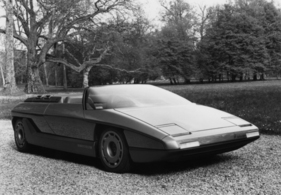
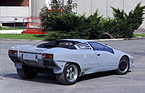
1980 saw the launch of the Athon, which was commissioned from Carrozzeria Bertone as a feasibility study for an open silhouette. The design of the vehicle, which was entirely in the style of the 1980s, was so futuristic that it could still pass as modern today with just a few changes. The Athon is considered the originator of Lamborghini's roadster concept.

In the search for a third model series, Lamborghini recognizes the new demand on the market for sporty off-road vehicles much earlier than other vehicle manufacturers. In response, the LMA, the prototype of the later LM 002, was created in 1982. It went into production in 1986 and is now regarded as the forefather of the Urus. The LMA had a tubular frame, a V12 front engine and reached a top speed of over 200 km/h - absolutely revolutionary for an off-road vehicle.
In 1985, Lamborghini began experimenting with a new material that had just been developed: an extremely stiff, robust and lightweight textile fiber made from carbon fibers. This material was used for the first time in the Countach Evoluzione, a one-off based on the Countach Quattrovalvole with a body made entirely of carbon fiber. The shapes are extremely angular, almost primitive, as the processing of the material that will revolutionize sports car design is initially very limited. The Countach Evoluzione weighs 400 kg less than the Quattrovalvole production model and is as fast as an arrow. This vehicle laid the foundation for the company's inseparable bond with carbon fiber and the high level of technical expertise in this area. The material, which has become increasingly important in the automotive sector, is still essential for Lamborghini today. It is used for the chassis of the current twelve-cylinder models from Sant'Agata Bolognese.
A van from Lamborghini?
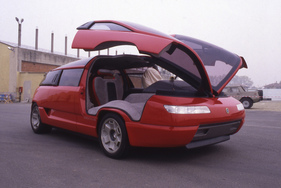
In 1988, the Genesis is presented at the Carrozzeria Bertone stand at the Turin Motor Show: In the search for a fourth model series, Lamborghini investigates the feasibility of a twelve-cylinder van with a longitudinally mounted front engine.

Its hallmarks are the front doors, which together with the huge windshield open like gullwing doors, and the outstanding performance for this type of vehicle. However, the resources for the development of new models are limited and are mainly used for the development of the new twelve-cylinder GT model.
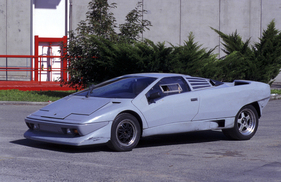
Work on the Diablo, presented in 1990 under the project name P132, began in 1985 with a style study commissioned from several designers. However, it was clear from the outset that the mechanics were to be a direct development of the Countach. After five years of tweaking and tinkering, the Diablo was finally ready to amaze the world. Its mission to replace the overpowering Countach sanctuary is a mammoth task, which the Diablo masters with flying colors. Today, 30 years later, the Diablo is just as coveted by collectors as the Countach.
Based on the Diablo, the Diablo Roadster was created in 1992, anticipating the design language of the open-top 12-cylinder super sports cars from Sant'Agata Bolognese, the Canto by coachbuilder Zagato in 1996, which almost made it into series production, and the Raptor, also by Zagato, with a large gullwing door in which the side doors and roof were integrated. These were joined in 1998 by the Pregunta from Heuliez with large side air intakes at the bottom and a hypermodern design, as well as the L147 from the I.D.E.A. Institute in 1999.
The first V10
The P140 project, launched in 1987 with the aim of creating a super sports car with a V8 or V10 engine, led to the creation of the Gallardo and the consolidation of the second model series as the mainstay of Lamborghini's commercial success.

The possible uses of different engines and design concepts are explored and find their answer in the Calà, which is realized by Giorgetto Giugiaro in 1995 and unveiled at the Geneva Motor Show. Its proportions are revived in the Gallardo, while the rounded shapes give way to more angular lines in typical Lamborghini style. The Calà is also being considered in an open-top version and shows Lamborghini's efforts to bring out the coupé as a roadster too.
And many others
The Concept S from 2005 is the work of Luc Donckerwolke, then head of the Centro Stile Lamborghini. Based on the Gallardo, this completely open-top model is characterized by an interior with seats completely separated by a longitudinal cross-member and particularly sophisticated aerodynamics thanks to careful flow research, which directs the airflow under the vehicle and thus optimizes its dynamic performance.
The Miura Concept from 2006, designed by Walter de Silva, then Head of Design at the Audi Group, is a modern reminiscence of the Miura of the 60s and 70s, which celebrated its 40th birthday in 2006. Although a style study, it is still a prime example in terms of clear design language and precise lines.
In 2007, the Reventón was created on the basis of the Murciélago LP 640, of which only 20 units rolled off the production line. With its precise, angular lines, the Reventón is a road car that pushes the limits. The body parts made of CFRP and carbon fiber are bonded to the CFRP and steel frame. The bi-xenon headlights feature light-emitting diodes, while the LED rear lights shine in the form of a triple arrow. Many of these solutions later found their way into Lamborghini's production models. The roadster version followed in 2009 with a production run of 16 vehicles.
The Estoque from 2008 is the first study of a possible fourth model series for a four-door Lamborghini with a sporty character. The concept car with front-mid engine presented at the Paris Motor Show is recognizable as a Lamborghini at first glance.
The Sesto Elemento from 2010 is a technology bundle developed on the technical basis of the Gallardo with a space-frame frame made of aluminum and carbon. All body parts and the most important interior components, including structural ones, are made of carbon fiber in order to save weight. This is reflected in a total weight of 999 kg and a power-to-weight ratio of 1.75 kg/CV. The Sesto Elemento once again underlines Lamborghini's pioneering role in the production and use of carbon fiber.
The Aventador J, the barchetta version of the Aventador, is unveiled at the Geneva Motor Show in 2012. It has no windshield, side windows or hood and revisits the Appendix J concept for touring cars. A racing car in its purest form.
Also in 2012, Lamborghini unveiled the prototype of the Urus super SUV at the Beijing Motor Show, which launched the brand's third model series in 2018 or, if you take the LM 002 into account, breathed new life into it. In keeping with Lamborghini tradition, this prototype already anticipates the most important stylistic and technical aspects of the production model, but without revealing all the final achievements.
In 2013, Lamborghini celebrates its 50th anniversary with the Veneno, with four coupés and nine roadsters being produced. A vehicle developed on the basis of the Aventador with a top speed of 355 km/h and sophisticated aerodynamics that ensure excellent road holding. The monocoque frame is made entirely of the carbon fiber material CFRP, which is also used for the body parts. In the interior, on the other hand, the ultra-light materials Forged Composite and CarbonSkin are used, which are also used in subsequent super sports cars. Also in 2013, the one-off Egoista, designed by Walter de Silva and clearly inspired by a fighter plane, is presented at the brand's 50th anniversary celebrations.
In 2014, the Asterion LPI-910, created by Filippo Perini, then head of the Centro Stile Lamborghini, was presented. The prototype of a hybrid coupé - LPI stands for Longitudinale Posteriore Ibrido - with 910 CV of combined power from the combustion engine and electric motors and at the same time the first hybrid concept from Lamborghini impresses with a wide range of technical solutions that are used years later in the recently presented Revuelto.
To celebrate the 100th anniversary of Ferruccio Lamborghini's birth, the Centenario, based on the Aventador, is presented in 2016, of which 20 coupé and 20 roadster models are produced. It is characterized by softer shapes and a more powerful engine with 770 CV, air intakes on the front flap for more downforce and a monocoque frame made of carbon fiber.
In 2018, Lamborghini Squadra Corse presents the SC18 Alston, a one-off based on the Aventador SVJ for a passionate customer. Although the SC18 is approved for road use, with its revised aerodynamics and improved brake and engine cooling for the 6.5-liter twelve-cylinder engine, it is primarily designed as a racing car.
The 2019 Sián is Lamborghini's first hybrid model available to customers, with 63 coupés and 19 roadsters being produced. The model developed on the basis of the Aventador SVJ also has a 6.5-liter twelve-cylinder engine with 785 CV, which in this case is equipped with titanium intake valves, a reconfigured control unit and a new exhaust system and is used in combination with an electric motor that provides a further 34 CV. The total output of 819 CV makes the Sián the most powerful Lamborghini production car to date. The electric motor fed by a supercapacitor with direct power output is an absolute novelty in the automotive sector.
Based on the Aventador, the Essenza SCV 12, where SC stands for Squadra Corse, will be produced from 2020 in a run of just 40 units that are not approved for road use. It is the first GT to pass the crash tests exclusively intended for racing cars and eliminates the need for a roll bar thanks to its extremely robust carbon fiber body structure. Its LED headlights are positioned lower and the rear section features an eye-catching diffuser and a wide adjustable spoiler. The car, which is longer and narrower than the Aventador, is characterized by an air intake extending from the roof to the hood. The aerodynamics developed in collaboration with Dallara ensure 1200 kg of downforce at 250 km/h. An 830 CV 6.5-liter naturally aspirated V12 engine, which has been rotated 180° compared to the Aventador, drives only the rear wheels of the racing car.
Also in 2020, Lamborghini Squadra Corse presents the SC20, a one-off based on the Aventador, which pursues the same mission as the SC18: born for the racetrack and yet with road approval. The completely open racing car is based on careful aerodynamic studies to achieve optimum airflow. The rear wing can be adjusted to three different positions to ensure low, medium or high downforce.
The Countach LPI 800-4 will be presented at the Sián in 2021. Launched to celebrate the 50th anniversary of the Countach, the LPI 800-4, which is stylistically inspired by its predecessor, will be produced in an edition of 112 units, based on the project number of the Countach of the 1970s. The successful blend of innovative solutions and retro touches from the pen of Mitja Borkert, the current head of the Centro Stile Lamborghini, exerts a very special fascination. All examples produced are already sold out before the official presentation of the model.
Last but not least, two one-off models from Automobili Lamborghini will see the light of day in 2023, celebrating the V12 engine in its pure combustion version once again before it is finally retired. The Coupé Invencible and the Roadster Auténtica, both based on the Aventador SVJ with a 780 CV V12, represent the absolute pinnacle of exclusive super sports cars. Inspired in some aspects by other limited series of the past such as the Sesto Elemento, the Reventón and the Veneno, the interior of these one-offs is kept more minimalist in order to be less distracting for the driver and to allow the emotions of the V12 to affect them unfiltered. Both cars share the monocoque carbon fiber frame and a full carbon body and feature design concepts and technical solutions that have been successfully tested in motorsport.
This extraordinary tradition will continue in the coming weeks when the first prototype of the fourth model series is unveiled in the USA - the all-electric Lamborghini, which is scheduled to go into production by the end of the decade as planned in the 2021 Direzione Cor Tauri program.
